
| Reviews & Columns |
|
Reviews DVD TV on DVD Blu-ray 4K UHD International DVDs In Theaters Reviews by Studio Video Games Features Collector Series DVDs Easter Egg Database Interviews DVD Talk Radio Feature Articles Columns Anime Talk DVD Savant Horror DVDs The M.O.D. Squad Art House HD Talk Silent DVD
|
 DVD Talk Forum |
|
|
| Resources |
|
DVD Price Search Customer Service #'s RCE Info Links |
|
Columns
  


 
|
|
|
Discovering Cinema
Under a new agreement, Flicker Films is going to be releasing DVDs produced in cooperation with France's Lobster Films and David Shepard's Film Preservation Associates. The first such disc is a pair of hour-long documentaries made by Lobster Films in 2004; Discovering Cinema. The first presentation, Learning to Talk, examines the myriad of methods that were attempted to achieve synchronized sound, and Movies Dream in Color looks at the difficult paths that were explored while attempting to create realistic color movies. These are two excellent shows, but what's more impressive are the copious bonus features that are included on each disc.
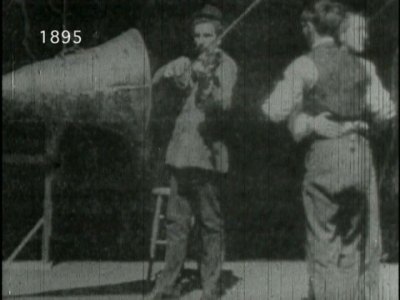 Learning to Talk: From the earliest days of motion pictures people were trying to add sound to film. This documentary looks at some of the methods used, how they worked (or more likely didn't work) and how commercially successful they were.
There were really three main ways that people tried to add audio to film. The least technologically challenging way was to just have people playing music in the theaters. That of course was the most common practice for decades. Some early experiments with live sound included hiring singers to sing along with shorts created especially for one song, having a conductor's baton on the screen so the orchestra or pianist could keep time with the film, and even having a piano score scroll along at the bottom of the screen. This last method worked well until the first time the film broke and had to be spliced. Then sections of the music were missing making it very hard to play.
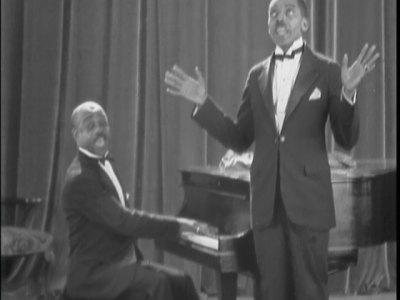 With Edison's invention of the phonograph, many inventors came up with elaborate ways to coordinate the sound from records with the images from a film. Unfortunately most of these were plagued by problems, almost the least of which was coming up with an accurate method to synchronize the sound. Recording was difficult and amplification was also a major hurdle. These problems were eventually solved with the Vitaphone system that Warner used to release the first 'talking' feature, The Jazz Singer.
The final method that was tried was creating a soundtrack on the actual film itself. This would solve the problem of synchronization, but it meant inventing a way to record a voice and music on optical film. The story of how this came about is related along with Fox buying the rights and dubbing the system Movietone.
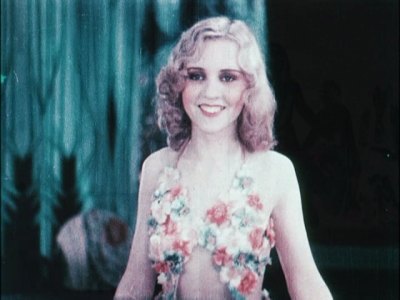 Movies Dream in Color: The other Holy Grail that people were looking for was a way to add color to film. Similar to the sound problem, there were three avenues that were investigated by many inventors of a period of years. The most commercially successful way to add color in the early days of film was to tint or tone the film itself. This was good for suggesting mood or cueing the audience in to the fact that the on-screen action was taking place at night, but it didn't create a realistic color image. Another method of applying color was to paint it on frame by frame. Later stencils were used to make the process go faster, but it was never widely used.
Another method was using additive colors. There were several different versions that used this property of light, but they all had the same concept: the action was filmed on black and white stock and during both the filming and projecting, the image was sent through a series of color lenses to recreate a color image. Some of these were fairly complex and innovative. One method involved filming alternating frames through red and green filters, another placed dyed brewer's yeast under the black and white film emulsion with the yeast acting as a filter. While some of these systems created some impressive looking images, none of them were commercially successful in the long run.
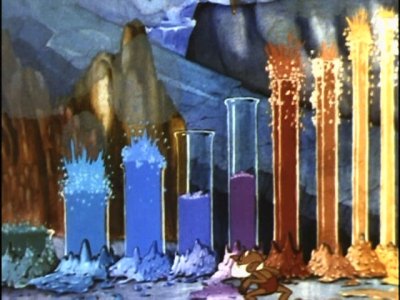 Finally it was acknowledged that the color had to be on the film itself. The show spends a good amount of time on the history of Technicolor, showing their subtractive color process and discussing the early two-strip method and their eventual invention of the three strip process that they are still famous for today. At around the same time, Eastman-Kodak came up with their Kodachrome process. And the rest, as they say, is history.
Both of these documentaries are excellent. The clearly show the development of sound and color and also describe several processes for each that I hadn't encountered before. The shows are narrated and mainly consist of rare examples of the different technologies that were tried. The sheer number of systems that were invented trying to solve both problems is fairly amazing. There is some expert testimony included, but the large majority of the time is taken up with vintage film clips showcasing various processes.
The DVD:
Audio:
The stereo soundtrack (in English) on both of these shows is very good. The narration is clean and clear and there aren't any audio defects to mar the production. Some of the old sound tests are less than pristine as far as the audio quality goes, but that's to be expected with experimental tests that were recorded up to 100 years ago.
Video:
The video was actually better than I was expecting. Many of the clips that make up these documentaries are in excellent shape which is nothing less than astounding since many of them were from failed experiments. The only problem is that this appears to be a PAL to NTSC conversion and there are some minor ghosting effects due to mixed frames. Since there isn't a lot of motion in any of the films is isn't as significant as it could be.
 Extras:
Not only do these films tell the story of the evolution of sound and color, but the bonus sections on each disc contain many examples of the various technologies discussed. One of the highlights is the complete short La Cucaracha, the first commercially released live action movie shot with three-color Technicolor. There's also an early Technicolor test that includes color footage of the Marx Brothers on the set of Animal Crackers.
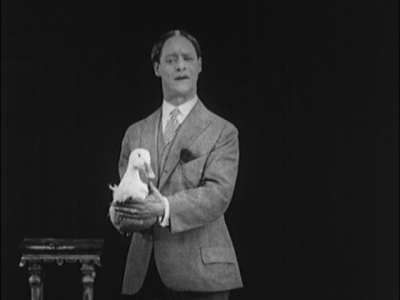
On the sound disc there's a trailer for The Jazz Singer, a ten minute interview with Sir Arthur Conan Doyle, as well as an early sound short that's a favorite among early film buffs; Guy Visser and his Singing Duck.
Final Thoughts:
These films contain a wealth of information. The documentaries do a great job of tracing the evolution of both sound and color and the bonus items are worth the price of admission. A great set that is highly recommended.
|



| Popular Reviews |
| Sponsored Links |
|
|
| Sponsored Links |
|
|
| Release List | Reviews | Shop | Newsletter | Forum | DVD Giveaways | Blu-Ray | Advertise |
|
Copyright 2024 DVDTalk.com All Rights Reserved. Legal Info, Privacy Policy, Terms of Use,
Manage Preferences,
Your Privacy Choices 
| |||||||