
| Reviews & Columns |
|
Reviews DVD TV on DVD Blu-ray 4K UHD International DVDs In Theaters Reviews by Studio Video Games Features Collector Series DVDs Easter Egg Database Interviews DVD Talk Radio Feature Articles Columns Anime Talk DVD Savant Horror DVDs The M.O.D. Squad Art House HD Talk Silent DVD
|
 DVD Talk Forum |
|
|
| Resources |
|
DVD Price Search Customer Service #'s RCE Info Links |
|
Columns
  


 
|
|
|
Treasures III: Social Issues in American Film, 1900-1934
The National Film Preservation Foundation has put together another excellent set of movies from American film archives. This third set, Treasures III: Social Issues in American Film 1900-1934 features 48 movies that deal with life in America. It's a great set filled with many rarities, from the first gangster movie and King Vidor's earliest surviving film to Paramount's and Cecil B. DeMille's last silent pictures. There are movies directed by D. W. Griffith, William Desmond Taylor, and Lois Weber as well as pictures featuring Mary Pickford and Richard Dix. There are newsreels, cartoons, features, and shorts, all of which deal in some way with some of the social problems in America at the time. From the women's suffragette movement to the plight of orphans and the problems of loan sharks in big cities, these films offer a look back into the past when America was a very different place.
Disc 1 - The City Reformed
The Black Hand (1906, 11 minutes) - This is the earliest surviving gangster film, a simple tale of crooks who kidnap a butcher's daughter and demand ransom. The police hide in the store owner's freezer and jump out when a member of the gang comes for the money, then rescue the girl. Told without close-ups the film has a very crude style. The exteriors are shot on the streets of New York while the interiors are poorly decorated sets.
How They Rob Men in Chicago (1900, 25 seconds) - Made in New York, this is a humorous jab at the lawlessness of Chicago, especially the police.
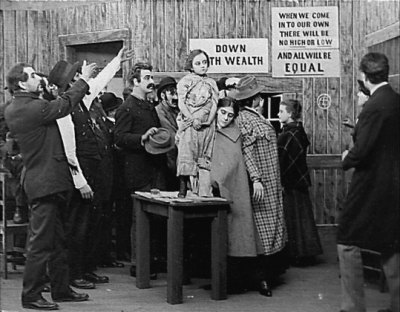 The Voice of the Violin (1909, 16 minutes) - D. W. Griffith directed this film about anarchists who want to bring down America's capitalist system. A violin teacher has fallen in love with one of his students, the daughter of a rich industrialist. When she says that she can't marry him because of the class difference, the teacher goes to a meeting of communists. Like them, he wants to do away with the class structure. Their moto: When we come into our own there will be no HIGH and no LOW: All will be EQUAL. At his first meeting the musician is picked to be part of a team to plant a bomb in a rich person's house. He goes along with the plot until he discovers that the house belongs to his beloved. By then the fuse has been lit, and his comrade knocks him out for being a traitor and leaves him to die.
Subtle this movie isn't, with all of the actors using broad gestures and overacting horribly. Griffith had only directing for eight months when he created this work, and the fact that he was new to the game shows. The climax of the film, where the hero crews through the bomb's fuse doesn't work well since it's unclear what's happening in the long shot. The intertitles are strange too, explaining the events in a scene before they happen.
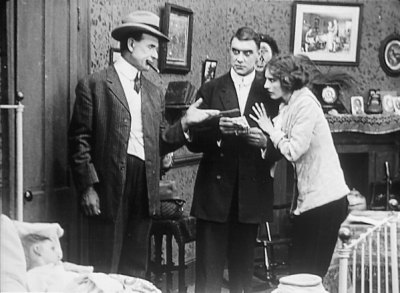 The Usurer's Grip (1912, 15 minutes) - While the previous films were made purely as entertainment, this film was trying to get across a message. When a couple's child gets sick, they find that they have to borrow money from an unscrupulous lender in order to get the money for a doctor. The ad in the paper states a 6% interest rate (the highest allowed by law at the time), but they end up being charged much more and have assorted 'fees' to pay on top of that. When the family gets behind in the payments a representative of the lender's goes to the man's place of employment and publicly embarrasses him, which causes him to get fired. Eventually he finds another job and this time his boss is more understanding. The employer calls the cops on the lender and then the worker joins a consumer credit co-operative, and not only pays off the original loan at 6% but develops good fiscal habits and ends up saving a lot of money.
From the Submerged (1912, 11 minutes) - A homeless man is stopped from killing himself by a kind woman and then strikes it rich. When his new friends go slumming for entertainment, he starts to feel guilty and searches for the woman who saved him. She turns out to be down on her luck and homeless to, so they marry. A bit contrived and silly, but still entertaining.
Hope - A Red Cross Seal Story (1912, 14 minutes) - A movie made to raise awareness of TB. This drama features a woman who comes down with the disease but has to move to another town since there are no treatment centers where she lives. When people find out what is happening, they start to sell Red Cross Seals and raise the money for a new hospital. An interesting short, since it really doesn't talk about TB. The causes, cures, or methods of stopping its spread are not mentioned at all.
The Cost of Carelessness (1913, 13 minutes) - An early traffic safety film complete with images (reenactments naturally) of children who have been hit by cars.
 Lights and Shadows in a City of a Million (1920, 7 minutes) - A Ford produced film to raise money for the Detroit Community Fund.
Six Million Children are Not in School (1922, 2 minutes) - Newsreel expose on child labor. The 6 million figure came from census figures, and though they exaggerated a little, that worked out to ¼ of the children not attending school.
The Soul of Youth (1920, 80 minutes) - It is doubtful that anyone would remember William Desmond Taylor today if he wasn't murdered in early 1922 with half of Hollywood being suspected of killing him. This is one of the films that he directed, very ably too. The story of a parentless child who turns to crime in order to feed himself is profiled in the film and alternatives to throwing him into an adult prison is advocated.
A Call for Help from Sing Sing (1934, 3 minutes) - This newsreel, made at the height of the depression, has Sing Sing's Warden Lawes speaking out in defense of homeless teens.
Disc 2 - New Women
Kansas Saloon Smashers (1901, 1 minute) - Carrie Nation destroys an illegal bar in Kansas and is persecuted for her troubles. Directed by Edwin S. Porter.
Why Mr. Nation Wants a Divorce (1902, 2 minutes) - Porter made this Mr. Mom precursor a year later in which Carrie's husband has trouble with the kids while she's off smashing saloons.
Trial Marriages (1907, 12 minutes) - When a bachelor reads of a progressive new idea, trial marriages, he thinks he's found an easy way to sleep around. He tries several, but the reality is far less ideal than he thought that it would be. His marriages were certainly a trial.
Manhattan Trade School for Girls (1911, 16 minutes) - A film selling the idea of trade schools for young women in the lower classes.
The Strong Arm Squad of the Future (1912, 1 minute) - A very politically incorrect cartoon against giving women the right to vote.
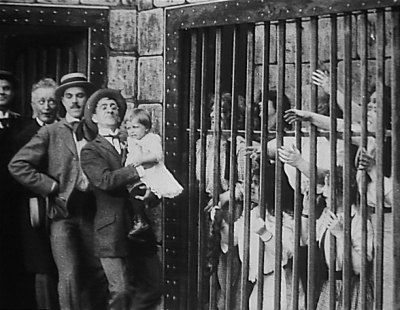 A Lively Affair (1912, 7 minutes) - What would happen if women received the vote? According to this short women would spend their days playing poker and fighting. This is a fairly strong anti-women's vote film. It implies that the family unit would be destroyed if women have a say in government, something that's best left to the men.
A Suffragette in Spite of Himself (1912, 8 minutes) - This British-made film was produced by Edison, and takes a different look at the suffrage movement. When some boys tape a "Votes for Women" flyer on a man's back, the misunderstandings start small but soon escalate.
On To Washington (1913, 80 sec.) - Newsreel coverage of a suffragette march on Washington.
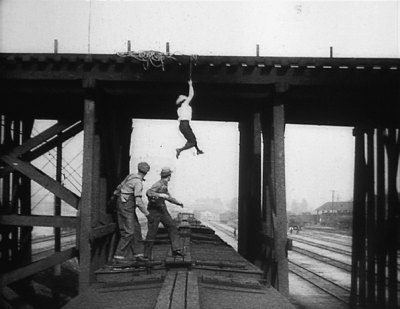 The Hazards of Helen, Episode 13 (1915, 13 minutes) - A chapter of one of the early film serials. The Hazards of Helen ran for an amazing 119 episodes (one released every week) and they were mainly self-contained stories without the cliffhangers that serials were later noted for. In this chapter Helen looses her job after the office is robbed. When she spots the criminals getting on a train after turning in her keys, the plucky Helen decides to apprehend them and get her job back. Instead of being overtly political, this serial employed a more subtle form of persuasion, showing that women could do anything that a man could do (and often more).
Where are my Children (1916, 65 minutes) - Pioneering female director Lois Weber directs this solid film that takes a firm stand against abortion but also promotes birth control, something that makes a lot of sense but is rarely done even today. When a district attorney prosecutes a doctor for performing an abortion where the woman died, he discovers that his wives friends have frequented the doctor so that their social calendar wouldn't be interrupted by an untimely pregnancy. A very effective and well made film, it presents the topic without hysteria and doesn't become preachy. (Something that would have made DeMille's Godless Girl (on the third disc) a much better film.) Note that Tyrone Power's father is featured in this picture.
The Courage of the Commonplace (1913, 13 minutes) - A look at life on the farm from a woman's perspective. A young girl dreams of going to college and saves up every cent she can to achieve her dream. When the family horse gets too old and sick to plow however, she sacrifices herself for the good of the family. Well done and with authentic looking sets, this film doesn't have the happy ending that Hollywood would insist upon all too soon.
Poor Mrs. Jones (1926, 45 minutes) - Mrs. Jones lives on a farm and her work is never done. From keeping the electric generator going to cooking and other chores she's always toiling over some task. When she complains to her husband, he sends her to her sister who lives in the big city. Discovering what city life is like Mrs. Jones learns to appreciate what she has. Made by the Dept. of Agriculture, this is a piece of propaganda aimed at keeping people, especially women, in rural areas. For a government made film this was surprisingly well done. The views of the city are especially effective and drive their point home.
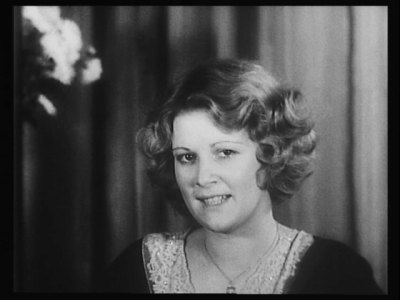 Offers Herself as a Bride for $10,000. (1931, 2 minutes) - With her two brother's dead, her parents about to be kicked out of their house and the depression raging, Mary Clowes comes up with a unique way to support her parents; she offers to marry anyone who will pay her $10,000 in advance. After she placed an ad in the paper, several news wires picked up the story and this short newsreel excerpt features an interview with the prospective bride.
Disc 3 - Toil and Tyranny
Uncle Sam and the Bolshevik (1919, 40 sec.) - Anti-union cartoon from Ford Motor Company which pictures union organizers as rats intent on ruining America.
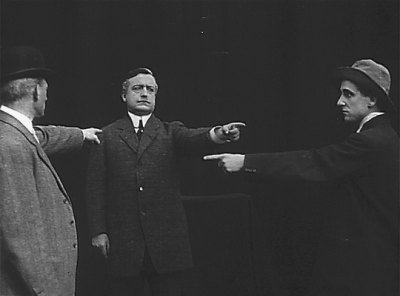 The Crime of Carelessness (1912, 14 minutes) - In the Triangle Factory fire of 1911, 146 workers, mostly young women, died when the overcrowded building caught on fire. Fire exits were locked or led to dead ends, the fire hoses had no water pressure, and fire escapes collapsed when workers used them. There was a great public outcry against the owners so the National Association of Manufacturers sponsored this film to try to improve the image of sweat shop owners. In the film a man's cigarette starts a fire (which is how it most probably was started in the Triangle factory) at an unnamed workshop even though non-smoking signs are posted. The movie lays the blame on workers, the management, and safety inspectors. While this appears to be even-handed and fair, and effective as a piece of propaganda, it's rather insulting. Down playing the owner's role in providing equipment that he knew was faulty and the shoddy working conditions, it tries to paint the tragedy as just one of those things that happens. As even the title suggest, it was just carelessness, not greed.
Who Pays Episode 12 (1915, 35 minutes) - The final episode in a serial, this chapter deals with overworked employees at a lumberyard. When Karl (Henry King) is fired after getting his skull cracked for daring to take a rest, his wife dies due to her "doubled labors". A union agitator gets the workers to strike, and an unstable Karl steals a gun which ends in tragedy. Like the previous film, this one takes an 'everyone is to blame' attitude that comes across as a little bit ridiculous when viewing the film today.
Labor's Reward (1925, 13 minutes) - This is the only surviving reel, the third of five. Produced by the American Federation of Labor, it urges people to buy union-made good only. Fairly weak, the pro-management films earlier on this disc play a bit better.
Listen to Some Words of Wisdom (1930, 2 minutes) - An early talkie newsreel about the best way to beat the Depression: namely spend all the money you have. Being thrifty will only prolong the agony. It's rather scary to think of people taking this advice in 1930 when the Depression was just beginning.
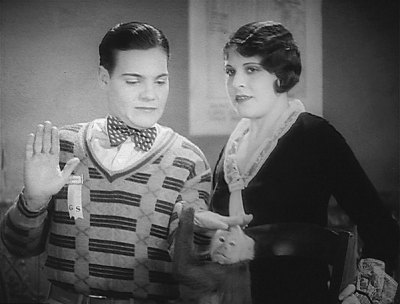 The Godless Girl (1928, 128 minutes) - Cecil B. DeMille's last silent picture, this is a rather odd and preachy film. When Judy (Lina Basquette) tries to start an atheist club at her school, the good, God-fearing students, led by Bob (James Duryea1), raid the meeting and a brawl is started. In the melee a girl falls over a stair railing and dies. What do the authorities do? Throw Judy and Bob into a juvenile detention facility wear the conditions are horrible. Tom and Judy then escape, get captured, survive a fire, and somewhere along the line fall in love. (Naturally.) Over the top even for a DeMille film, the plot is so convoluted and unbelievable that it's really hard to take the film seriously.
Disc 4 - Americans in the Making
Emigrants Landing on Ellis Island (1903, 2 minutes) - Newsreel footage of people coming to the land of opportunity.
An American in the Making (1913, 15 minutes) - A film by U.S. Steel that shows immigrants the opportunities for employment and assimilation in the steel industry. It also takes the occasion to throw out some worker safety tips too.
Ramona (1910, 16 minutes) - The Helen Hunt Jackson classic is filmed by D.W. Griffith and features a very young Mary Pickford. This one reel Biograph short cuts much of the book, naturally, and makes much more sense if viewers have read the original.
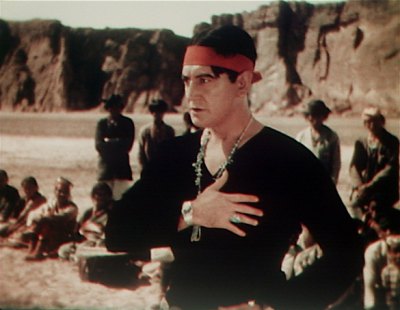 Redskin (1929, 82 minutes) - A Paramount film shot mainly in two-strip Technicolor, this was their first color movie as well as the final silent film that the studio would make. It stars Richard Dix as Wing Foot, the son of a Navajo chief who goes off to college and tries to learn the ways of the white people. There he isn't accepted there however and returns to his village. When the woman that he loves, a member of a different tribe, is going to be force to marry another against her will, Wing Foot decides to take matters into his own hands.
An interesting film from a historical stand point, it's only mildly entertaining today. The plot is unusual since it shows the friction not only between whites and Indians but between different Indian tribes too. The film was going to be all color, but the cost of the color stock was too high forcing the director to switch to black and white film for the scenes taking place in the white-man's world. While this was accidental, it did create a nice effect when watching the film.
United Snakes of America (1917, 80 sec) - An animated short from Ford, it warns good Americans about the dangers of dissenters and people who want to keep us out of WWI.
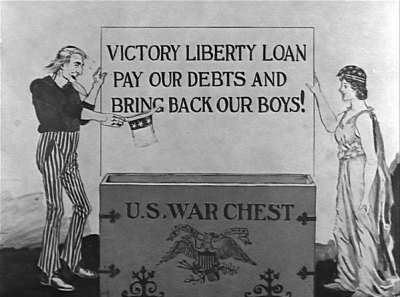 Uncle Sam donates for Liberty Loans (1919, 75 sec.) - A patriotic cartoon that entices people to buy Liberty Bonds to "Bring our boys home."
100% American (1918, 14 minutes) - Mary Pickford lent her talents to this short. She plays a girl who stops spending her money on useless items and saves up to buy war bonds instead.
Bud's Recruit (1918, 26 minutes) - King Vidor's earliest surviving film, this movie tells the tale of two brothers, Bud, a young enthusiastic American who can't wait to become old enough to volunteer and beat the Kaiser, and Reggie, an effeminate young man who is old enough to join, but doesn't. Bud's got a trick up his sleeve however. A well told film that is very enjoyable.
The Reawakening (1919, 10 minutes) - Another film from the Ford Motor Company. In WWI over 10% of the 2 million Americans who were sent Europe returned wounded. This short shows how maimed vets can be made good as new with artificial limbs. An upbeat film, it takes a rather simplistic look at the problem.
Eight Prohibition Newsreels (1922-23, 13 minutes) - An amusing look at Prohibition. This collection of newsreel footage shows raids on bootleggers as well as clips from politicians of the day. It's interesting to note how the tone of the pieces change over the ten years these clips were filmed. A fun and enjoyable way to finish off the collection.
The DVD:
Audio:
All of the selections were accompanied by music composed and performed by a wide variety of musicians, and they all fit the pieces well. There were no audio defects and the discs sounded fine.
Video:
These films were all restored by the various archives that contributed to this set, and they look wonderful. There is some variation to the quality of the image, and a few films show signs of decomposition, but they generally have excellent contrast, a good amount of detail, and a wide range of grey hues. Like the two previous sets, these films look magnificent.
Extras:
These films all come with commentary tracks from a wide range of film scholars and historians who offer some very interesting insights. While a couple of commentators merely state the action that's happening on the screen, the majority talk about the background of the film, especially the social conditions at the time.
Each film also comes with on-screen notes which are reproduced in nice 192-page book included with the set.
Final Thoughts:
Anyone who is interested in early film or American history should run out and buy this set. Like the two previous collections, this group of 48 movies is a must have. Highly Recommended.
1) James apparently changed his screen name to Tom Keene, presumably in an effort to get better parts since it sounded better. It didn't really work as he spent most of his career in b-movie westerns and his last part was in Ed Wood's infamous Plan 9 from Outerspace.
|


| Popular Reviews |
| Sponsored Links |
|
|
| Sponsored Links |
|
|
| Release List | Reviews | Shop | Newsletter | Forum | DVD Giveaways | Blu-Ray | Advertise |
|
Copyright 2024 DVDTalk.com All Rights Reserved. Legal Info, Privacy Policy, Terms of Use,
Manage Preferences,
Your Privacy Choices 
| |||||||