
| Reviews & Columns |
|
Reviews DVD TV on DVD Blu-ray 4K UHD International DVDs In Theaters Reviews by Studio Video Games Features Collector Series DVDs Easter Egg Database Interviews DVD Talk Radio Feature Articles Columns Anime Talk DVD Savant Horror DVDs The M.O.D. Squad Art House HD Talk Silent DVD
|
 DVD Talk Forum |
|
|
| Resources |
|
DVD Price Search Customer Service #'s RCE Info Links |
|
Columns
  


 
|
|
|
Doctor Who - Timelash
What can you say about one of the most universally reviled Doctor Who adventures? When I first saw Timelash well over a decade ago, I hated it. It contained all of the aspects of the show that people make fun of: horrible special effects, hokey stories, stupid villains, and nonsensical plot devices. I was fairly surprised when the Restoration Team announced that it was coming to DVD as a stand alone disc. I figured they'd try to slip that one by us by packaging it with some more popular stories, possibly as a season set. In any case Timelash has been released in Region One on DVD and having given it a second look....it's not quite as bad as I remember it. It's not a good adventure by any means, but it's not painfully bad either.
Background:
Okay, most of you probably already know this, but for those who aren't familiar with the long running SF show, here's a bit of history. Doctor Who started in 1963 with William Hartnell creating the role of The Doctor, a mysterious and crotchety old man who traveled through time and space with his granddaughter Susan, and two of her teachers. They traveled in the TARDIS, a device that looked like a small London Police Call Box on the outside, but on the inside was an immense and spacious time machine.
The show was a hit but in 1966 there was a problem. Hartnell became ill and had to leave the show (though some say it was the new production team rather than illness that caused the departure.) In order to keep the show going the producers and writers came up with an ingenious idea: Since there wasn't much known about the Doctor (aside from the fact that he was an alien) why not have him die and then regenerate his entire body in the form of a new actor. This turned out to be not only a good gimmick to keep the show going, but also made the main character more interesting and mysterious. As the show went on, more details of exactly who and what the Doctor was slowly emerged. It turned out that he was a 700+ year old Time Lord from the planet Gallifrey who stole the TARDIS from a repair bay, which explains why it doesn't always work as well as it should, and was on the lam. He did this because he didn't see eye-to-eye with the rest of his race. He much preferred to get involved and help people out when he could rather than just sit back and watch things happen like the rest of the Time Lords.
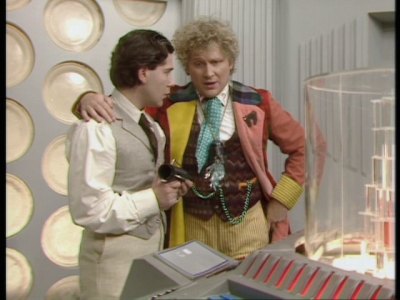
As the years went on the show continued to be popular and the BBC went through many actors playing the Doctor and even more traveling companions. Colin Baker, the star of this adventure, was the sixth person to play the Doctor on TV.
This story:
The Doctor (Colin Baker this time) and his companion Peri (Nicola Bryant) are arguing in the TARDIS when they get trapped in a Krontron Corridor. This rift in time pulls them, none too gently, to the planet Karfel, a place the Doctor has visited once before (in an untold story.) Karfel is ruled by an evil dictator called the Borad, who controls the people with an army of androids and the help of his second in command, the Maylin (Paul Darrow from Blake's Seven.) Not everyone is happy with the way things are run, and there is an active group of rebels. Whenever one is caught, they are sent into the Timelash and never heard from again.
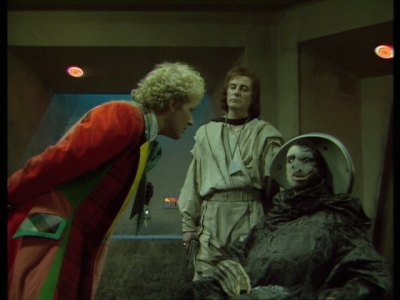
When the Doctor and Peri arrive, the Maylin is very cordial and nice since he needs the Doctor's help. An important key that he wore around his neck was ripped off by a rebel just before she jumped into the Timelash. He needs the Doctor to follow this rebel to her destination and get his symbol of power back. To encourage the Doctor he holds Peri hostage. Will the Doctor be able to find the amulet/key, and if he does will he turn it over to the Maylin?
This story was written by Glen McCoy, his first and only Who script. The ex-ambulance driver was new to writing and his script underwent a lot of revision. Even with extensive re-writes it rarely approaches mediocrity. There's just a lot wrong with the story. Peri, who is usually a fairly strong character and isn't afraid to argue with the Doctor spends all of her time being a captive and screaming and various monsters come menacingly close. The plot hinges on the Doctor being able to create a marvelous new device that basically lets his move around invisibly while appearing visible in another location. Of course it's hard not to wonder why he doesn't carry one of these with him at all times like the sonic screwdriver. The answer is that it's just too powerful and a bit of a cop-out, as illustrated by the end of this story.
Not only that but the second episode (of two) was short, and so there's a separate story that lasts about five minutes, which shows how the Doctor stops an interstellar war from starting. Rushed and out of place, this section will leave viewers scratching their heads wondering why it was even included.
 |
| |
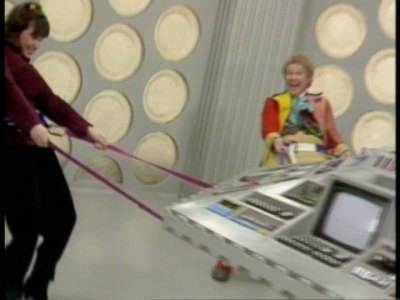
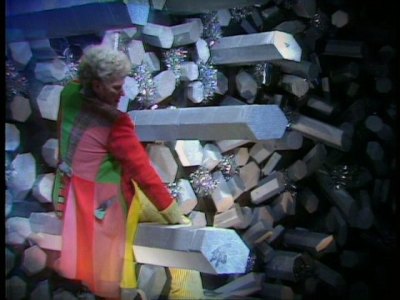
The script isn't the only problem however. The sets were silly and cheap, the interior of the Timelash being particularly groan inducing, most of the production was over-lit with glaringly bright rooms, the monster was ridiculous in both appearance and manner, and the whole adventure had the feeling of an amateur fan-production. At the beginning of the first episode the doctor is looking at a paper star chart! That makes no sense since the position of the stars changes as one moves around the cosmos. The most ludicrous moment however is when the TARDIS enters the Krontron Corridor (what a horrible name). The Doctor and Peri reach into a box and get nylon straps and attach themselves to the central console to ride out the turbulence. It looks silly and would be totally ineffective if there really was any drastic movement.
 |
| |
Having said all that, the show wasn't as gut-wrenchingly bad as I remember it. Yes, Paul Darrow does do a horrific job of acting (he was trying to get away from his role on Blake's 7 and purposefully tired something different which didn't work) but he's still a fun villain. The trip into the past to find the amulet was also well done and the character the Doctor meets there was engaging, though the surprise revelation about him at the end is a bit stupid. The Doctor also has some good scenes, such as when he and the rebels are trapped in the room with the Timelash. This will never be considered one of the show's best adventures given the distance of time (no pun intended) it's not as bad as it came across in the late 80's.
The DVD:
This story contains two 45-minute episodes (all of the episodes from this season were that length. They reverted back to the 30-minute format with the following season.) They are presented on a single DVD-9 disc in a keepcase. The cover matches the other US releases of Doctor Who.
Audio:
This show comes with the original mono soundtrack that fits the show just fine. The dynamic range is nothing to write home about, but the dialog is generally crisp and clear and there is no background noise, tape hiss, distortion or dropouts. There are optional subtitles in English.
Video:
The full frame image looks very good. The Restoration Team has done their magic and this show has good color, fine detail and solid definition. There is a small patch in the second episode that appears a bit softer than the rest, but this was a minor problems.
Extras:
The Doctor Who discs generally have a good selection of bonus items, and this one is no different. The there is a commentary track with actors Colin Baker, Nicola Bryant and Paul Darrow over both episodes, as well as a very nice 25 minute documentary about this story, The Good, the Bad, and the Ugly (presented in anamorphically enhanced widescreen.) This latter item features actors Colin Baker, Nicola Bryant, Paul Darrow, David Chandler, Robert Ashby, script editor Eric Saward, writer Glen McCoy and journalist Paul Lang. Unlike a Hollywood movie where everyone falls over themselves trying to praise the production no matter how bad, the cast and crew are fully aware of the fan reaction and don't try to deny that this isn't the best story ever. It was very refreshing to hear the creators and cast admit that mistakes were made. Both the commentary track and the documentary are fully upfront about the dip in quality that this episode took, and that makes these recommended viewing.

There's also a pop-up informational text option, which is very informative as always. It does give some dry statistics, like how many people viewed each episode, but there's also some interesting notes such as script changes that were made and background information on the supporting characters.
There's also a photo gallery and the listing from the Radio Times in .pdf format.
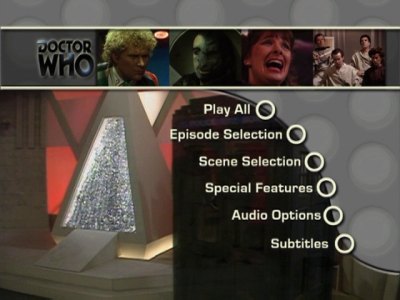
An Easter Egg appears on this disc too. If you highlight the Doctor Who logo on the main menu screen and press select, the original intros and outros that were shown on BBC1 when the episodes first aired will be played.
Final Thoughts:
As has been pointed out by others, Timelash is an anagram for "Lame Shit". The show isn't totally lacking however and has some redeeming value. It's one of those shows that fans love to hate, and if you've never seen it, this adventure is really worth watching if for no other reason than to be able to jump in when other fans are trashing it. The extras are fun too. It's great to hear the cast and crew acknowledge that the show wasn't perfect, and that alone makes this disc worth a rental.
|



| Popular Reviews |
| Sponsored Links |
|
|
| Sponsored Links |
|
|
| Release List | Reviews | Shop | Newsletter | Forum | DVD Giveaways | Blu-Ray | Advertise |
|
Copyright 2024 DVDTalk.com All Rights Reserved. Legal Info, Privacy Policy, Terms of Use,
Manage Preferences,
Your Privacy Choices 
| |||||||