
| Reviews & Columns |
|
Reviews DVD TV on DVD Blu-ray 4K UHD International DVDs In Theaters Reviews by Studio Video Games Features Collector Series DVDs Easter Egg Database Interviews DVD Talk Radio Feature Articles Columns Anime Talk DVD Savant Horror DVDs The M.O.D. Squad Art House HD Talk Silent DVD
|
 DVD Talk Forum |
|
|
| Resources |
|
DVD Price Search Customer Service #'s RCE Info Links |
|
Columns
  


 
|
|
|
H.P. Lovecraft Collection, Vol. 4: Pickman's Model, The
The fourth volume from the H. P. Lovecraft collection has been re-released, and it takes a slightly different tact than the previous installments. This time the three versions of the same story, Pickman's Model, are presented and it makes for some very interesting viewing. All three films are unique and while one doesn't work as well as the others, it is fun to see how Lovecraft's story, and especially the role of Pickman himself, is adapted by three different directors on three continents.
Background:
It would be easy to write off H. P. Lovecraft as an over-rated hack. After all, his plots are very simple more often than not, there's frequently little in the way of character development, and his prose is turgid and opaque. Indeed critics have raised all those points and more (especially the way he labels a creature as indescribably horrific only to describe it two pages later) but these people miss the point. Lovecraft's strength, and the reason he's remembered today when so many of his contemporaries are forgotten, is in his unique ability to create a horrific atmosphere and a pervading sense of unease. No other writer has been able to consistently generate a feeling of foreboding and discomfort the way Lovecraft can. He's the father of modern horror fiction, and has influenced such diverse writers as Stephen King and Batman scribe Denny O'Neil (who named Gotham's Arkham Asylum after the fictions city of Arkham Massachusetts which appears in Lovecraft's fiction.
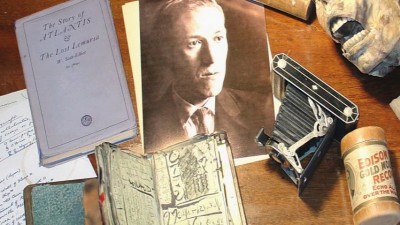
Because of his prose style and the way he leaves much of the horror to the readers imagination, Lovecraft's stories are innately difficult, some would say impossible, to accurately adapt to other mediums, especially a visual one like film. This hasn't stopped many people from trying, and the results have been more often than not unsatisfactory, at least as far as the feature films are concerned.
Lurker Films has now released a series of discs containing adaptations of Lovecraft-inspired movies that do capture the horror master's style and atmosphere on film. Known as The Lovecraft Collection, each of these discs offers some interesting takes on Lovecraft's stories.
Volume 4: Pickman's Model
One of the more well known Lovecraft stories, Pickman's Model has never been a favorite of mine though I don't dislike it. The story, as Lovecraft wrote it, is a monolog given by a man named Thurber to his companion Eliot concerning a mutual friend of theirs, Richard Upton Pickman. Pickman was an artist who painted disturbing images, grotesque but realistic pictures of inhuman creatures, and he had recently disappeared after being shunned by the local art circles. In the story, Thruber tells of the last time he saw Pickman, and how his artist friend took him to a secret studio in an old and run-down section of town. Once there they go into the basement where Pickman does his work. There is an ancient well in the floor, but more unusual than that are the bizarre and monstrous painting that the artist has created. They fill Thurber with terror, and their depictions of monster that live underground and haunt basements and subways are so real as to cause Thurber to never again go underground. The real horror however, is when Thurber discovers where Pickman gets his inspiration.
The three main films on this disc all use the same story for inspiration but develop it differently. All three have their merits and are worth watching,
Chilean Gothic (46 minutes): This featured film was made for broadcast on TV in Chile, has the largest budget on the disc, and is the most impressive. Having more time and money to work with, the creator's expanded Lovecraft's story, adding more characters and events to make Pickman's tale more horrific. This version revolves around a reporter, Gabriel (Rodrigo Sepúlveda), who is looking to establish the circumstances surrounding the death of his friend, Anibal. All he knows is that his friend was spending time with an artist, Richard Upton Pickman, who can't be located. He tracks down Pickman's only friend, an old professor, and his ex-land lord, who both give him clues and hints about the artist's personality and where he has gone. Gabriel tracks the reclusive man down, but he soon wishes that he hadn't.
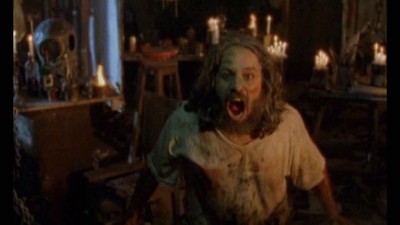
This version worked very well and has a feeling of dread and foreboding running throughout it, much like Lovecraft's story. The director wisely leaves much of the horror off screen, including Pickman's drawings. The viewer's imagination is can come up with something much more intense than any painting and that helps add to the suspense of the piece. This is an excellent version of the tale that uses the story as a starting point and alters it to fit a different media. Just what the best adaptations do.
A/V: The 1.66:1 color image was a little grainy and was on the soft side, but these flaws actually worked in the film's favor, enhancing the spooky aspect of the movie. The stereo Spanish soundtrack is fine, and English subtitles are available.
Pickman's Model (Italy) (31 minutes): An excellent adaptation of Lovecraft's story. Starting with an eerie scene of Pickman hiring a model and taking her to his basement, the narrative changes a few of the details but keeps the feel of the original. Pickman is a lame and creepy man which adds a lot to the story, and the director came up with a nice way to illustrate Pickman's horrid paintings: instead of trying to come up with an image as scary as those described in the story, the art is represented by a series of fast flashing horrific images. Not being able to focus on any one, it creates a creepy felling that is very effective. The ending was also very well done. The best version of the story on this disc.
A/V: The full 1.78:1 anamorphic color image looked like it was recorded on digital tape. There was a lot of aliasing and fine lines had a tendency to shimmer when the camera panned over them. There was a lot of digital noise too, especially on the blank canvas in the basement. The Italian 5.1 surround sound was effective though with the music filling the room nicely and creating an eerie atmosphere. There are optional English subtitles.
Pickman's Model (Texas) (30 minutes): This student film was made in 1981 by an RTF student at my alma-mater, UT Austin, and because of that the first film that I screened from this disc. Unfortunately is feels like a student film. Filmed in black and white, the sets are always a bit too bright; making the basement Pickman brings his friend to look like a quickly decorated set. The acting is likewise not that impressive with both Pickman and Thurber. What's most troublesome though is that the ending didn't work well...where Lovecraft's story ends abruptly with a shock; this one drags on after the revelation at the end which makes it even less effective. This was also the only film to actually let viewers get a good look at Pickman's paintings, another poor choice as they look rather amateurish instead of hauntingly horrific.
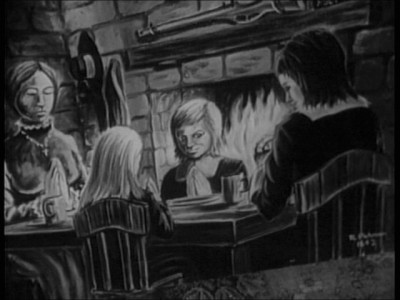
A/V: The full frame black and white image was a bit grainy and on the soft side, but it was otherwise fine.
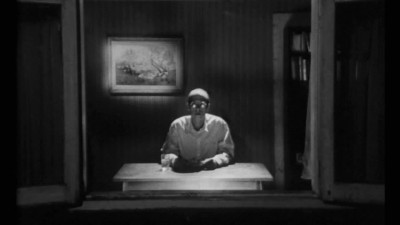
Between the Stars (6 minutes): Based on a line from an unfinished Lovecraft story, this short film concerns a man who's only escape was looking at the stars at night. A rather odd film, it was fun to watch even if it was a bit pointless.
A/V: The 1.66:1 B&W image suffered from some digital artifacts, mosquito noise mainly, but otherwise was fine.
In the Vault (6 minutes): A CGI animated short about a bitter grave digger, George, who didn't do his job very well and ended up paying for it. It's a very loose adaptation and the director decided to add some humorous sections, like George pissing on a casket before covering it with dirt. This didn't suit the mood of Lovecraft's at all and made the cartoon lighter than it should have been. The animation style is rather dated too, and looks like something from a videogame rather than a film.
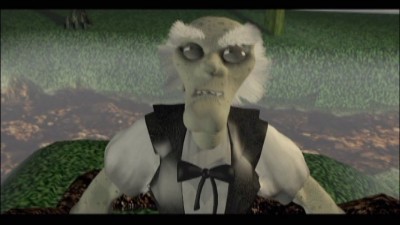
A/V: The computer graphic look good on the full frame image. Not spectacular, but good.
The DVD:
Extras:
Also included on this disc are a couple of nice bonus features. The first one is a ten-minute interview with authors Ramsey Campbell and Robert B. Price, two fans of Lovecraft who talk about his work, its place in literature, and how it affected them. They have some interesting things to say and its worth watching. There also two introductions by Campbell and Price that were shown before films at the H. P. Lovecraft Festival one year. They're very short but fun.

The disc also comes with a nice 8-page booklet that includes essays on all the films.
Final Thoughts:
This is another fine collection of films based on the works of H. P. Lovecraft. Presenting three versions of the same story make this one of the most interesting volumes in the series. The approaches are so different the disc never gets boring, even when watching the same tale three times in a row. This is a great series and well worth checking out. A strong Recommendation.
|



| Popular Reviews |
| Sponsored Links |
|
|
| Sponsored Links |
|
|
| Release List | Reviews | Shop | Newsletter | Forum | DVD Giveaways | Blu-Ray | Advertise |
|
Copyright 2024 DVDTalk.com All Rights Reserved. Legal Info, Privacy Policy, Terms of Use,
Manage Preferences,
Your Privacy Choices 
| |||||||