
| Reviews & Columns |
|
Reviews DVD TV on DVD Blu-ray 4K UHD International DVDs In Theaters Reviews by Studio Video Games Features Collector Series DVDs Easter Egg Database Interviews DVD Talk Radio Feature Articles Columns Anime Talk DVD Savant Horror DVDs The M.O.D. Squad Art House HD Talk Silent DVD
|
 DVD Talk Forum |
|
|
| Resources |
|
DVD Price Search Customer Service #'s RCE Info Links |
|
Columns
  


 
|
|
|
Synecdoche New York
All the world's a stage,
And all the men and women merely players;
They have their exits and their entrances,
And one man in his time plays many parts,
His acts being seven ages.
-William Shakespeare, "As You Like It", Act 2 scene 7
The movies that Charlie Kaufman writes often fall into the "love 'em or hate 'em" category. His films are usually filled with bizarre concepts and unique ideas and the themes are often opaque and hard to grasp with only one viewing. That is especially true with Kaufman's latest work, Synecdoche, New York an ambitious film that is also his least accessible. Even though many mainstream viewers will be turned off by the surreal and almost avant-garde nature of the story, those that are willing to stay with it will be rewarded with an amazing piece that will go down as a modern day classic.
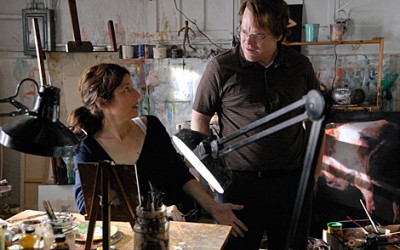
If you read any reviews of Synecdoche, New York at some point the writer will confess that it's a movie that's almost impossible to summarize. That's very true and any synopsis will be woefully incomplete or so long and bloated as to put the reader to sleep. In any case the movie revolves around Caden Cotard (Philip Seymour Hoffman), a hypochondriac who directs stage dramas at regional playhouses but dreams of something bigger. He's married to Adele (Catherine Keener,) an artist who paints on incredibly small canvases, and together they have a 4 year old daughter, Olive (played by several actresses as she grows up). Things are going marginally well for Caden at the beginning. He's in counseling with his wife, but his adaptation of "Death of a Salesman" opens to rave reviews. Then the day before the family is to leave for Berlin, Adele tells Caden that she doesn't want him to go to her first big exhibition. She takes Olive off with her and at the point Caden's life, his whole reality, no longer seems to make sense to him. Time is out of joint, and events no longer unravel as they are supposed to. He tells a friend that he's miserable since Adele hasn't called in the two weeks she's been gone, and the friend replies that it's been over a year since she left. He discovers that his wife is an international sensation and has married two German men, but there's no mention of a divorce.
In the middle of this crisis, Caden receives a MacArthur Genius Award, which includes a large sum of money so that he can pursue his art without having to worry about commercial success. He finds a large warehouse in New York and starts to put on a grand play; one that will be real, and talk about the human condition. It will examine how we all cope with life, knowing that the only possible end is death. The whole script will be improvised by the actors, and every day Caden plans to gives notes to the cast describing what happens to them, which they then act out.
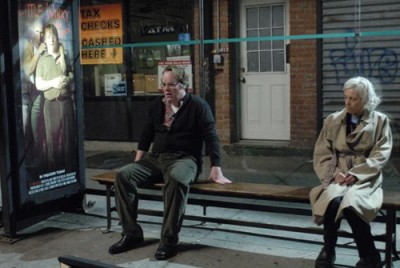
He starts with a reasonable sized cast, but as his life becomes more disjointed the number of players grows and grows. Soon he realizes that he needs an actor to play himself, and hire a man who has been stalking him for years. What starts off as a simple set for a play expands and grows until it becomes a scale model of Manhattan in an impossibly large warehouse. Being an exact replica, the set also has a warehouse, which houses a scale model of New York City, in which there is another warehouse...
At the same time both peculiar and brilliant, this is a wonderfully amusing dark comedy which is also a dense and challenging film to watch; an intelligent film that refuses to wait for the viewers to catch up. But this ambitious project largely works because even if you miss some themes and ideas that are presented (I'm certain that I did) there's enough that you can grab to make the film both enjoyable and thought provoking.
The movie, though it has several themes, is really about a man trying to make sense out of his life. He's trying to piece together just what went wrong the only way he can, by creating a play that mimics life. The flaw to his approach however is that the more time he spends trying to make sense of the world, the less time he actually spends there, making his life all the more disjointed and confused.
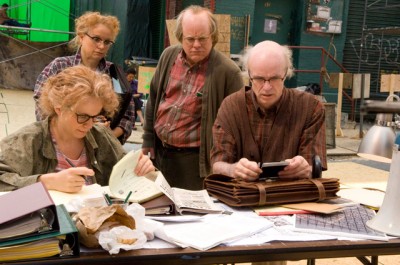
While the film does have a definite ending, there are still a lot of questions left when the credits start to roll. (Why was Caden so obsessed with Olive yet totally ignored his second daughter? Was the house on fire a joke? Where was Adele every night at the end of the film? Etc. etc.) That's not a bad thing however. The film has the potential to start a lot of conversations and is one that stays with you long after the lights go up.
While I like most of the movies that Kaufman has written, he is sometimes too clever for his own good. In particular I found Adaptation to be pretentious and filled with "I'm so much smarter than you" moments that it was hard to enjoy the film for what it was. Happily he manages to avoid that pitfall in this film and gives a thoughtful and intelligent film that doesn't come off as elitist or snobby.
It was Kaufman's first time directing and he does a very credible job. While it's not perfect, the film does drag in places, the movie unfolds in a strange manner that we've come to expect from Kaufman-penned projects. The last half hour was the only problem I had as it could have easily been cut in half. The film takes place over 40 years, and Caden was an old man by this time and the slow, plodding pace of the conclusion could have been deliberate.
The movie was really laid upon the shoulders of Philip Seymour Hoffman, who is in practically every scene. He does a wonderful job showing Caden becoming more and more obsessed with his project as well as portraying him over a wide period of time. Hoffman resists the urge to chew the scenery and gives a very sedated performance which fits the role perfectly. In the hands of a lesser actor the movie could have turning into camp comedy or (more likely) a disjointed mess.
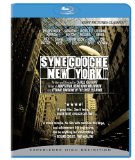
The Blu-ray Disc:
Video:
Presented with its theatrical 2.35:1 aspect ratio intact, the 1080p/AVC MPEG-4 presentation looks very good for the most part. The film used a lot of earthy colors, browns, grays, and tans, and they're reproduced very well. The movie does have a flat look to it, especially the New York City inside of the warehouse, but that was probably intentional. Because of that there are few scenes that really pop, but the level of detail is very good and the blacks are nice and solid. On the digital side things also look fine, without any glaring compression artifacts.
Audio:
The disc comes with a Dolby TrueHD 5.1 mix that is a bit of overkill. This is a quiet film, there's not a lot going on aurally with large stretches with only minimal dialog. The soundtrack does a good job with what's there, producing the limited sounds effectively and, even more important, being dead silent when it's called for. There is some use made of the soundstage, and when it is used there is good directionality.
Extras:
The disc comes with a nice set of featurettes. There isn't a commentary, which is too bad but not too surprising, but the rest of the bonus features are pretty interesting. First off is In and Around Synecdoche, NY : The Making of Synecdoche, NY (19 min) which discusses the nuts and bolts of the production. Why they used the colors that they did, what emotions they were going for in some sequences, and most interestingly, how they kept track of which New York City they were shooting; the real one, the warehouse NYC, the NYC in a warehouse inside the original warehouse, or the NYC in a warehouse, inside a warehouse, inside a warehouse. There are visual cues that help the viewer keep it straight, and I missed just about all of them.
The Story of Caden Cotard: In Conversation with Phillip Seymour Hoffman is a 12-minute interview with the actor who discusses his character and the challenges of playing someone over a 40 year period. He mainly speaks in generalities about the character so as to not give anything away, but it's still interesting to hear his take on the role. Next up is wonderfully named Infectious Diseases in Cattle: Bloggers Roundtable (37 min). This brings five movie bloggers together to discuss their impressions and reactions to the film. I would have had a great time if I was actually there and could join in on the conversation, but as it was it was a bit aggravating. Topics that I found interesting were dropped and things that I could not have cared less about were talked about for way too long. Also included are three cartoons which were shown on TV in the film, and a trailer for the movie.
The final bonus item is a NFTS/Script Factory Masterclass with Charlie Kaufman (28 minutes.) Kaufman does few interviews and this is an excellent chance to hear his thoughts on all of his films as well as his early days writing for TV. The person who is interviewing him asks some dumb questions (such as "Why did you send Meryl Streep to accept your Oscar?" to which a dumbfounded Kaufman replies "Oscar?? Umm, do you mean BAFTA?") but Kaufman has a lot of interesting things to say. I only wish someone else had been in the interviewer's chair.
Final Thoughts:
Charlie Kaufman is one of the few writers working in Hollywood who assumes his audience is intelligent and makes them work during his films. A lot of people will hate this film and think it's nonsensical, but I disagree. It's a masterful look at a man trying to make sense out of the world through his art. Even though it doesn't work, he keeps on trying as his creation grows larger and larger, spinning out of control. A film the almost demands multiple viewings, this Blu-ray looks and sounds great. Highly Recommended.
Note: The images in this review are not from the Blu-ray disc and do not necessarily represent the image quality on the disc.
|



| Popular Reviews |
| Sponsored Links |
|
|
| Sponsored Links |
|
|
| Release List | Reviews | Shop | Newsletter | Forum | DVD Giveaways | Blu-Ray | Advertise |
|
Copyright 2024 DVDTalk.com All Rights Reserved. Legal Info, Privacy Policy, Terms of Use,
Manage Preferences,
Your Privacy Choices 
| |||||||