
| Reviews & Columns |
|
Reviews DVD TV on DVD Blu-ray 4K UHD International DVDs In Theaters Reviews by Studio Video Games Features Collector Series DVDs Easter Egg Database Interviews DVD Talk Radio Feature Articles Columns Anime Talk DVD Savant Horror DVDs The M.O.D. Squad Art House HD Talk Silent DVD
|
 DVD Talk Forum |
|
|
| Resources |
|
DVD Price Search Customer Service #'s RCE Info Links |
|
Columns
  


|
|
|
Mighty Boosh Special Edition DVD, The
The Mighty Boosh has run for three non-consecutive series on the BBC, and has been rebroadcast here in the States on BBC America and now on Adult Swim. The show is an abstract comedy about the adventures "through time and space" of Howard Moon and Vince Noir. The first series is set at their place of employ, the "Zooniverse," a bizarre riff on a regular zoo (animals talk, the director knows nothing about animals, etc.). The second series takes the leads out of the zoo and into a Dalston, London flat. In the third series, Howard and Vince work at a shop called Nabootique. Across all three series, the format remains basically the same; their surroundings are virtually irrelevant and serve merely as a point of departure for strange adventures into previously unknown dimensions where they meet fantastical creatures, engage in musical numbers, and accomplish nothing of lasting significance. The Mighty Boosh is immensely popular in Britain and has found a sizable following in this country, and elsewhere.
There's no accounting for taste. It's a two-way street, and despite that maxim's warning, I'm still trying to dissect my baffled dislike of The Mighty Boosh. I came to this new boxed set (which includes all three seasons, plus an additional disc of new extra content) completely fresh, having never seen a single episode before. But I started watching with a fair amount of anticipation, because the series has been described to me in glowing terms by several friends with whom I have much in common and whose taste in movies and television I wholeheartedly trust. It has also been well reviewed. Beyond that, British television is often excellent and I'm an enormous fan of many British series. I was confident that at the very least I'd have a marginally positive reaction to the show, if not a stronger appreciation. As it turns out, I was alternately maddened and bored by this promising yet flat show that tries way to hard to be edgy, "alternative," unique, and funny - but fails to achieve any of those things with any consistency. Truly amusing moments pop up here and there - but the stories are like an eighth-grader's creative writing assignment; the pointless lunacy is always forced and arbitrary. In the end, my reaction to this set was a dull boredom; a consistent desire to stop watching was trumped only by my responsibility to write this review, a task I now face with a confused sense of being stymied by a program that I expected to like but did not.
Like Monty Python's Flying Circus, the title of The Mighty Boosh has no real significance, nor does the show's tagline: "Come with us now, on a journey through time and space, to the world of The Mighty Boosh." Although laced with elements of fantasy, the program is really just a rather narcissistic showcase for the antics of its creators, Julian Barratt and Noel Fielding. Perhaps it's not fair to label these two comedians as particularly narcissistic - however, I find this to be the only logical reason for the show's existence. The Mighty Boosh is not character-driven, or plot-driven. The humor is not situational or subtle. The entire show is driven by zany sketch-like shenanigans that are virtually content-free - just a string of jokes, most of them lifeless. The jokes don't build on one another, as is the case in most comedy shows. Character bits are usually developed over time, resulting in continually-raised comic stakes. Here, jokes are just spread rather thin over each episode. Our "appreciation" of them does not hinge on knowing something specific about the characters, or on carefully-staged situations and conflicts. The jokes exist in a near-vacuum, sucked away into nothingness at the moment of their execution.
This may be more a reflection of my own comedy "values" than it is a substantive criticism of Barratt and Fielding. Nonetheless, a sense of connection to and investment in character is a hallmark of all good entertainment, regardless of genre. All we have to hold onto in The Mighty Boosh is Barratt's rather dense, self-important Howard Moon and Fielding's charming grin and elaborate hairdo. This is not enough.
Absurdity is one of the key syntactical features of comedic language. I don't think absurdity has, or can have, rules. However, when compared side-by-side to another absurdist, avant garde show like Tim and Eric Awesome Show, Great Job! on Adult Swim, some interesting points of comparison arise. (To be sure, Tim and Eric is not to everyone's taste, and the show's comedy is not always successful, yet it is original and takes absurdity to new places.) The Mighty Boosh gives lip service to the traditional structure of a half-hour sitcom; there is no laugh track, but each episode is stage-bound, and contains some semblance of a self-contained plot. By contrast, Tim and Eric rarely utilizes coherent storylines, is very fragmented, and the internal "logic" of each episode is really based on an intuitive post-production editorial approach. The comedy "bits" of Tim and Eric are created for comedy's sake alone - sometimes one laugh is good enough - and then each episode is compiled after the fact, utilizing odd opticals, music, animation, and sound effects to create an illusion of cohesiveness. That illusion, however, is an organic part of what Tim and Eric is "about," which is an abstract, absurdist send-up of the television-oriented aspects of our society.
The Mighty Boosh has no grand pretensions, which is fine. But instead of embracing the more outlandish aspects of Barratt and Fielding's comedy and running with them, the show remains bogged down in the soggy trappings of traditional half-hour comedy programs. This is why the situations seem forced. This is why we don't feel invested in the characters. This is why the jokes are all one-offs, disconnected from a larger whole. The structure upon which Barratt and Fielding have decided to hang their comedy is rather old, and inappropriate to their brand of humor. A freer approach, less stage-bound, and more intuitive, would likely have served them better.
The DVD
The Package
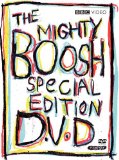
This attractively-designed and brightly-illustrated set combines all three previous series releases with an additional disc of bonus content. In all, it contains seven discs in a fold-out design similar to the four-disc edition of Ben-Hur, with an extra panel that contains a booklet, some illustrated cards, and a sheet of stickers. This is all housed within a nice card slipcase. The disc content is broken down as follows:
Disc 1: Series One episodes "Killeroo," "Mutants," "Bollo," "Tundra," "Jungle," and "Charlie"
Disc 2: Series One episodes "Electro" and "Hitcher," plus Special Features
Disc 3: Series Two episodes "Call of the Yeti," "The Priest & the Beast," "Nanageddon," "Fountain of Youth," "The Legend of Old Gregg," and "The Nightmare of Milky Joe"
Disc 4: Series Two Special Features
Disc 5: Series Three episodes "Eels," "Journey to the Centre of the Punk," "The Power of the Crimp," and "The Strange Tale of Crack Fox"
Disc 6: Series Three episodes "Party" and "The Chokes," plus Special Features
Disc 7: Box Set Special Features
The Video
The enhanced 1.78:1 image is excellent across all discs. It's a recent production (2004 - 2007), so clarity is to be expected and the BBC does not disappoint. The production design of the program tends toward bold use of color, and the video here reflects that with good fidelity.
The Sound
The stereo soundtrack is simple, well-separated, and strong. The show's prominent use of music is particularly well-mixed, which is no surprise as Barratt himself is the composer. It's a very serviceable, enjoyable track.
The Extras
Bonus content on this set is very generous. I've broken it down by disc below:
Disc 1: The episodes "Bollo" and "Tundra" contain commentary tracks by Barratt and Fielding, joined by performer Rich Fulcher. Not surprisingly, my interest in these tracks - in which the participants are lively and discuss the show enthusiastically - mirrored by level of interest in the show itself. Fans will likely find them far more enjoyable than I.
Disc 2: Commentary tracks with Barratt, Fielding, and Fulcher are included on "Electro" and "Hitcher." The other features for Series One begin with Inside the Zooniverse (28:04), which is a solid behind-the-scenes piece. Mighty Boosh: A History (9:37) details the Barratt/Fielding duo's previous life as successful stage and radio performers. There is a set of Outtakes (6:19), a compilation of Boosh Music (12:10), and a Photo Gallery.
Disc 3: All episodes include commentary tracks featuring creators Barratt and Fielding.
Disc 4: The original series pilot - an alternate version of "Tundra" from Series One - starts things off (28:40) and features an ill-advised laugh track which was wisely dumped. Boosh Publicity (19:11) is an interesting documentary piece that tracks efforts to promote the show. Making of Series 2 (28:40) is a behind-the-scenes look at the show. Next is a skippable Photo Gallery, an Outtakes reel (5:06), a generous helping of Deleted Scenes (14:23), a short film called Sweet (10:43) with Barratt and Fielding that predates the series, and another compilation of Boosh Music (15:37).
Disc 5: There are commentary tracks on "Eels," "Journey to the Centre of the Punk," and "The Strange Tale of the Crack Fox."
Disc 6: Making Boosh 3 (27:35) takes us behind the scenes once again. Boosh Publicity (29:23) follows the creators as they promote the show on radio, television and elsewhere. There is a lengthy bunch of Deleted Scenes (22:35), a promo for Mint Royale featuring Fielding and others (3:35), another Boosh Music compilation (9:21), a short reel of Outtakes (5:21), and a trailer for the third series.
Disc 7: New to this release, this disc contains even further bonus material. An introductory screen warns us that the content on this disc has been designed to take us on a "random journey." My "journey" took me first to the documentary The Mighty Boosh: A Journey Through Time and Space (57:20), a comprehensive look at the series. Boosh Pilot Deleted Scenes (4:11) were next. Then I found a Boosh Q&A at the Institute of Contemporary Arts (45:58), and sketches for an unproduced 1997 show called (Un)Natural Acts (15:03). Boosh Night Live (16:09) captures the feel of a Barratt/Fielding live show. Navigation at this point began to get extremely irritating, and I stopped searching for content, although there is almost certainly more here.
In all, the set contains a wealth of extra features that will likely satisfy fans deeply.
Final Thoughts
I still feel like I should have liked The Mighty Boosh even though I didn't. The meandering, loopy, unfocused comedy is forced, contrived, and somehow false. It self-consciously reaches for jokes and "zaniness" rather than demonstrating an intuitive comic sensibility. This boxed set combines very good technical presentation with an enormous quantity of bonus material. Fans will love it. Although not my cup of tea, I realize that the show has a following, and therefore the uninitiated should give it a look, but rent it.
|



| Popular Reviews |
| Sponsored Links |
|
|
| Sponsored Links |
|
|
| Release List | Reviews | Shop | Newsletter | Forum | DVD Giveaways | Blu-Ray | Advertise |
|
Copyright 2024 DVDTalk.com All Rights Reserved. Legal Info, Privacy Policy, Terms of Use,
Manage Preferences,
Your Privacy Choices 
| |||||||