
| Reviews & Columns |
|
Reviews DVD TV on DVD Blu-ray 4K UHD International DVDs In Theaters Reviews by Studio Video Games Features Collector Series DVDs Easter Egg Database Interviews DVD Talk Radio Feature Articles Columns Anime Talk DVD Savant Horror DVDs The M.O.D. Squad Art House HD Talk Silent DVD
|
 DVD Talk Forum |
|
|
| Resources |
|
DVD Price Search Customer Service #'s RCE Info Links |
|
Columns
  


 
|
|
|
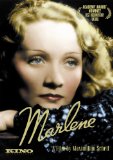
Marlene
Of Marlene Dietrich's fifty or so feature film appearances, I have only seen about five or six. Whatever the film, she always contributes an exotic presence and the feeling that she has come from someplace else - somewhere mysterious and seductive. No matter what the scenario or setting, when Marlene Dietrich shows up there's no mistaking her for your mother, sister, or aunt - she's like no woman you're ever likely to know. She's cool and sultry at once. Enigmatic and unreadable, Dietrich confounds the expectations of male characters in one film after another, from The Blue Angel (1930) onward. Maximilian Schell, who co-starred with Dietrich in (and won an Oscar for) Judgment at Nuremberg (1961), understands her allure and her unique place in film history. His documentary, Marlene (1984), is assembled like one giant montage, and Dietrich lent only her voice - and not her face - to his effort.
Schell sets up his dilemma in snatches of dialogue between himself and his editors - Dietrich will not allow herself or her house or her belongings be filmed. But she will speak with him - and Schell's interviews with her make up the bulk of the film's soundtrack. Dietrich's recollections, opinions, contrary attitude, and scrappy verbal tussles with Schell are the heart of the picture. These remarks - alternatively laser-sharp and rambling - are laid over with movie clips, songs from her theatrical performances, still photos, and bits of what appear to be semi-staged behind-the-scenes footage of Schell and crew trying to grapple with their subject's difficult behavior and willful obstructionism. The montage-like feel of the finished whole is totally appropriate given the refracted nature of what is "knowable" about celebrities, especially performers like Dietrich whose existence revolves around a very smart, very knowing act.
What does Schell's Marlene tell us about the star that we can't learn from other sources? Many uncontested facts of her life are ignored here - the film is not a biography. It is more of a record of Dietrich's attitude toward her own life and celebrity, which she vociferously claims is largely trivial. She seems to care nothing for her past films or future legacy, saying that it was all just "work" that is done now, and there's no point revisiting it. Constantly deriding her silent films as "kitsch," one clear opinion that emerges regarding her filmography is that The Devil is a Woman (1935) was her favorite. (It was the last of her seven collaborations with director Josef von Sternberg.) She says Fritz Lang was a terror, praises Orson Welles as a genius, and that Hitchcock was impenetrable. She says almost nothing about her co-stars, other than Spencer Tracy whom she apparently adored. All of this is in keeping with her sense of personal privacy - she gossips about no one and maintains a vacuum seal on her own private life.
The only time she discusses anything personal at all is when Schell asks whether her husband (German film production manager Rudolf Sieber) had tricked her into marriage. Dietrich is characteristically tight-lipped and vague - yet genial in tone - on the subject of this odd relationship; they were married from 1924 until Sieber's death in 1976, but only lived together for the first five of those 52 years.
In the end, this film is more about the filmmaking process as well as a thematic exploration of certain kinds of desire - the erotic desire often embodied by Dietrich herself, the desire of admirers to "know" a celebrity, and the desire of a documentarian to break through an unwilling subject's defenses. Schell's original intent was almost certainly subverted by Dietrich's intransigence, and his reliance on clips and Dietrich's status as a mysterious legend likely resulted in some different, but absorbing, directorial choices.
It's too bad Maximilian Schell (who I also find to be underrated as an actor, Oscar-winner though he is) hasn't directed other films, because in Marlene he shows a natural affinity for the interplay of complex themes and unusual visuals. The editing here is organic, intuitive, and impressionistic. The overall effect is like being in a film and television museum - dusty old monitors and faded screens showing unrestored footage from a bygone era. All of which would play into Dietrich's repeated assertions that much of her work is either "rubbish" or "kitsch."
It was nominated for a Best Documentary Feature Oscar and won several other awards. Marlene could have been a staid but informative PBS-style presentation, but Schell's film plays with some very "meta" material in a subtle and natural way. It doesn't hurt that his subject is one of the most colorful, difficult, and magnetic personalities in Hollywood history.
The DVD
The Video
Kino International regularly releases interesting and important films, often featuring restored picture and sound elements, and decent extras. It is truly unfortunate - and disappointing - that they have not seen fit to do so with Marlene. First and most significantly, the picture here is presented in a sub-par full-frame transfer. It was shot at 1.66:1 and it's a shame that it's cropped here, especially since this is not a television documentary, but a visually-thoughtful feature deserving of a restored anamorphic transfer. Beyond that, the colors are extremely drab and faded. Blacks are totally broken-up and everything else looks terribly muddy. This is a rare misstep by a great distributor.
The Audio
The mono soundtrack is perfectly serviceable, and it's fortunate that the interviews with Dietrich are well-recorded. There's no dynamic range here to speak of, but it would have been nice to see the film's sound restored (along with the picture) for this release. The interviews are conducted in alternating German and English, with English subtitles where appropriate.
The Extras
A short still gallery is provided, but the stills are from Dietrich films, not this one. A Schell commentary would have been wonderful - as would any supplements on this odd, unusual film. Another missed opportunity.
Final Thoughts
Maximilian Schell has given us a fitting tribute to one of the greatest and most enduring film icons. Complex and uncompromising, Marlene Dietrich's stubborn, willful romanticism - and obvious contradictions - are the fertile ground upon which Schell constructs an involving, meditative film study. The technical aspects of this DVD release are most disappointing, but Marlene is still recommended.
|



| Popular Reviews |
| Sponsored Links |
|
|
| Sponsored Links |
|
|
| Release List | Reviews | Shop | Newsletter | Forum | DVD Giveaways | Blu-Ray | Advertise |
|
Copyright 2024 DVDTalk.com All Rights Reserved. Legal Info, Privacy Policy, Terms of Use,
Manage Preferences,
Your Privacy Choices 
| |||||||