
| Reviews & Columns |
|
Reviews DVD TV on DVD Blu-ray 4K UHD International DVDs In Theaters Reviews by Studio Video Games Features Collector Series DVDs Easter Egg Database Interviews DVD Talk Radio Feature Articles Columns Anime Talk DVD Savant Horror DVDs The M.O.D. Squad Art House HD Talk Silent DVD
|
 DVD Talk Forum |
|
|
| Resources |
|
DVD Price Search Customer Service #'s RCE Info Links |
|
Columns
  


|
|
|
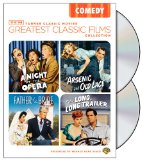
TCM Greatest Classic Films Collection: Comedy
The TCM collections being released in waves by Warner Brothers are very good bargains. Each release is a four-film collection culled from a particular genre within the Warner backlist. The transfers are sourced from the most recent DVD for each film, which are uniformly excellent. Included on each disc are the same extras found on the most recent release as well - the only way you lose out is if the title in question has a two-disc special edition; in those cases, the contents of the second disc are absent. But generally speaking, for about $20, you get four grade-A movies, with the best transfers available, and often with some decent extras.
This set, TCM Greatest Classic Films Collection: Comedy, includes four classics from the Golden Age of Hollywood, all of them previous released in very good editions.
Disc 1, Side A: Arsenic and Old Lace
Perhaps unique among films directed by Frank Capra, Arsenic and Old Lace has an edge about it. Credit that to the original play by Joseph Kesselring and the lightening-fast screenplay by the wonderful Epstein brothers. Capra's direction is fluid and confident, but the bizarre story, characters, and dialogue are what make the film memorable.
Mortimer Brewster (Cary Grant) is a theater critic and confirmed bachelor who has been "turned" by the lovely Elaine; at the film's start, they elope and are planning their honeymoon. Their simple desires are derailed when Mortimer discovers that his beloved aunts Abby and Martha have been poisoning old bachelors to ease their lonely suffering. They cheerfully admit the murders, throwing Mortimer's life into chaos. The arrival of Mortimer's criminally insane brother Jonathan (Raymond Massey) and his associate Dr. Einstein (Peter Lorre) complicates matters for Mortimer and Elaine as they attempt to maintain some kind of control over the family's macabre antics.
Arsenic and Old Lace plays like a screwball take on The Addams Family, which debuted in The New Yorker a year before the play was written. The actors talk very fast at times, and Grant's mugging, which at first seems overwrought quickly gives way to a very careful sense of timing. Lane goes well beyond the call of duty here, making Elaine an appealing heroine when she could have easily stayed a damsel in distress. The film is moodily shot by the great Sol Polito, and the design of the Brewster sisters' house (the primary set) is appropriately off-kilter. Massey and Lorre make a great pair of villains, although one wishes that Boris Karloff, who played Jonathan on Broadway, had been cast here as well.
Although the film's final lines are a ridiculous anti-Darwinian "explanation" of Mortimer's relative sanity and a transparent attempt to settle down humorless audiences, Arsenic and Old Lace maintains a feeling of freshness and comic invention after 70 years.
Disc 1, Side B: A Night at the Opera
One of the most beloved of the Marx Brothers' films, and known today primarily for its famous stateroom scene, A Night at the Opera has a clunky, talky first act that drags a bit. The convoluted, nonsensical plot revolves around Driftwood's (Groucho) attempt to woo the wealthy Mrs. Claypool (Margaret Dumont), offering her entrée into high society by getting her to underwrite the career of a rising opera star, Riccardo (Allan Jones). Fiorello (Chico) is Riccardo's manager, and Tomasso (Harpo) his friend. Together, they conspire to help Riccardo land the lead in a touring company's production of Il Trovatore.
The plot, of course, is secondary to the horseplay of the brothers, and A Night at the Opera contains several memorable set pieces. The sluggish first act picks up with the famous conversation about contracts between Groucho and Chico ("The party of the first part..." etc.) When the whole group is aboard the steamer to New York, we have the crowded stateroom scene, as well as show-stopping musical performances by Chico and Harpo. The climactic sabotage of the opening night of Il Trovatore still retains an unpredictable chaotic hilarity after 75 years.
The best thing about the Marx Brothers is the quickness and the musicality that comes across not just when they play instruments, but when they trade quips and establish a patter in a particular scene. This is evident in A Night at the Opera, even though their strengths have been watered down here in their first MGM outing with the addition of a silly romantic subplot and the overlong Marx-less musical sequences. A Night at the Opera is Marx-lite, as it dumbs down their strengths for consumption by a mass audience. No wonder the movie was such a huge hit. A Night at the Opera is deservedly a classic, but the Marx Brothers seem to have had a harder time being themselves here. Stick with the Paramount pictures if you're looking for the original, unadulterated Marx Brothers.
Disc 2, Side A: The Long, Long Trailer
This glowing, fussily-designed Vincente Minnelli cream puff would have made appropriate viewing for anyone over the last decade or so on the verge of being lured into a subprime mortgage. It is a paean to, and a satire of, all-American consumer acquisitiveness, as well as a comic warning of the dangers inherent in taking on debt. This film is surpassed only by Jingle All the Way in its total dedication to buying as a central theme. Lucille Ball and Desi Arnaz are the perfect representation of all that was wrong with the 1950s and of the crass form of commercial enterprise of which they themselves were a part.
Lucy and Desi (here re-named Tacy and Nicky) are about to be married. Tacy has her heart set on buying a trailer home, so that the couple can be mobile - and stay together - while Nicky's job as a civil engineer bounces him around the country. After much whining - though not as migraine-inducing as that on I Love Lucy - Tacy gets her wish. The couple purchases a trailer - at three times the budgeted cost; they buy a new car to go with it, along with several additional accoutrements. Costs add up, and the couple is quickly in massive debt. With that, they take off across the country, and the misadventures begin.
There is little that feels unique about The Long, Long Trailer. The film was produced a couple of years into I Love Lucy's run, and the comedy in it feels watered down compared to the show. I am no fan of anything that Lucille Ball ever did, but the high energy and screwball antics of her television program certainly account for much of its success. Here, the comic set-ups are slow and lazily edited. They feel stagy and awkward, and there are zero laughs. In addition, the issue of debt, which is at the heart of the movie's exposition, is forgotten by its end. The bright '50s color palette and production design makes for a visually interesting if generally predictable experience.
Disc 2, Side B: Father of the Bride
Also frothily directed by Vincente Minnelli (four years earlier, in 1950), Father of the Bride is highly representative of certain middlebrow attitudes of the 1950s. Here we have dad Stan Banks (Spencer Tracy) worrying himself sick about daughter Kay's (Elizabeth Taylor) impending nuptials with Buckley (Don Taylor) while mom Ellie (Joan Bennett) excitedly goes about making plans for the big ceremony.
All manner of clichés are on display here. Tracy's typically careful performance notwithstanding, he's playing the part of a TV dad here - worried but trying not to show it, making a big fuss over Buckley's "credentials" and whether he'll be able to provide for his daughter, etc. These are the making of many generations'-worth of nonsensical tropes about fathers and daughters, and their presence here reminds us how old they are and how misdirected. Stan isn't really worried about Buckley, he's anxious about "losing" his daughter. The scenes in which Stan frets about Buckley are particularly absurd, because they take the place of more realistic concerns that could have cropped up in such a situation: What if Buckley was black? What if he was poor? What if he was a writer - or God forbid, a musician? Actually, there is nothing "wrong" with Buckley - he's from a family that is basically a mirror image of the Bankses. Did people in the 1950s get all worked up about nice pleasant well-groomed young men coming after their daughters? Or did they just pretend to in order to avoid dealing with the more substantive social problems in their midst? This film, if nothing else, provides a pretty empty-headed opportunity for audiences to do so.
But...it is not without its charm. The performances out-act what the script provides. Tracy is almost always appealing, and the monologues he directs to the audience are especially successful. Taylor was never lovelier and Bennett holds her own as a mother who wants her daughter to have the lavish ceremony she couldn't afford herself. The pace is quick. Minnelli demonstrates more confident comedy chops here than he would four years later in The Long, Long Trailer. The 1991 Steve Martin remake focuses more on slapsticky hijinks than the original, which, for all its phony paternal fretting, is still a more heartfelt experience.
The DVD
The Package
As with other releases in the series, two double-sided discs are housed in a regular single-width keepcase, with a disposable and ill-fitting card slipcover.
The Video
The transfers are all full-screen and black-and-white, except The Long, Long Trailer, which is in color. The three black-and-white pictures look fine. A Night at the Opera shows a little print damage, and there are jumps where some frames are missing, but overall it looks fine (it's also the oldest film of the bunch). Arsenic and Old Lace and Father of the Bride could use a bit of clean-up work at this point, but they, too, look pretty good for their age. The Long, Long Trailer is a little worse for wear. The color process was called Ansco, and it hasn't survived particularly well. Although the bright pastels of the production design still come through, the transfer shows wavering tones in many scenes.
The Audio
Each film comes with its original mono soundtrack. In all cases, these are adequate, clear, and in good shape. A few hiccups and pops are heard during A Night at the Opera, but both dialogue and music are more or less intact.
The Extras
The bonus content from each feature's prior release is intact here:
Arsenic and Old Lace: Stage to Screen, a text feature on the translation of the story from stage play to film.
A Night at the Opera: Commentary track by Leonard Maltin; Remarks on Marx (33:57) a look at the film through the eyes of contemporary comics, writers, and filmmakers; Groucho Marx on the Hy Gardner Show (5:22) discussing Thalberg and the transition from Paramount to MGM; two shorts: Robert Benchley's very funny How to Sleep (10:39) and Sunday Night at the Trocadero (20:17), which recreates a happening evening at the legendary Los Angeles nightclub circa 1937; and the feature's Theatrical Trailer (2:17), which includes some unique material.
The Long, Long Trailer: Two shorts: Ain't it Aggravatin'? (8:18) with Dave O'Brien's Pete Smith character, and a Droopy cartoon called Dixieland Droopy (7:43).
Father of the Bride: Two short newsreels, both silent - Wedding Bells for Movie Star Elizabeth Taylor (1:24) documents her first marriage (to Conrad "Nicky" Hilton in 1950), and President Truman Meets "Father of the Bride" (1:12) shows the cast of the feature meeting a seemingly bemused Truman; a Behind the Scenes text feature; and the Theatrical Trailer (2:13).
Final Thoughts
With the possible exception of The Long, Long Trailer, which I found tedious and unfunny, there are a few nights' decent entertainment in this four-film set. Three of the four films are classics, and there are decent extras to boot. Recommended.
|



| Popular Reviews |
| Sponsored Links |
|
|
| Sponsored Links |
|
|
| Release List | Reviews | Shop | Newsletter | Forum | DVD Giveaways | Blu-Ray | Advertise |
|
Copyright 2024 DVDTalk.com All Rights Reserved. Legal Info, Privacy Policy, Terms of Use,
Manage Preferences,
Your Privacy Choices 
| |||||||