
| Reviews & Columns |
|
Reviews DVD TV on DVD Blu-ray 4K UHD International DVDs In Theaters Reviews by Studio Video Games Features Collector Series DVDs Easter Egg Database Interviews DVD Talk Radio Feature Articles Columns Anime Talk DVD Savant Horror DVDs The M.O.D. Squad Art House HD Talk Silent DVD
|
 DVD Talk Forum |
|
|
| Resources |
|
DVD Price Search Customer Service #'s RCE Info Links |
|
Columns
  


 
|
|
|
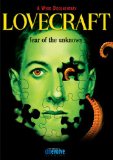
Lovecraft: Fear of the Unknown
H.P. Lovecraft, one of the creators of horror literature as we know it, was a tall, skinny, long-faced racist/xenophobic recluse - a man who was demonstrably afraid of the world, and transmogrified that fear into stories of the uncanny that define "weird fiction." He lived in Providence, RI, for most of his life, often in long periods of solitude and seclusion. His stories pit protagonists of learning and science - often Providence-area natives - against unspeakably horrific creatures of godlike power and omnipotence. These creatures - who appear in a loosely connected group of stories known as "The Cthulhu Mythos" - observe humanity with utter dispassion, and Lovecraft's characters are powerless before them. In these stories, Lovecraft envisions a world where the ultimate terror goes hand-in-hand with the ultimate knowledge - the human confrontation with previously unknown powers that totally compromise and moot our Earth-bound concepts of human advancement and values. Is anything more frightening than the idea that individual human lives are insignificant and meaningless? It could be argued that this fear was the engine behind all human activity - and yet all human industry was threatened by the forces Lovecraft imagined. The consecration of this deeply existential neurosis in his short stories comprises a key contribution to literature - a body of work that maintains lasting philosophical immediacy.
Lovecraft: Fear of the Unknown is an appropriately-titled look at this very influential author's life and work. It is also - as far as I can tell - the first feature-length film to look at Lovecraft in detail. Director Frank H. Woodward has up to this point largely been involved in documentary featurettes on DVDs of other films. Woodward does a good job of balancing biographical material with analysis of Lovecraft's style, vision, and key stories. He has also assembled a crack panel of talking heads to delve into these topics. Neil Gaiman, Guillermo del Toro, John Carpenter, Lovecraft scholar S.T. Joshi, writer Ramsey Campbell, director Stuart Gordon, Peter Straub, and Caitlin Kiernan are among the illustrious names who go beyond praise and offer true insight into Lovecraft's work. Del Toro in particular has some very perceptive things to say; Gaiman's input is more critical of Lovecraft, but still very thoughtful and interesting. All of these contributors reflect a deep knowledge and engagement with Lovecraft's work that goes well beyond a standard appreciation.
Visuals are provided by a combination of present-day footage of Providence locations, historical photographs, and artists' renditions of scenes from Lovecraft stories. Although Lovecraft died in 1937, no film footage of the author is included here. Perhaps there is none available, which would be a sadness; it would be particularly interesting to hear him reading his own work, but there is nothing like that here (although an actor reads some of Lovecraft's words in voice-over). As far as the contributions of artists who have visualized scenes from Lovecraft's stories, I don't find them of great value - in fact, I believe they do a disservice to the power of Lovecraft's language. Since Lovecraft specializes in "fear of the unknown," as the documentary's title affirms, illustrating his stories moots their effect. Lovecraft's voice is mannered and recognizable - his distinctive tone is what grips readers. Lovecraft's narrators are often faced with the indescribable - Lovecraft uses words to get at difficult-to-summarize, deeply rooted metaphysical ideas. The stories are not about what the monsters look like - they are about the effects these monsters have on the minds of his human protagonists. They are almost a MacGuffin that provides a point of entry for the dissection of the deepest kind of fear and revulsion. Rendering those monsters in full-color illustration neuters the power that Lovecraft invests them with on the page.
This is a relatively minor criticism, though, of a film that provides a solid overview of this fascinating man - an author whose influence remains very strong among writers across many genres (in fact, although he's not mentioned or interviewed here, I see a great reflection of Lovecraft in the work of Chuck Palahniuk). Given his extreme eccentricity - he lived a life almost totally sealed off from regular society - and his unpleasant, noxious views on race and immigration, Lovecraft would likely have made a very discomfiting dinner guest. But his work's indelibility, with its descriptive power and parallels to that of Nietzsche and Sartre, embodies humanity's most deep-seated fears and anxieties.
The DVD
The Video and Audio
The DVD screener I received was a review copy, coming in a small black envelope. Therefore, I cannot be certain as to whether the technical presentation represents the final product. The enhanced video presentation and solid stereo soundtrack are fine. The transfer does show a bit of digital noise/artifacts, although detail is generally good. The sound mix is simple and clear.
The Extras
The main extra feature is a selection of Extended Interviews (75:00) that run almost the length of the 90-minute feature. There are some great additional insights here, all provided by the feature's interviewees. It's good stuff, with some redundancy, but worth watching.
Final Thoughts
Lovecraft's work has fascinated me for years - and as a former resident of his hometown, it was certainly interesting to learn more about the man whose self-authored and enigmatic epitaph is "I AM PROVIDENCE." Frank H. Woodward has crafted an informative and insightful introduction to this strange, strange man. Recommended.
|



| Popular Reviews |
| Sponsored Links |
|
|
| Sponsored Links |
|
|
| Release List | Reviews | Shop | Newsletter | Forum | DVD Giveaways | Blu-Ray | Advertise |
|
Copyright 2024 DVDTalk.com All Rights Reserved. Legal Info, Privacy Policy, Terms of Use,
Manage Preferences,
Your Privacy Choices 
| |||||||