
| Reviews & Columns |
|
Reviews DVD TV on DVD Blu-ray 4K UHD International DVDs In Theaters Reviews by Studio Video Games Features Collector Series DVDs Easter Egg Database Interviews DVD Talk Radio Feature Articles Columns Anime Talk DVD Savant Horror DVDs The M.O.D. Squad Art House HD Talk Silent DVD
|
 DVD Talk Forum |
|
|
| Resources |
|
DVD Price Search Customer Service #'s RCE Info Links |
|
Columns
  



 
|
|
|
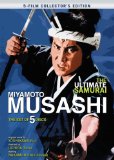
Ultimate Samurai Miyamoto Musashi
AnimEigo // Unrated // May 4, 2010
List Price: $99.98 [Buy now and save at Amazon]
The Movie Series:
Miyamoto Musashi, the famous Japanese sword fighter, has been immortalized in many books and movies. In the

Miyamoto Musashi I: Takezo (Makamura Kin'nosuke) has convinced his best friend Matahachi (Kimura Isao) to leave their small village and find glory, honor, and prestige as soldiers. As the movie opens the Battle of Sekigahara has recently ended, and the two villagers were on the loosing side and Matahachi was wounded they manage to convince a young lady, Akemi, and her mother (who they encountered while they were grubbing the bodies of the dead soldiers for anything they could sell) to hide them in their barn.
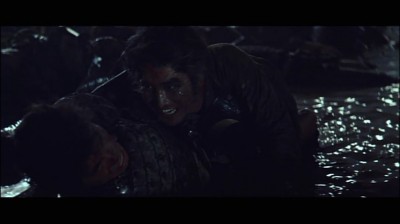
The older woman nurses Matahachi back to health and they eventually decide to run off together with her daughter leaving Takezo behind. With few options, Takezo heads back to his old village, mainly so he can see his older sister but also to inform Matahachi's mother, Obaba, and his fiancé,
Since he was on the losing side of the war, Takezo is a wanted man and after running a road block the army traces him back to his village. There he's betrayed by Matahachi's mother, Obaba, who blames the young man for the fact that her son has run off, and Takezo barely escapes into the nearby mountains. Living like an animal, the strong and fierce man starts killing off the soldiers that are looking for him as well as villagers who aid in the search. There seems to be no hope of catching the murderous thug until a cagey monk comes up with a plan.

Miyamoto Musashi II: Duel at Hannya Hill: Takezo spends the three years that take place between the first and second movies in the tower of a castle reading and studying. He's managed to tame his wild side and has emerged as a samurai. He receives a job offer (presumably very well paid) from the lord of the area, but he declines. Instead he wants to travel the land and learn more about combat and fighting. He has decided that he will follow the way of the sword, no matter what the cost. The lord encourages Takezo to change his name and Miyamoto Musashi is born. (Mushashi is spelled with the same characters as Takezo, but the pronunciation is more refined and less 'low brow.')
Musashi proves to be a tough opponent. Traveling to a famous school, the Yoshioka Dojo, he wounds several of the students studying there. He really wants to duel the school's master, but he's away and when he does arrive the senior students convince the master not to fight. After all, the man is a lowly ruffian and even fighting with such a person would bring shame on their school. Instead they plan a surprise attack, which the sly Musashi evades.
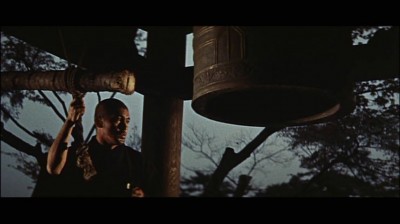
He next arrives at the Hozo'in Temple where the monks in residence practice a well respected martial art and fight with long spears. In an exhibition with Monk there Musashi kills his opponent with one blow from a wooden sword and leaves. This angers the other Monks and they make plans to ambush the wandering samurai.
Miyamoto Musashi III: Birth of the Nito-ryu Style: Starting out immediately after the previous movie ended, Musashi is a little conflicted about his last battle, but swears to continue on the way of the sword. He sets off on his next mission, to have an instructional duel with Yagyu Sekishuusai, a famous swordsman who teaches at a remote mountain dojo. Sekishuusai is getting old and is no longer interested in fighting. His time is taken up with flower arranging and practicing the tea ceremony, and he refuses to even meet with someone wanting to duel. Musashi isn't one to give up so easily, so he plans to storm the dojo and fight anyone who will accept his challenge until the master is forced to show himself. His plans get sidetracked however just as they begin.
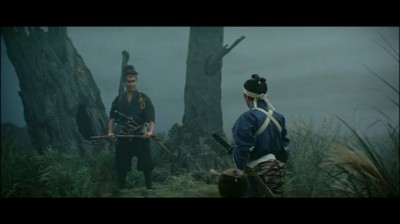
His business with the Yoshioka Dojo hasn't finished either. He has sent the school a letter challenging their master to a duel. The leader of the dojo is the oldest son of the former master, and he realizes that he's not as skillful as he needs to be to stand against Mushashi, but with his school's honor at stake he's left with little choice.
Another travelling samurai, Kojiro, who was first introduced in the previous film, also starts appearing where Musashi goes. He seems to be studying the powerful man and it's clear that he's sizing up the competition.
Miyamoto Musashi IV: Duel at
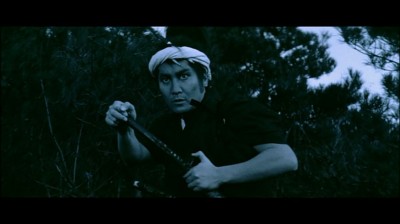
Miyamoto Musashi V: Duel at
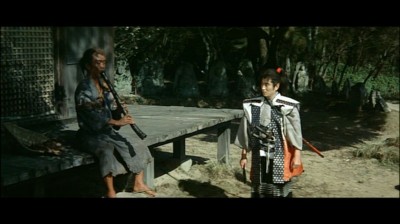
There's actually a lot more going on in this series than the overview suggests. There are several subplots that are expertly woven through the series. These include Musashi's feelings for
The films also resist turning Musashi into a superhero (thought they come close a couple of times.) He's a great warrior, but they show him worrying about the outcome of upcoming battles and feeling regret for some of his victims. This is especially true one man who he wounds seriously, though non-fatally, who was significantly below his ability. His inner conflict is shown when he announces in a soliloquy that he shouldn't have battled such a weak opponent, but at the end exclaiming proudly that he won!
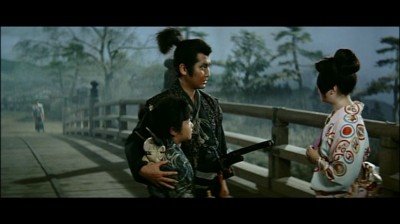
There are several other times when Musashi questions what he's done and if he's on the right path, and it all builds up to the surprising conclusion he reaches at the end of the last film. The samurai also is forced to make some hard choices and sacrifices much over the course of the movies. He has to not only eschew comfort, stability, and security, but also love and to a large extent friends too.
In the hands of a lesser director this film series could have turned into a melodrama, mindless action flicks, or turned out slow and ponderous. Uchida Tomu, who is described in the commentary as being criminally neglected in the west, a view I whole-heartedly agree with after seeing his work, does a magnificent job. Not only is the pacing and tone consistent through the series, but it's an absolutely beautiful film to watch. Some of the exterior scenes are breath taking but even when they move to a sound stage the compositions are wonderful. The way Tomu pays attention to framing and using the scenery as almost another character in these films reminds me of some of the best work of John Ford, which is a high compliment.

The DVD:
These five films arrive on five DVDs each in its own slimpack case which in turn are housed in a nice slipcase.
Audio:
The films come with the original Japanese mono soundtrack and optional English subtitles. The audio is clean and clear and though the dynamic range is limited to the technology of the time (these were made in the mid 60's) the background music and other effects sound fine. As they've done with their anime product for years, Animeigo gives these films wonderful subtitles. First off they outline the words in black so that if the background color matches that of the subtitle, even in just one small area, it's still easy to read them. They also color code the titles so if three people are talking it's easy to tell just who is saying what. It's a very effective way of presenting subtitles and I'm surprised that it isn't the norm by now. It really adds a lot to the presentation.
Video:
I was very impressed with the 2.35:1 anamorphic image. The colors were significantly brighter than I was expecting and the level of detail was excellent. There is some natural film grain present, which Animeigo wisely decided to leave in rather than try to artificially remove it, but digital defects are very uncommon. There are a few print flaws, a couple of spots here and there, but they're never distracting and much less prevalent than I was expecting.
Extras:
Each film comes with a series of translation notes, a theatrical trailer, and an image gallery. In addition DVDTalk reviewer Stuart Galbraith IV provides an excellent commentary to the first film. It's no secret that my favorite commentary tracks are those that are recorded by knowledgeable film historians, and Stuart's is right up there with the best of them. Filled with information that ranges from trivial but interesting (where Toei's logo, waves washing up onto some giant rocks, was filmed) to fairly important (the historical background to the film, history on the actors, and just why this version of the story is less well known in the west than Hiroshi Inagaki's films based on the same story). He even has a chance to throw in an interview and some other surprises. It's an engaging commentary and well worth listening to, and my only regret is that it only accompanies the first film.
Final Thoughts:
This is an excellent, excellent series of films. Though I haven't seen Hiroshi Inagaki's three movie Samurai series (which is based on the same novel) in years, I have to admit that I like this version much better, something I never thought would happen before I screened these films. Expertly directed and wonderfully acted the series is a treasure. Add to that a very nice transfer and a great commentary (not to mention the wonderful subtitles) and you've got a must-buy set. DVDTalk Collector's Series.
|



| Popular Reviews |
| Sponsored Links |
|
|
| Sponsored Links |
|
|
| Release List | Reviews | Shop | Newsletter | Forum | DVD Giveaways | Blu-Ray | Advertise |
|
Copyright 2024 DVDTalk.com All Rights Reserved. Legal Info, Privacy Policy, Terms of Use,
Manage Preferences,
Your Privacy Choices 
| |||||||