
| Reviews & Columns |
|
Reviews DVD TV on DVD Blu-ray 4K UHD International DVDs In Theaters Reviews by Studio Video Games Features Collector Series DVDs Easter Egg Database Interviews DVD Talk Radio Feature Articles Columns Anime Talk DVD Savant Horror DVDs The M.O.D. Squad Art House HD Talk Silent DVD
|
 DVD Talk Forum |
|
|
| Resources |
|
DVD Price Search Customer Service #'s RCE Info Links |
|
Columns
  


 
|
|
|
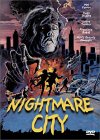
Nightmare City
Starz / Anchor Bay // R // August 6, 2002
List Price: $19.98 [Buy now and save at Amazon]
Italian director Umberto Lenzi is probably best known in horror circles for Cannibal Ferox and Eaten Alive, a pair of documentary-style strolls into the jungle whose plots are more or less summarized by their titles. Nightmare City, more familiar on these shores under the title City of the Walking Dead, is the third of Lenzi's sixty-seven directorial efforts to be released on DVD in the United States. As Nightmare City kicks off, an unidentified cargo plane is surrounded by police and military folks. They're not entirely sure what's lurking inside, but if they knew it would the hundred bloodstarved, radioactive survivors of a largely unexplained nuclear accident, the authorities presumably would have come better prepared. Newshound Dean Miller (Hugo Stiglitz) is among the few to escape the bloodbath. While the military ponders what the appropriate action should be, Miller sets out to rescue his wife from the hospital where she works and spirit her off to some idyllic land where people aren't eaten. Of course, they run into countless vampiric, contaminated creatures along the way, and we're introduced to a number of insignificant B-plot characters who are obviously all going to die because they're insignificant B-plot characters.
The mayhem comes at the hands (and knives and chains and axes) of creatures that aren't zombies, but I'll refer to them as zombies anyway since "contaminated HU-man" is too unwieldy. In an interview on the disc, director Umberto Lenzi is careful to point out that he didn't want his zombies to be a carbon-copy of George Romero's, placing him as one of just a handful of Italian horror directors to make such an astonishingly bold decision. The plodding gutmunchers in Dawn of the Dead had only the most rudimentary of motor skills, though the limber ghouls in Nightmare City are rather accomplished pilots and drivers, not to mention bright enough to sever phone lines and manually lower a crowded elevator. These faux-zombies are also snazzier dressers, generally wearing sport coats without the sorts of stains and wear one would expect from ceaseless hours of carnage. One unavoidable point of comparison with Romero's zombie films is that the bloodsucking creatures can still only be dispatched with a blow to the brain. Lenzi states in an interview on the disc that he wanted the degeneration of the zombies' appearance to progress as the movie goes on, mirroring the downfall of society or something. Social commentary is always welcome in horror, except Lenzi forgot that the third zombie or so out of the plane in the very first scene in which they appear is as crusty and deformed as they come. So much for that.
It's admittedly been a few years since I last gave Dawn a gander, but I don't seem to recall Romero's zombies having a breast fetish. I doubt that any locale where women unilaterally do not wear bras can accurately be labeled a "nightmare city", but almost without exception, each and every female victim has at least one boob popping out throughout the course of an attack. One unlucky lass even gets Ms. Righty lopped off. That's one of only two moderately graphic attacks in Nightmare City, the other involving a houseguest, one of her eyes, and something bearing an uncanny resemblance to a railroad spike. By and large, the attacks are just some uninteresting pattern of stab, stab, choke, stab, stab... Even less thrilling than the kills is the general structure of the movie, where the numerous attack sequences are separated with lengthy stretches of nothing in particular. Nightmare City is unable to inspire any dread, tension, or really even any interest. Romero was able to heighten suspense by taking advantage of familiar, claustrophobic settings. Nightmare City takes place over a large and unspecified location, failing to establish any sense of time or distance. I have no idea how many days are supposed to have passed or how far the plague has spread. The zombies' surviving victims become afflicted as well, but despite the sheer number of attacks, we're not treated to many scenes where anyone except Anna and Dean manages to escape unscathed. Actually, I believe it's stated that a victim has to sustain some injury to become contaminated as well, so perhaps I should've said "escape scathed".
The sequences with the military serve no purpose whatsoever. We're forced to endure a pair of virtually identical monologues about how "we're going to have to declare martial law ourselves!", but they're never shown doing much of anything except sitting in cramped quarters and complaining. The only clues we're given that the military has been up to anything at all would be the numerous camoflague-clad corpses strewn about the background in most every scene. Major Holmes demands that his lady love stay inside their palatial home and not let anyone in under any circumstances. Of course, her character wouldn't have been introduced if she were that bright. After a trot outside to see a lawnmower moving on its own accord, Sheila discovers a bloody knife has been jabbed into a clay bust of her husband. At this point, she isn't fully aware of the contaminated menace, but I can't really envision a scenario in which a fake head with a blood-smeared knife running through it would not inspire at least some moderate panic. Sheila doesn't bother to call her husband to let her known of her impending peril, preferring to just toy around her home for some lengthy, poorly defined period of time. Thankfully, the zombies in her house are considerate enough to wait to kill her. It's not as if they're ravenous creatures reliant on the blood of their victims for sustenance or anything. Sheila isn't entirely worthless, though, providing a few blessed moments of lingering nudity in an aborted love scene. Also screaming for deletion are the lengthy portions in the TV studio where an indescribably bad dancing show is being taped. Even a rhythmless white boy such as myself can tell that the lackluster music contributed by Stelvio Ciprirani (Piranha 2: The Spawning) isn't likely to inspire anyone to "get down", nor is the small army of unattractive men and women (one of whom bears an uncanny resemblance to former Journey frontman Steve Perry; one of the men, I mean) certain to garner much in the way of ratings magic.
I disliked the ending of Nightmare City, but bitching about it might result in a somewhat unwelcome jaunt down Spoiler Lane. Those who want to go in fresh should skip the remainder of this paragraph entirely. First, I should probably mention that the climax of Nightmare City is surprisingly effective. Abandoned amusement parks, which aren't just the territory of Scooby-Doo episodes, are an appropriately creepy locale, and the well-timed rescue gone awry is responsible for the single best moment in the movie. It's at this point that we're treated to 'the twist'. In the interview provided on this DVD release, Lenzi gushes about Nightmare City's cyclical nature and how well it went over with critics. Thankfully, I'm not a critic, but a lowly horror fan with a keyboard, so I suppose I'm under no obligation to agree. Without giving away any more than I have to, Dean finds himself in a position where he knows exactly how events are going to unfold. There's no glimmer of recognition on his face as all of this happens -- nothing more than the familiar nonchalant expression from just under an hour and a half earlier. As the inevitable occurs, Dean doesn't seem the least bit worried, nor does he even appear to be thinking, "Golly, isn't this a coincidence?" As a result, Lenzi's potentially great ending is more Demonwarp than Demons. Professor Peabody says that the moral of the story is "stop while you're ahead".
Nightmare City is perched on one of the lower rungs on the Italian zombie ladder. Though certainly not an essential purchase for budding Eurohorror enthusiasts, Nightmare City has its schlocky charms and has managed to amass a not-entirely-insubstantial fanbase over the past couple of decades. Anchor Bay has done a respectable job with its release on DVD, providing a newly recorded interview with Umberto Lenzi and a rather nice anamorphic widescreen presentation.
Video: Nightmare City is presented in its theatrical aspect ratio of 2.35:1 and is enhanced for widescreen televisions. Though there's nothing about the visuals themselves that inspire any sort of enthusiasm, Anchor Bay has done an amazing job with this relatively obscure twenty-two year old film. No wear or even appreciable speckling is at all visible. Detail remains relatively strong throughout, making it apparent that this wasn't some half-hearted Smooth-O-Rama™ job where crispness and clarity are cast aside to produce an artificially smoother, cleaner looking image. Some exceedingly light grain is apparent at times, though hardly to any level that would seem intrusive or at all out of place. Colors appear to be reproduced accurately, sporting the generally drab color design and wholly unrealistic blood frequently found in similar movies filmed around the same general time. The source material must have been in phenomenal shape, or Anchor Bay invested a considerable amount of time and money into making Nightmare City look as great as possible. Either way, the end result is very pleasing.
Audio: The English Dolby Digital mono audio doesn't inspire quite as much giddiness on my part. It's just standard monaural fare for a film of its age and tiny budget. Judging by the fact that dialogue virtually never matches with lip movements, it seems blatantly obvious enough that Nightmare City was shot wild, and all of the film's audio was recorded after the fact and on the cheap. Under those conditions, there's somewhat of a ceiling as to how great a track like this can sound. The audio is a little meek, requiring a signficant bump in volume to compensate. As expected, there are no crystalline highs or deep, resounding bass. I didn't spot any low-level noise lurking in the background or even a faint flicker of distortion. The mono soundtrack is nothing stunning or spectacular, but it's serviceable.
Supplements: A quick glance at reviews for the Japan Shock PAL DVD release of Nightmare City turns up mentions of numerous extras, including an audio commentary, a nearly hour long interview, quite a few pieces of music from the film's soundtrack, a still gallery, a filmography, liner notes, and a theatrical trailer. This DVD release from Anchor Bay doesn't have quite as impressive an assortment of supplemental material, though what's present is still quite a bit more than what most any other company would have provided. I have to admit that the reportedly hysterical commentary track with Lenzi will be missed. The differences between the two releases were discussed on the Mobius Home Video Forum, and one user provided a couple of quotes from Lenzi. "Look at this scene...suspense...suspense. Is similar to Hitchcock, isn't it?" "The coming of the contaminated men is terrific...terrific!"
First up is a twelve-minute interview with Umberto Lenzi, produced by Bill Lustig's Blue Underground. The director is candid about some of the problems with the movie, particularly stiff Superstar Mèxicano Hugo Stiglitz and an underwhemling shooting script. At the same time, Lenzi is prone to overinflating the value of the movie, likening it to Tom Hanks' Philadelphia (?) and frequently pointing out how grounded in reality Nightmare City is. So...yeah. The interview is in anamorphic widescreen and includes English subtitles.
A 16x9-enhanced trailer runs just under four minutes, and a Lenzi bio rounds out the extras.
Conclusion: Nightmare City doesn't stand out as one of the more memorable Italian efforts detailing the zany exploits of the ravenous undead, especially considering that the creatures featured here are still alive. Though the movie itself is nothing exceptional, Anchor Bay has done a typically commendable job with its release on DVD. Italian horror completists may find this disc tough to pass up at $13.20 shipped from Deep Discount DVD, but more casual fans may want to stick with a late-night rental.
The mayhem comes at the hands (and knives and chains and axes) of creatures that aren't zombies, but I'll refer to them as zombies anyway since "contaminated HU-man" is too unwieldy. In an interview on the disc, director Umberto Lenzi is careful to point out that he didn't want his zombies to be a carbon-copy of George Romero's, placing him as one of just a handful of Italian horror directors to make such an astonishingly bold decision. The plodding gutmunchers in Dawn of the Dead had only the most rudimentary of motor skills, though the limber ghouls in Nightmare City are rather accomplished pilots and drivers, not to mention bright enough to sever phone lines and manually lower a crowded elevator. These faux-zombies are also snazzier dressers, generally wearing sport coats without the sorts of stains and wear one would expect from ceaseless hours of carnage. One unavoidable point of comparison with Romero's zombie films is that the bloodsucking creatures can still only be dispatched with a blow to the brain. Lenzi states in an interview on the disc that he wanted the degeneration of the zombies' appearance to progress as the movie goes on, mirroring the downfall of society or something. Social commentary is always welcome in horror, except Lenzi forgot that the third zombie or so out of the plane in the very first scene in which they appear is as crusty and deformed as they come. So much for that.
It's admittedly been a few years since I last gave Dawn a gander, but I don't seem to recall Romero's zombies having a breast fetish. I doubt that any locale where women unilaterally do not wear bras can accurately be labeled a "nightmare city", but almost without exception, each and every female victim has at least one boob popping out throughout the course of an attack. One unlucky lass even gets Ms. Righty lopped off. That's one of only two moderately graphic attacks in Nightmare City, the other involving a houseguest, one of her eyes, and something bearing an uncanny resemblance to a railroad spike. By and large, the attacks are just some uninteresting pattern of stab, stab, choke, stab, stab... Even less thrilling than the kills is the general structure of the movie, where the numerous attack sequences are separated with lengthy stretches of nothing in particular. Nightmare City is unable to inspire any dread, tension, or really even any interest. Romero was able to heighten suspense by taking advantage of familiar, claustrophobic settings. Nightmare City takes place over a large and unspecified location, failing to establish any sense of time or distance. I have no idea how many days are supposed to have passed or how far the plague has spread. The zombies' surviving victims become afflicted as well, but despite the sheer number of attacks, we're not treated to many scenes where anyone except Anna and Dean manages to escape unscathed. Actually, I believe it's stated that a victim has to sustain some injury to become contaminated as well, so perhaps I should've said "escape scathed".
The sequences with the military serve no purpose whatsoever. We're forced to endure a pair of virtually identical monologues about how "we're going to have to declare martial law ourselves!", but they're never shown doing much of anything except sitting in cramped quarters and complaining. The only clues we're given that the military has been up to anything at all would be the numerous camoflague-clad corpses strewn about the background in most every scene. Major Holmes demands that his lady love stay inside their palatial home and not let anyone in under any circumstances. Of course, her character wouldn't have been introduced if she were that bright. After a trot outside to see a lawnmower moving on its own accord, Sheila discovers a bloody knife has been jabbed into a clay bust of her husband. At this point, she isn't fully aware of the contaminated menace, but I can't really envision a scenario in which a fake head with a blood-smeared knife running through it would not inspire at least some moderate panic. Sheila doesn't bother to call her husband to let her known of her impending peril, preferring to just toy around her home for some lengthy, poorly defined period of time. Thankfully, the zombies in her house are considerate enough to wait to kill her. It's not as if they're ravenous creatures reliant on the blood of their victims for sustenance or anything. Sheila isn't entirely worthless, though, providing a few blessed moments of lingering nudity in an aborted love scene. Also screaming for deletion are the lengthy portions in the TV studio where an indescribably bad dancing show is being taped. Even a rhythmless white boy such as myself can tell that the lackluster music contributed by Stelvio Ciprirani (Piranha 2: The Spawning) isn't likely to inspire anyone to "get down", nor is the small army of unattractive men and women (one of whom bears an uncanny resemblance to former Journey frontman Steve Perry; one of the men, I mean) certain to garner much in the way of ratings magic.
I disliked the ending of Nightmare City, but bitching about it might result in a somewhat unwelcome jaunt down Spoiler Lane. Those who want to go in fresh should skip the remainder of this paragraph entirely. First, I should probably mention that the climax of Nightmare City is surprisingly effective. Abandoned amusement parks, which aren't just the territory of Scooby-Doo episodes, are an appropriately creepy locale, and the well-timed rescue gone awry is responsible for the single best moment in the movie. It's at this point that we're treated to 'the twist'. In the interview provided on this DVD release, Lenzi gushes about Nightmare City's cyclical nature and how well it went over with critics. Thankfully, I'm not a critic, but a lowly horror fan with a keyboard, so I suppose I'm under no obligation to agree. Without giving away any more than I have to, Dean finds himself in a position where he knows exactly how events are going to unfold. There's no glimmer of recognition on his face as all of this happens -- nothing more than the familiar nonchalant expression from just under an hour and a half earlier. As the inevitable occurs, Dean doesn't seem the least bit worried, nor does he even appear to be thinking, "Golly, isn't this a coincidence?" As a result, Lenzi's potentially great ending is more Demonwarp than Demons. Professor Peabody says that the moral of the story is "stop while you're ahead".
Nightmare City is perched on one of the lower rungs on the Italian zombie ladder. Though certainly not an essential purchase for budding Eurohorror enthusiasts, Nightmare City has its schlocky charms and has managed to amass a not-entirely-insubstantial fanbase over the past couple of decades. Anchor Bay has done a respectable job with its release on DVD, providing a newly recorded interview with Umberto Lenzi and a rather nice anamorphic widescreen presentation.
Video: Nightmare City is presented in its theatrical aspect ratio of 2.35:1 and is enhanced for widescreen televisions. Though there's nothing about the visuals themselves that inspire any sort of enthusiasm, Anchor Bay has done an amazing job with this relatively obscure twenty-two year old film. No wear or even appreciable speckling is at all visible. Detail remains relatively strong throughout, making it apparent that this wasn't some half-hearted Smooth-O-Rama™ job where crispness and clarity are cast aside to produce an artificially smoother, cleaner looking image. Some exceedingly light grain is apparent at times, though hardly to any level that would seem intrusive or at all out of place. Colors appear to be reproduced accurately, sporting the generally drab color design and wholly unrealistic blood frequently found in similar movies filmed around the same general time. The source material must have been in phenomenal shape, or Anchor Bay invested a considerable amount of time and money into making Nightmare City look as great as possible. Either way, the end result is very pleasing.
Audio: The English Dolby Digital mono audio doesn't inspire quite as much giddiness on my part. It's just standard monaural fare for a film of its age and tiny budget. Judging by the fact that dialogue virtually never matches with lip movements, it seems blatantly obvious enough that Nightmare City was shot wild, and all of the film's audio was recorded after the fact and on the cheap. Under those conditions, there's somewhat of a ceiling as to how great a track like this can sound. The audio is a little meek, requiring a signficant bump in volume to compensate. As expected, there are no crystalline highs or deep, resounding bass. I didn't spot any low-level noise lurking in the background or even a faint flicker of distortion. The mono soundtrack is nothing stunning or spectacular, but it's serviceable.
Supplements: A quick glance at reviews for the Japan Shock PAL DVD release of Nightmare City turns up mentions of numerous extras, including an audio commentary, a nearly hour long interview, quite a few pieces of music from the film's soundtrack, a still gallery, a filmography, liner notes, and a theatrical trailer. This DVD release from Anchor Bay doesn't have quite as impressive an assortment of supplemental material, though what's present is still quite a bit more than what most any other company would have provided. I have to admit that the reportedly hysterical commentary track with Lenzi will be missed. The differences between the two releases were discussed on the Mobius Home Video Forum, and one user provided a couple of quotes from Lenzi. "Look at this scene...suspense...suspense. Is similar to Hitchcock, isn't it?" "The coming of the contaminated men is terrific...terrific!"
First up is a twelve-minute interview with Umberto Lenzi, produced by Bill Lustig's Blue Underground. The director is candid about some of the problems with the movie, particularly stiff Superstar Mèxicano Hugo Stiglitz and an underwhemling shooting script. At the same time, Lenzi is prone to overinflating the value of the movie, likening it to Tom Hanks' Philadelphia (?) and frequently pointing out how grounded in reality Nightmare City is. So...yeah. The interview is in anamorphic widescreen and includes English subtitles.
A 16x9-enhanced trailer runs just under four minutes, and a Lenzi bio rounds out the extras.
Conclusion: Nightmare City doesn't stand out as one of the more memorable Italian efforts detailing the zany exploits of the ravenous undead, especially considering that the creatures featured here are still alive. Though the movie itself is nothing exceptional, Anchor Bay has done a typically commendable job with its release on DVD. Italian horror completists may find this disc tough to pass up at $13.20 shipped from Deep Discount DVD, but more casual fans may want to stick with a late-night rental.
|



| Popular Reviews |
| Sponsored Links |
|
|
| Sponsored Links |
|
|
| Release List | Reviews | Shop | Newsletter | Forum | DVD Giveaways | Blu-Ray | Advertise |
|
Copyright 2024 DVDTalk.com All Rights Reserved. Legal Info, Privacy Policy, Terms of Use,
Manage Preferences,
Your Privacy Choices 
| |||||||