
| Reviews & Columns |
|
Reviews DVD TV on DVD Blu-ray 4K UHD International DVDs In Theaters Reviews by Studio Video Games Features Collector Series DVDs Easter Egg Database Interviews DVD Talk Radio Feature Articles Columns Anime Talk DVD Savant Horror DVDs The M.O.D. Squad Art House HD Talk Silent DVD
|
 DVD Talk Forum |
|
|
| Resources |
|
DVD Price Search Customer Service #'s RCE Info Links |
|
Columns
  


 
|
|
|
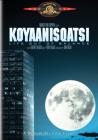
Koyaanisqatsi
Starting with the Santa Fe - based Institute for Regional Education, ex-monk Godfrey Reggio embarked on a cinematic journey to put his New Age pantheistic humanism on film. Koyaaniskatsi and Powaqqatsi are plotless documentaries driven by intense Philip Glass music scores; both dazzle in slightly different ways. Starting as a film-festival hit, the first of the trilogy wowed the light-show freaks with its kaleidoscopic timelapse photograpy, blending boiling cloudscapes and speeding city traffic into hypnotic patterns. Powaqqatsi was more organic but slowed itself to a meditative crawl, and won fewer worshippers. Coming soon is Naqqoykatsi, a third part of the trilogy that, by the looks of the trailer included on these discs, is even more chaotic and disturbing.
These are two separate DVD releases.
Koyaaniskatsi
One of the most desired titles on DVD, Koyaaniskatsi has been out of print on a fuzzy, flat VHS for almost twelve years. The light-'em-if-you-got'em film fans who smoked up screenings of 2001 and Fantasia went nuts over this wordless, seamless 87 minutes of boiling clouds, blurred freeway traffic and hallucinogenic views of Las Vegas, open pit mines, a Hostess Twinkie assembly line, and every scenic wonder in the great West. A lot of the film is done with time-lapse photography, which speeds up action by taking only a frame or so a second, instead of 24 each second. In my editorial circles, we therefore call it TimeLapseskatsi.
The emphasis here is on technology - things, machines, vehicles, rockets, and a lot of the footage is from stock libraries, particularly Louis Schwartzberg's Energy Productions, who had an ad in Daily Variety each week for twenty years. Atom bombs explode and rockets surge skyward, and we hold on the stock shots longer than usual, making them seem all the more strange.
Hypnotic repetition patterns are built into the music, and much of what we see is cyclical or repetitive as well - the hot dogs coming out of a meat processing machine, traffic surging in cyclic fits in New York. When we see human faces, it's a relief, although many of them are just pedestrians in motion, dwarfed and dominated by the activity around them. The poetry of Alphaville with its talk of the city as a huge breathing ant hive, has become reality. And like Alphaville, the nightime cities with their traffic represented by unbroken rivers of streaked, streaking headlights seem to exist in some other temporal dimension.
The absence of voiceover or other overt messages causes us to concentrate on the visual patterns and become, perhaps, absorbed by them. Encouraged by the sussuring Glass rhythms, it's easy to imagine Koyaaniskatsi as one long, unbroken meditation on the modern world. Godfrey Reggio is basically a modern guru. His Institute for Regional Education commercials and short subjects were overtly subversive, but all messages are sublimated here.
MGM's DVD of Koyaaniskatsi is an immaculate transfer where even the sometimes grainy stock footage is curried and combed to perfection. The disc's best feature is the Greg Carson-produced interview-docu with Reggio and Glass. The composer comes off as a earnest collaborator who marvels at the creative freedom they had to rescore and recut sections of the film until both were satisfied. Reggio's interview is self-described as a 'rave' and resembles nothing less than a slightly subdued version of Dennis Hopper's character in Apocalypse Now. You get the feeling that Reggio lets loose with twenty-minute monologues like this at the drop of a hat. With almost perfect diction, excellent speaking skills and nary an 'umm' or 'ahh', he rattles off about 1000 observations, descriptions and comparisons relating to his film in record time, never breaking his stance of enlightened enthusiasm. He starts with the use of a Hopi word for the title and goes from there. The docu should be seen after the feature, so as not to dull the impact of some of the visuals, but it will really be an asset to Koyaaniskatsi fans seeking more insight into this remarkable artist.
PowaqqatsiIf Koyaaniskatsi is TimeLapseskatsi, then Powaqqatsi should be called SlowMo-skatsi. Less popular (but preferred by Savant) mainly because of its non-distribution by an uncomprehending Cannon Films, Powaqqatsi consists almost completely of new photography of indigenous people going about their real lives. Shot for shot, it has more remarkable and original footage than its predecessor. The visual poetry has a tendency to become precious - one silhouette of a wise man with a staff is rather annoying - or to show the politics of its makers, but this followup film has a strong emotional impact to add to the first installment's intellectual headiness.
Powaqqatsi celebrates humans over technology and has a warmth that the first film lacks. There are dozens of beautiful faces in this show - kids, men, women, and wizened oldsters of every race and origin. We see them at work, happily at first. There is a section in the first third where every cut, from a circle of women threshing wheat to the spinning skirts of an Andean dancer, is so beautiful one cannot help but exclaim out loud. Man is shown to be able to live practically anywhere: crammed into stilt houses around any body of water, on remote islands, in the middle of deserts and on the tops of mountains. An Indian mud village, with its painted stucco walls, is orange and immaculate-looking; the ritual costumes of Africans, Indians, and Andeans become a collage of color and diversity and pride.
The imagery is then subverted by the ugliness of modern reality, with its endless ore-cars, regimented native troops, grim and grimy sweatshops, and roads shared by vehicular traffic and barefoot, rickety-legged men with impossible loads on their backs. There are images here that burn into the memory: a kid who couldn't be more than seven beating the ox that pulls his huge cart, while his father tries to rest beside him. Tons of rocks and garbage pour into a bay, possibly being dumped as landfill. A hundred toothpicks sticking out of an abstract grid are revealed to be a sideways shot of laundry hung from highrise windows, as a jet passes at an impossible angle. A kid in Hong Kong marvels at the beauty of dozens of superimposed neon signs. A brief shot of soot-covered men carrying heavy loads up soot-covered stairs in a hellish, smoking work yard is a more potent image of brute labor than anything in Metropolis. Television is reduced to a constantly morphing display of commercial goods, rapturous faces, and violent weapons, becoming the Hopi Powaqq - an evil, seducing sorcerer that sucks the lifeforce of other entities to further its own life.
Unlike the abstract Koyaaniskatsi, opposing content is used to form new meanings and messages with a decided political intent. The author's contrast of victims and oppressors becomes all too clear and rather strident here, with blasts of music accompanying huge closeups of 'oppressed' men staring down the camera with accusing, bitter eyes. One little black boy holds up two fists defiantly, but trembles - with fear?. A bejeweled woman in a sari holds her child and gazes seemingly right into our souls.
A very spiritual man, Reggio concludes Powaqqatsi with an extended lento passage, returning to natural images, especially water, to end on an endorsement of faith as the true center of human value. The face of a toothless shaman, smiling in rapture, mixes with the almost perfect reflections in an Indian river. It's a return to calm and peace that becomes a visual meditation on the fate of mankind. Whether the show's theme is an oversimplification is debatable ... other minds would argue that the idyllic lifestyles of primitive peoples were long ago spoiled by ovepopulation, disease, war and slavery, and without benefit of modern technology. And there's plenty of arguments for man's spiritual diversity being warped into fundamentalist oppression. Powaqqatsi is a poem, not a coherent political treatise.
Powaqqatsi is perhaps the highpoint of Philip Glass' musical output. The score isn't dominated by hypnotic synthesizer noodlings and weird dissonant Invaders from Mars-like choral effects. There's instead a whole range of music stylings, much of it suggested by rhythms and instruments from the Third World, and often rising to a pitch that drives the images on screen instead of simply accompanying them.
Powaqqatsi looks even better than its predecessor because so much of it is pristine original camera footage shot by high speed cameras. MGM's generous compression brings it all out in breathtaking detail and sparkling color. Sometimes we wish there were optional subtitles saying where individual shots were filmed, as scenes jump from continent to continent with abandon. It's like 50 volumes of National Geographic images, arranged as that company would never arrange them. Godfrey Reggio is again fascinating in his 'raving', and it's best to just listen and let his ideas flow over you than to try and decipher each phrase as you hear it - You don't talk to Godfrey, man, you listen to him. He doesn't stress the relationship, but this is clearly the work of a spiritual man of faith: he says his dozen or so years in a monastery ended decades ago, but that's still the man he is.
Both discs have a new trailer for Naqqoykatsi, a phantasmagoria of altered images that would probably be dubbed Digi-skatsi by my old editorial crew. This one means 'War as a style of life', and promises to be more controversial (and welcome) even than Powaqqatsi. The trailers for the first two films are on both discs as well.
1 On a scale of Excellent, Good, Fair, and Poor, Koyaanisqatsi rates:
Movie: Excellent
Video: Excellent
Sound: Excellent
Supplements: Interview docu, trailers
Packaging: Keep case
Reviewed: September 14, 2002
On a scale of Excellent, Good, Fair, and Poor, Powaqqatsi rates:
Movie: Excellent
Video: Excellent
Sound: Excellent
Supplements: Interview docu, trailers
Packaging: Keep case
Reviewed: September 14, 2002
Footnotes:
1. While at Cannon, Savant cut the trailer for Powaqqatsi, a plum assignment that got me out of the Penitentiary 3 quality ghetto when Godfrey Reggio insisted that the cutter of an earlier promo for the film (then called North/South: Powaqqatsi) be given the trailer. That put me ahead of 3 or four senior cutters who wanted the project. Reggio visited for twenty minutes to criticize my first cut, which for him was 'too pretty', too musical, and too 'Film Board of Canada.' After a solid fifteen minutes of the thickest graduate-film student lingo I'd ever heard (Reggio lives and breathes that stuff) I got the message - make the trailer less rythmical and less closely tailored to the music track (which was one heck of a difficult music cutting job). The Powaqqatsi trailer was shown almost nowhere, but graced the front of the old VHS release. I hustled an article on my trailer in Adweek (how do you sell a movie with no stars, no plot, no commercial hook?), a self-promotional coup that sprung me from the sinking ship that was Cannon, and into my first real trailer boutique job, cutting a 70mm advance distributors' promo for The Abyss ... ahh, one doesn't remember the long stretches of unemployment, just the good times. MGM had no copy of the trailer, so I loaned them my stereophonic copy on video for the DVD.
Return
| |
|



| Popular Reviews |
| Sponsored Links |
|
|
| Sponsored Links |
|
|
| Release List | Reviews | Shop | Newsletter | Forum | DVD Giveaways | Blu-Ray | Advertise |
|
Copyright 2024 DVDTalk.com All Rights Reserved. Legal Info, Privacy Policy, Terms of Use,
Manage Preferences,
Your Privacy Choices 
| |||||||