
| Reviews & Columns |
|
Reviews DVD TV on DVD Blu-ray 4K UHD International DVDs In Theaters Reviews by Studio Video Games Features Collector Series DVDs Easter Egg Database Interviews DVD Talk Radio Feature Articles Columns Anime Talk DVD Savant Horror DVDs The M.O.D. Squad Art House HD Talk Silent DVD
|
 DVD Talk Forum |
|
|
| Resources |
|
DVD Price Search Customer Service #'s RCE Info Links |
|
Columns


|
|
|
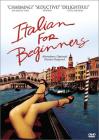
Italian for Beginners
Italian for Beginners is a delightful (yes, I've been using that word a lot lately) romantic soap opera. Provided the viewer is not allergic to its Dogme 95 style, it is the perfect date movie. Its content is much the same "when-will-the-nice-people-pair-off?" journey as any other show, but here the fresh faces and charming observations about life and love are especially contagious.
First, what makes Italian for Beginners so delightful, when what passes for romance in most modern American movies leaves Savant cold? It's commercialism. Movie stars are pretty, but the magic of investing one's heart in worrying about whether Nicolas Cage or Leonardo DiCaprio or (name two hot female stars) are going to get together just doesn't happen for me. First, the overpackaging of romantic teams is disgusting, with supermart tabloids and television news primed to promote whatever fantasies can be sold: Were there really sparks between the stars? Is the famous actor-husband jealous? American movie stars have too much money riding on their images to risk subordinating themselves to real roles in any but the highest-profile pictures. Actors in independent films may hit the mark, but again, when anybody really succeeds there, they move up to star status, or start pretending they've ascended. It may be snobbery against the Hollywood game, but I'm not inclined to invest my movie fantasies in the mainstream money machine.
This is probably unfair to American product, because it's possible that all the actors in Italian for Beginners are well-known to Danish audiences. But the overall effect can't be the same. I'll make the wild guess that none of these Danes command the kind of salaries seen in Hollywood, and none has left an IMDB trail longer than a few years. We react to them as if they were the people at the next table in a coffee shop. 1
Second, much has been made of the Dogme 95 trappings. A clever attention-getting idea started by some Danish filmmakers, Dogme 95 is a little set of rules that gives a film distinction for eschewing glitz and technical polish, and concentrating instead on stories and performances scaled down to human dimensions. The general idea is a kind of techno-asceticism that believes that movies have become debased by what are normally called production values: opticals, special effects, music scores. Some productions follow the rules more than others, but Italian for Beginners comes pretty close to full compliance. In Italian for Beginners, I only noticed an un-sourced piano clinking out an opera aria over the first shot in Venice. The film plays rather cutely, even with its end credits (there are no titles) written on scraps of paper, which are tossed one after another in front of the camera. There's even a little hand-drawn Dolby logo!
The fact is that if the performances in Italian for Beginners were filmed in Imax or 70mm, the emotional effect would be the same, only the film would be prettier. I agree with the music idea for this particular film, as a score telling me how to react to scenes, instead of making me work to read the character's reactions, is Savant's main gripe with overproduced movies. The asceticism does get the movie down to the human level. We saw this one in the theater (another date picture that Savant went to grudgingly, and then fell in love with) and the audience ate it up.
The style is not cinema verité, and even though most of the filming is hand-held, the camera doesn't jerk around spasmodically. There are real angles and points of view, and the show is indeed directed by someone with an eye to drama. Savant responded well to all the characters, who seemed true to themselves almost all of the time. Hal-Finn is relentlessly boorish and Jorgen Mortensen a bit tiresomely unprepossessing, but they both work because we all know people just like them. The story is somewhat idealized, as the characters actually have rather finite barriers to overcome to find happiness. What matters is that we recognize their problems as intelligent, real, and universal - most of us share two or three of them. It's a fantasy of course, that all the characters are reasonably attractive and their destinies therefore a tad more hopeful than most. But hey, it's surely more pleasant than being asked to be concerned about a serial killer or some elfish twenty-somethings with killer wardrobes.
Savant's getting pretty used to seeing pleated Rembrandt-style round collars in Danish movies, as pastors seem to be in all I've seen this side of Lars von Trier: Babette's Feast, Ordet. The Danes are so religiously soulful in these movies that it's nice to hear the hairdresser in this film stumble over the right way to talk to the new pastor in town. Italian for Beginners really isn't about an Italian class, but a philosopy of thoughtful living. And even with the film's occasional contrivances, it's hard not to be won over. It's not 'cute', like Amelie, but it certainly works less to achieve its romantic result.
Readers already smitten by this show might consider giving an unrelated book a read. It's so close in basic tone, when I read it I thought this movie had to have been inspired by it. It's called Evening Class, by Maeve Binchy, and it covers much the same ground, with some similar characters. Their problems have a little more grit, but much the same payoff. Italy remains the romantic Neverland for northerners, in this case, the Irish. The book stresses what Italian for Beginners doesn't quite communicate, that adult language classes are fantastic places to meet nice people, and if you're so inclined, to transform yourself into a human being again. In a language class, there are no strangers, and everyone is reduced to the same level of communication. When the class clicks, everybody blooms. It's like a place where everyone around you knows the real you. You can be open and friendly to anybody you wish, and the unattached people stand out very quickly. For many years I've recommended language classes to all my friends who grouse about having no way to meet potential girlfriends ... and although nobody's taken me up on it, I'm convinced it's the answer. Ah, wisdom.
The picture is rated "R", just for a few swear words and the beginnings of a 'get it on' scene.
Miramax's DVD of Italian for Beginners is very plainwrap, and lacks a trailer or any explanation of the film or Dogme 95 that might help out with newbies. In theaters, the film played in a pale-colored flat 1:55 print. In actuality, it was shot on the BetaSP format. Those who saw it on a screen, transferred to film with a film-look conversion, may be taken aback at first, or think they've gotten the wrong disc. On DVD the show is the original video, which looks better but of course has a whole different feel to it. The first few scenes are jumpy and a bit cramped-looking, but very quickly the television soap feel dies out and the basic drama takes over.
Writing package copy for a movie as special as this would be no easy task, but the pap on the package-back doesn't begin to convey anything about the film: "... an education that will change everything they know about love!" Phffft.
Is this the right time to again say bad things about Miramax? Italian for Beginners is listed as running 118 or 112 minutes originally, depending on what European country it was shown in. Miramax has again decided to 'help' us by trimming 19 minutes from the film! Now, push come to shove, if it were my money invested in the picture, I'd see the logic if I were convinced that cutting would increase the chances of the picture being a success here in the States. But not reverting to the original full-length show for video release is plain stupid. I can add Italian for Beginners to the list of Miramax movies (Like Water for Chocolate, Amelie) that I need to see in versions before the Weinsteins' grubby hands got a hold of them. Maybe Dogme '02 should include a codicil - no moronic distributor tampering.
On a scale of Excellent, Good, Fair, and Poor, Italian for Beginners rates:
Movie: Excellent
Video: Very good
Sound: Excellent
Supplements: Zilchorama, unless you like 'other romantic suggestions from Miramax'
Packaging: Keep case
Reviewed: October 11, 2002
Footnote:
1. ... although Bent Mejding, the old pastor, had the role of the dauntless blonde hero of the Danish Reptilicus forty years earlier. What a world!
Return
| |
|



| Popular Reviews |
| Sponsored Links |
|
|
| Sponsored Links |
|
|
| Release List | Reviews | Shop | Newsletter | Forum | DVD Giveaways | Blu-Ray | Advertise |
|
Copyright 2024 DVDTalk.com All Rights Reserved. Legal Info, Privacy Policy, Terms of Use,
Manage Preferences,
Your Privacy Choices 
| |||||||