
| Reviews & Columns |
|
Reviews DVD TV on DVD Blu-ray 4K UHD International DVDs In Theaters Reviews by Studio Video Games Features Collector Series DVDs Easter Egg Database Interviews DVD Talk Radio Feature Articles Columns Anime Talk DVD Savant Horror DVDs The M.O.D. Squad Art House HD Talk Silent DVD
|
 DVD Talk Forum |
|
|
| Resources |
|
DVD Price Search Customer Service #'s RCE Info Links |
|
Columns


 
|
|
|
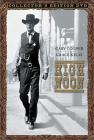
High Noon - Collector's Edition
High Noon is a very budget-conscious show. Most Hollywood westerns of the time with stars as big as Gary Cooper, were also being filmed in color, and this picture takes place on a B-Western backlot with almost no special production at all. It's one of producer Stanley Kramer's earliest message pictures, his attempt (along with Carl Foreman, from whom he wrested co-producer credit) to make a grand statement about law'n order, the same way he 'came right out' with so-called bold statements on the Race issue (Home of the Brave) and disabled veterans (The Men). The movie has powerful performances, especially from Cooper and the marvellous Katy Jurado, and very crisp direction by Fred Zinnemann.
We studied the film a lot at UCLA in the early 70s, using the school's large Stanley Kramer collection. The film theorists in Professor Stephen Mamber's class were impressed by the use of clocks, and the experiment to make the film play in real time. In one screening we clocked the clocks, so to speak, and they did indeed stay within a couple of minutes of where our clock did. So many of them were built into dialogue scenes, they had to be part of the original structure during shooting, and not an 'editorial save' imposed later in post-production, an oft-repeated apocryphal claim. We compared the time structure to Robert Wise's earlier The Set-Up, but I forget what our conclusions were.
The feminists in the critical studies program also lauded the formulation of the Katy Jurado role. Helen Ramirez is the alternative to the Waspish Grace Kelly, the 'dark woman' or 'Mexican girlfriend' who usually dies to protect a hero who would never stoop to marrying her. Ramirez is the most independent and sensical character in the show, taking no guff from punk Lloyd Bridges (an excellent jerk) and even telling off La Princess in no uncertain terms. I think that smart people realize that Amy Fowler may be the socially correct choice for a bride, but the smart, worldly-wise Helen Ramirez has a real capacity to love. Marriage with Ramirez could be a great adventure, but the stiff Kane is too busy complicating his internal dilemmas.
Finally, it's obvious that High Noon is excellently edited, especially its use of the recurring Tex Ritter song to underscore Will Kane's isolation, and the dynamite metronome montage that kicks in as high noon approaches. Crisp cutting minimizes what is really a pretty unexciting set of confrontations, as Kane and Miller's men square off in Hadleyville, before the stock, 'Drop yer gun or she's dead' conclusion. A lot of the sucess of this comes from the script, which makes early use of the same 'deadline' device that predominates many new action films. We're told that something dreadful is going to happen in X minutes - the Titanic will go down, the bomb will go off. Time becomes an automatic suspense machine as the seconds tick away. And Carl Foreman even provides the clocks. Stylistically, High Noon is a triumph of talent over a second-rate production.
So what's the objection? in a nutshell, High Noon is a stacked deck of clichés that aren't particularly useful as a meditation on law 'n order, the American character, how to behave in society - or even as a yardstick to Western Movie Wisdom. The messages it delivers are inconsistent and contradictory, and ladled on with the subtlety of a shovel.
Marshall Kane's town is a rotten place filled with rotten people. The judge skedaddles, literally taking his American flag and the scales of justice with him (symbol! symbol!). Frank Miller's return obviously means death and tyranny, but so many of Hadleyville's able-bodied men are so firmly on Miller's side, you'd think Marshall Kane had framed the outlaw. (now that would be a revelation...) There's no decency whatsoever in the place save for Kane, that isn't crippled like Lon Chaney, Jr., or powerless like the more meek among the citizens. Harry Morgan is a craven coward, Kane's Deputy is concerned only for his hurt feelings, and the whole congregation is a worst-case scenario of Bad Civics in Action. For a supposedly Left-Wing tract, the film tries really hard to prove that Democracy doesn't work (ever been to a neighborhood meeting?) because people are basically selfish scum. Best friend Jonas (Thomas Mitchell), who we expect to come to Kane's defense, instead uses the lack of consensus to squelch any momentum to support Kane, the same way he hustled Kane out of town after the wedding.
One can understand why the saloon crowd might favor Miller, but for these stupid Church-going citizens not to immediately realize that backing Kane is their only sane choice, is to stack the deck pretty high. It's essentially a ploy to let us know that only Will Kane has any morals or ethics, that only He actually cares enough about What's Right to stand up for it. Of course, things are manipulated so that Kane never gets to make his case. He gives feeble four-word speeches, like "I need help", and meekly accepts little crucifixions along the way. How Mr. Law & Order stood up to drunks and dangerous thugs is a big question, when he's too straight-laced to use the tiny bit of influence or intimidation it would take to secure the help of his own deputy he so desperately needs. The Christ parallel is repeated again and again - when people don't rally to his aid, he remains silent, a queer combination of pride and humility. Carl Foreman even turns Helen Ramirez into a martyr-enabler. When one of her silent partners asks if she wants Kane given aid (it's understood that he has the power get some paid talent behind him) she says a simple 'no'. How can Kane undergo his test of character and will-power, if he gets help from any quarter?
Now, there's no reason why Kramer and Foreman can't stack the deck any way they wish, but in this case, what's the point? The end result boils down to nothing more than a murky, 'A man's gotta do what a man's gotta do', basically celebrating stubborn individualist purity - the kind which only exists in very, very simpleminded Westerns. The basic 'read' of High Noon is that Hadleyville is an America which won't stand up to defend its best and proudest - with the Liberal interpretation that Kane represents the beleaguered Foreman, one man alone against the scourge of the Blacklist. It doesn't add up to much, as the threat of Miller comes from outside the community, and Foreman's HUAC tormentors are part of the government itself. Unless you think that Frank Miller represents McCarthy, which isn't very apt.
It isn't in Foreman's character, but High Noon fits better as a Right Wing Conservative fantasy about America fighting Communism in foreign wars. Good ol' Kane (General MacArthur and company) put down EVIL five years ago (roughly the end of WW2), but now EVIL is back and it's personal. But nobody gives a damn, or worse, they're on the side of the Commies. Kane has to go it alone. Poor General MacArthur, stabbed in the back by his own government. This fits in well with the pacifist argument in High Noon, too. Amy Fowler is a very peculiar Quaker, from a strict sect that surely sees the need for stronger Law'N Order profile than the average citizen. They object to fighting in wars, not defending their homes against criminals or local lawlessness. First thing they'd do is close the saloon. When she blasts Robert J. Wilke in the back, the movie crudely suggests that Christian pacifism is an illusion. Anybody who doesn't pick up a gun is a wuss, and Amy wins the right to keep her man the American Way, by killing for it.
The end of High Noon is the biggest puzzle, that plays as emotionally correct, but doesn't satisfy either read of the movie. Kane tosses his star in the dust to show contempt for the town that hypocritically comes out to congratulate him after the fight ("I was with you all the time, Butch!"). Perhaps John Wayne and Howard Hawks were correct when they interpreted this as Kramer and Foreman saying, 'Screw America.' Hadleyville wasn't just a bunch of jerks, there were good women (Virginia Christine, whose uncle would later become a Pod in Invasion of the Body Snatchers) and loyal kids like the one who so badly wanted to help. Kane's turning his back on all of them. Now he and his snooty wife can go open a store 'somewhere else', where they couldn't have hidden from Miller. Are people in this next town going to be any different? Or will they be more scum unworthy of the ethically superior Mr. and Mrs. Kane? The 'message' of High Noon is either very confused, or very simpleminded and useless. People always finish the film saying how deeply they feel its message, and then they can't come up with an answer for what it means to them.
As a drama without symbolic significance, High Noon is just fine. I like to read nuances into the Kane-Ramirez relationship, and criticize Amy's tissue-thin commitment to the husband she expects to turn from hawk to dove overnight. The Dimitri Tiomkin music is always a kick, as is the plain-wrap Tex Ritter song that opens the plain-wrap film so perfectly. It's also fun to see eternal bad guys Lee Van Cleef and Robert J. Wilke in this early team-up, to of course be gunned down as they were again and again through the following decade.
Mad Magazine recognized High Noon as the key Western of the decade. When it lampooned 'adult Westerns', it showed a picture of a traumatized Will Kane shooting a hole through his pocket watch, as if he had a neurotic aversion to clocks as a symbol of the existential tyranny of Time. The earliest Mad spoof, Hah! Noon!, had Kane solve his little problem with 'Killer Diller Miller' by calmly realizing that the situation was too big for the local police - in the last panel Miller was met at the train by a thousand National Guard Troops with guns and tanks. The spoof had one of my favorite Western gag lines, ribbing the obvious doubles for Bridges and Cooper in the big barn fight: "Now my stuntman's going to give your stuntman the beating of his life!"
High Noon also has to be the most quoted and re-shot Western ever. Besides the whole Gunsmoke TV series basically being a spinoff, every smart-aleck director has restaged bits of it in a critical mode. Peckinpah in The Wild Bunch riffed on the kids who mirror the bloodthirsty truth of their parents in their play ("Bang! You're dead, Kane!"). Sam Fuller did a wild and wooly number on the 'Drop yer gun or she's dead' conclusion I mentioned above. In his Forty Guns, Barry Sullivan just blasts down hostage Barbara Stanwyck so he can get a clean shot at sniveling bad guy John Ericson, and then walks cooly past her body, professionally aloof from his handiwork. Sergio Leone turned the first ten minutes of Once Upon a Time In the West into an extended parody of High Noon's three gunmen hanging out at the train station, intimidating the telegraph clerk to pass the time.
Artisan's Collectors Edition DVD of High Noon is an okay transfer of a good original element. Yes, the exteriors were meant to be stark-looking, but the contrast is higher than it should be in the opening reel. Elsewhere the bit rate and compression are okay, but not exceptional. The soundtrack is very punchy and active; there's a restored mono track and an enhanced track. The film is accompanied by a commentary with Maria Cooper-Janis, Jonathan Foreman, and Tim Zinnemann.
Leonard Maltin hosts a making-of docu with old Zinnemann and Kramer interviews, and a new one from Lloyd Bridges. Maltin stays safe with his generalized statements, the director is charming, and Kramer defensive. Bridges just spins a few on-the-set stories. A second docu is amateurish by comparison. It's partly produced and hosted by Maria Cooper-Janis, Gary's daughter. She reads some terribly written 'host' copy that doesn't begin to tie together a lot of bland observations by High Noon offspring who really don't have much connection to the subject - the sons of Zinnemann, Foreman and Kelly. It's also terribly edited. Perhaps part ownership of High Noon reverted to the Cooper estate? There's really no reason for this thing to be here as a docu, although star-loving nostalgia fans might like it just the same. For all the media hype about special edition DVDs 'flying off the sales racks', the average level of content on them is pretty low.
Another nice extra is a radio broadcast with Tex Ritter. He discusses his career in general, and his experience recording High Noon's Oscar-winning song.
The cardboard sleeve cover for High Noon is a real curiosity - it's exactly the same as the keep case cover inside. Why it is needed at all is a mystery, except perhaps to tell the foolish buyer, "Oooh! This must be special!"
On a scale of Excellent, Good, Fair, and Poor, High Noon rates:
Movie: Very Good
Video: Good
Sound: Excellent
Supplements: commentary, two docus, Tex Ritter interview
Packaging: Keep case in card sleeve
Reviewed: , 2002
| |
|



| Popular Reviews |
| Sponsored Links |
|
|
| Sponsored Links |
|
|
| Release List | Reviews | Shop | Newsletter | Forum | DVD Giveaways | Blu-Ray | Advertise |
|
Copyright 2024 DVDTalk.com All Rights Reserved. Legal Info, Privacy Policy, Terms of Use,
Manage Preferences,
Your Privacy Choices 
| |||||||