
| Reviews & Columns |
|
Reviews DVD TV on DVD Blu-ray 4K UHD International DVDs In Theaters Reviews by Studio Video Games Features Collector Series DVDs Easter Egg Database Interviews DVD Talk Radio Feature Articles Columns Anime Talk DVD Savant Horror DVDs The M.O.D. Squad Art House HD Talk Silent DVD
|
 DVD Talk Forum |
|
|
| Resources |
|
DVD Price Search Customer Service #'s RCE Info Links |
|
Columns


|
|
|
Star Trek the Next Generation - Season 6
It's Next Generation's refusal to rest on its laurels that allowed it to become, in my opinion, a far more dramatically successful show than the original Star Trek that inspired it. Star Trek: The Original Series had innovative, beyond-its-times ideas, such as the character of Uhura: a black woman as a part of the bridge crew was radical in the 1960s. However, its best work came at the beginning of the series, and in the latter half of its three-year run, the original Star Trek began to fall apart story-wise. (An episode like "Spock's Brain" speaks volumes in that regard.) In contrast, Next Generation began on a slightly shaky note (even the most dedicated fan must concede that "weak" is a charitable way to describe the first season) but swiftly gained its bearings and began to fly, and then to soar. Next Generation in fact hit a high point in Season Four and managed to remain at its peak for the remaining three seasons.
This is all a roundabout way of saying that Season Six is every bit as good as the excellent Season Five. Without starting any major new story arcs (with the exception of introducing the Cardassians), Season Six explores the story possibilities opened up by earlier seasons, and breaks new ground in narrative terms with some very well-done individual episodes.
Season Six gets off to an uneven start by having several of the season's weaker episodes at the beginning: it opens with the conclusion of Season Five's cliffhanger, "Time's Arrow." As I noted in the review of Season Five, "Time's Arrow" is probably the weakest of all the season-ending episodes... which means, given the level of the other season-enders, that it's still a very entertaining episode, even if it's not as mind-blowing as "The Best of Both Worlds" or "Redemption." The first few stand-alone episodes that we get after the opening episode include "Realm of Fear" and "Man of the People," which aren't bad but are still not up to the same standard as the rest of the show. Fortunately, the stories soon heat up.
Taking advantage of the greater depth of story possible in a longer episode, Season Six offers not just one, but two two-part episodes mid-season: "Chain of Command" and "Birthright." "Birthright" is the latter of the two, and highlights the interesting backstories of both Worf (Michael Dorn) and Data (Brent Spiner). The real gem is the intense "Chain of Command," which mixes Picard (Patrick Stewart) up with the Cardassians, a race who would move into the Star Trek spotlight in Deep Space Nine.
Many of the best episodes of Season Six, such as the outstanding "Tapestry," feature Picard as a significant player, as the writers for Next Generation had realized what a resource they had in the acting skills of Patrick Stewart. Season Six balances this by making excellent use of the entire ensemble over the course of the season, providing all the actors with at least one truly outstanding episode in which their character is the star. "Frame of Mind" offers a mind-bending story (literally) with Riker (Jonathan Frakes) in the spotlight. "Timescape" plays with time effects, and like all of Next Generation's time-related episodes, it's great fun. "Face of the Enemy" tangles Troi (Marina Sirtis) up with one of Next Generation's most interesting enemies, the treacherous Romulans. "Second Chances" also features Riker and finally picks up on a few of the often-hinted-at threads of the history between him and Troi.
Speaking of picking up on threads from earlier seasons, the episodes "A Fistful of Datas" and "Ship in a Bottle" show us that Next Generation's writers haven't forgotten about the possibilities of the holodeck as shown in earlier seasons. "Ship in a Bottle" is particularly well-crafted, as it draws on certain "hanging" elements from earlier holodeck episodes... most notably, the Sherlock Holmes simulations.
Season Six closes with the cliff-hanger first part of "Descent," which proves to be a stronger season-ending episode than the previous year's "Time's Arrow." The Borg are back... and if we thought the Federation knew all it needed to know about them, we're wrong. I'm itching to give more detail on why "Descent" will have you on the edge of your seat waiting for Season Seven and the resolution of the cliff-hanger, but I don't want to spoil anything; you'll have to wait and watch "Descent" for yourselves.
So what makes Season Six work so well? Top-notch storytelling, as usual. The show continues to look good in terms of visual effects, but Next Generation was never about eye candy. The special effects and the ships are there in service of the interesting stories that Next Generation tells, stories that draw on the deep affection for the characters that we've developed over the past five seasons, that explore interesting ideas, that present situations "out there" in space that are sometimes very much like what we struggle with in our present society, and sometimes very different.
Video
Next Generation Season Six is presented in its original television aspect ratio of 1.33:1, and has been lovingly presented by Paramount in an excellent DVD transfer. The ten-year-old episodes have been cleaned up and presented in an almost perfect transfer. The print is completely clean, with no instances of flaws at all and only an occasional hint of grain in the background of some scenes. I did notice a faint hint of edge enhancement in some parts of the image in comparison to the completely edge-enhancement-free Season Five; however, it's still less than the edge enhancement visible in the first few seasons, and is a very minor flaw.
On the positive side of the comparison to Season Five, Season Six's color palette is more vibrant and rich, showing off the bold colors favored by the Next Generation costumes and sets while maintaining a completely natural tone.
Contrast continues to be a strong point of the transfer, with black levels nicely rich and dark; dimly-lit scenes are as clean as brightly-lit ones, and show an excellent level of detail. In short, these episodes never looked this good on TV; any viewer will be delighted by the image quality.
Audio
As with the earlier seasons of Next Generation, the soundtrack for Season Six has been remastered into Dolby 5.1. The dialogue is consistently clear and distinct, and there is no background noise in the track at all. The music (including the classic theme) is rich and attractive-sounding, while always remaining correctly balanced with the dialogue. Special effects are crisp and distinct.
In addition to the Dolby 5.1 soundtrack, a Dolby 2.0 track is provided, as are English captions.
Extras
Season Six offers about 75 minutes of bonus material, found on the seventh disc of the set. The "Mission Overview" provides a seventeen-minute look at some of the key episodes of the season, with interviews from cast and crew involved in "Time's Arrow," "Relics," "Chain of Command," and the Deep Space Nine pilot episode that featured a visit from the Enterprise. Another seventeen-minute featurette titled "Bold New Directions" focuses on the Next Generation directorial debuts of Patrick Stewart (in "A Fistful of Datas") and LeVar Burton (in "Second Chances").
The "Departmental Briefing" section includes two featurettes: a fifteen-minute featurette on production, focusing on the re-creation of the bridge set from the original Enterprise for the episode "Relics," and a twenty-minute profile of visual effects producer Dan Curry.
The special features are rounded out by a nineteen-minute featurette specifically profiling the character of Data, with interviews from Brent Spiner done specifically for the DVD. A trailer for the upcoming theatrical release of the feature film Star Trek: Nemesis, as well as the DVD release of Deep Space Nine: Collector's Edition, are also included.
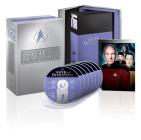
The packaging and menus of Season Six follow in the footsteps of the preceding five seasons. The seven DVDs are packaged in a cardboard fold-out that fits inside a shiny silver "gift box." It looks very nice on the shelf, though it's not particularly convenient to handle when it comes time to actually watch the series.
Final thoughts
Season Six of Next Generation offers a continuation of the excellent storytelling showcased in the preceding two seasons. For any viewers who are interested in Next Generation but somehow have never had the chance to see it, I would suggest starting from an earlier set, perhaps Season Three or Four, and building the collection from there; you'll soon be hooked and ready to buy the next few seasons all the way through Six and Seven. For any fan of the show, the overall high quality of the DVD release, as well as that of the contents, makes Season Six a must-have addition to the collection.
|



| Popular Reviews |
| Sponsored Links |
|
|
| Sponsored Links |
|
|
| Release List | Reviews | Shop | Newsletter | Forum | DVD Giveaways | Blu-Ray | Advertise |
|
Copyright 2024 DVDTalk.com All Rights Reserved. Legal Info, Privacy Policy, Terms of Use,
Manage Preferences,
Your Privacy Choices 
| |||||||