
| Reviews & Columns |
|
Reviews DVD TV on DVD Blu-ray 4K UHD International DVDs In Theaters Reviews by Studio Video Games Features Collector Series DVDs Easter Egg Database Interviews DVD Talk Radio Feature Articles Columns Anime Talk DVD Savant Horror DVDs The M.O.D. Squad Art House HD Talk Silent DVD
|
 DVD Talk Forum |
|
|
| Resources |
|
DVD Price Search Customer Service #'s RCE Info Links |
|
Columns


|
|
|
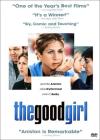
Good Girl, The
Justine Last (Jennifer Aniston) is thirty years old, with a boring husband (John C. Reilly), a mind-numbingly dull job at the Retail Rodeo, and no prospect of anything different in the future. Her world is a tiny, enclosed bubble of unfulfilling work, superficial friendships, and an unsatisfying marriage; no wonder, then, that she is full of simmering dissatisfaction and frustrated anger at the world. She's a "good girl" on the surface, but when she meets young Holden (Jake Gyllenhaal), an introverted but passionate college dropout, her desires and frustrations begin to bubble up to the surface beyond her control.
It appears that The Good Girl was marketed at least in part as a comedy, or as a comedy/drama, but it's really not a comedy in any meaningful way, unless we consider any film with a few humorous moments to be a comedy. The central focus of the film is squarely tragic: Justine coming face to face with the meaninglessness of her life, and having to deal with the frightening prospect of making a radical change in that life. Some of Justine's co-workers are portrayed as oddball, mildly funny figures, but they're not drawn beyond the realms of realism; similarly, a few mildly humorous moments in some scenes will make the viewer smile. But these are simply lightening touches on an otherwise quite serious film.
There's no attempt here to "prettify" Justine's life; many small touches throughout the film, such as her husband's pot-smoking habit, add up to a life that's made bearable only by moments of mindless escape. It's particularly telling that Justine sees only two choices in her life: acceptance of the stultifying status quo, or complete rejection of everything and everyone in her life. She doesn't seem able to consider alternatives, such as trying to change her life from within; the film suggests, without pushing it at the viewers, that Justine is in fact caught in a trap formed over the years by her upbringing, the expectations of family and friends, and the routine of work.
The story never quite gells, however. The film centers around Justine's emotional state and the choices she makes, and in the beginning does a good job of setting up the circumstances for the dilemma she finds herself in later. Toward the middle and end of the story, though, some of the decisions she makes seem insufficiently supported by the character development up to that point. There's also a slight inconsistency in tone late in the film, as it takes a short swerve almost into farce for the duration of one scene between Justine and Holden, before settling back into its serious tone.
Oddly, some of the material that would have made The Good Girl a stronger drama was left on the cutting room floor. In the commentary for the deleted scenes, director Miguel Arteta remarks for most of these scenes that he wanted to leave them in, but had to cut them to keep the film's running time down. At only 94 minutes, The Good Girl indeed is as short as a typical comedy; but the additional few minutes of deleted material would have developed the story significantly, particularly in regard to Justine's ultimate decision about her life.
The Good Girl doesn't entirely succeed as a story, but it gets credit for trying. The film takes an honest, unsparing look at people in dead-end lives, and follows the story through to its dramatically consistent conclusion; there's no feel-good ending tacked on here. It's an ambiguous ending that will leave you wondering exactly what it means in terms of Justine's future.
The DVD
Video
20th Century Fox presents The Good Girl on DVD in an anamorphic transfer that preserves the film's original 1.85:1 aspect ratio. I can't say as I particularly liked the cinematography or the color choices in the film; certainly the Retail Rodeo scenes are intentionally ugly and stark, but other scenes as well have a color scheme that never quite looks right. My sense of dissatisfaction with the look of the film is clearly drawn in part from the fact that the DVD transfer handles the color and contrast quite badly.
In general, the colors look a bit "off": flesh-tones and pastels are sometimes slightly orange-tinted, while areas that are supposed to be dark acquire a greenish tinge. The contrast is fine in most scenes, but when the image becomes very dark, even in a small part of the image, that area shifts to complete black and loses detail. I noticed some flaws in the transfer, such as a shimmering effect in some of the darker areas, that I would attribute to compression: the DVD unfortunately wastes half the disc's space on a pan-and-scan version of the film (including a duplicate commentary track) on the flip side of the DVD. Unfortunately, edge enhancement is also visible throughout the film; it doesn't get out of hand, but it's noticeable.
On the bright side, the transfer of The Good Girl is very clean: there are no print flaws, and there's essentially no noise in the picture. Taken overall, it's a watchable transfer, but it could have been a lot better.
Sound
The Good Girl is presented with a satisfying Dolby 5.1 soundtrack. For this mainly dialogue-based film, the surround channels add mostly general ambiance rather than specific surround effects, with the result that the overall audio experience is fuller than with just a 2.0 track. Dialogue is always clear, and the occasional voiceover of Justine-as-narrator is well-balanced with the rest of the track. A Dolby 2.0 Spanish track is also included, along with English and Spanish subtitle options.
Extras
The highlight of the bonus features on The Good Girl is the presence of a great deal of commentary from the makers of the film. Director Miguel Arteta and writer/actor Mike White provide a full-length audio commentary for the film; they also provide optional commentary for a set of nine deleted scenes. It's not the most insightful commentary in the world, but it's moderately interesting.
Jennifer Aniston also provides scene-specific commentary for a handful of scenes throughout the film, mainly focusing on her impressions of the other actors and her experiences working on a tight shooting schedule. Aniston's commentary is handled very well on the DVD, as it automatically skips over any scenes that have no recorded commentary and moves to the next scene that she talks about.
There's also a short "gag reel," which is almost entirely made up of shots of the various actors breaking into laughter while doing their scenes. In other words, though the moment might have been funny on the set, the humor is just not captured on the gag reel. An "alternate ending montage" offers a very slightly different perspective on the conclusion of the film.
Final thoughts
The Good Girl suffers from not being given full rein as a drama rather than a comedy; though its lighter moments are well done, the strength of the film lies in its serious material, which paints a realistic and unflattering portrayal of people caught in dead-end lives. If The Good Girl had been given a better DVD transfer, it would probably be worth recommending a buy, but with image quality no more than average, I'd suggest it as a good rental choice.
|



| Popular Reviews |
| Sponsored Links |
|
|
| Sponsored Links |
|
|
| Release List | Reviews | Shop | Newsletter | Forum | DVD Giveaways | Blu-Ray | Advertise |
|
Copyright 2024 DVDTalk.com All Rights Reserved. Legal Info, Privacy Policy, Terms of Use,
Manage Preferences,
Your Privacy Choices 
| |||||||