
| Reviews & Columns |
|
Reviews DVD TV on DVD Blu-ray 4K UHD International DVDs In Theaters Reviews by Studio Video Games Features Collector Series DVDs Easter Egg Database Interviews DVD Talk Radio Feature Articles Columns Anime Talk DVD Savant Horror DVDs The M.O.D. Squad Art House HD Talk Silent DVD
|
 DVD Talk Forum |
|
|
| Resources |
|
DVD Price Search Customer Service #'s RCE Info Links |
|
Columns
  



 
|
|
|
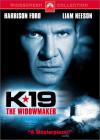
K-19 the Widowmaker
I have a fondness for submarine films, as the premise means that right from the start there will be some interesting dramatic elements. The submarine setting offers a tightly-enclosed sphere of action that can't be escaped from, places a crucial distance between the higher-ups calling the shots on land and the captain calling the shots on the boat, and creates a sense of tension for the characters in a boat that's fundamentally at the mercy of an unforgiving ocean. Into this mini-genre, what does K-19 the Widowmaker have to offer, and how does it stack up against giants like The Hunt for Red October or Das Boot?
In the first hour of the film, we get an interesting story that appears to move outside the "Cold War adventure" conventions: the conflict lies in the crew's struggle to get K-19 operational in the face of inadequate support and unrealistic expectations from the Soviet bureaucracy. The tension increases when their captain Mikhail Polenin (Liam Neeson) is abruptly demoted to executive officer and a new, hard-line captain, Alexei Vostrikov (Harrison Ford), comes aboard to get K-19 on duty, ready or not. What develops at this point is an interesting examination of two conflicting styles of command: the more easy-going, gentle style of Polenin, and the hard-edged, push-them-to-the-limits style of Vostrikov. At this point, K-19 shows signs of being a thoughtful, intelligent film that takes the fascinating enclosed world of a nuclear submarine as a place to explore conflicts of leadership and idealism, much like the excellent Crimson Tide.
Unfortunately, K-19 begins a slow dive beginning in the second hour of the film, and turns into a generic disaster film, chock-full of predictable "heroism." I say "heroism" in quotes because the film purports, by the end, to be a celebration of heroic devotion to duty, but it's by no means clear that this is the message of the story. Where is the line between heroic sacrifice and throwing one's life away? What is the distinction between loyalty (to family, to fellow shipmates, to the state) and blind obedience? K-19 the Widowmaker is thoughtful enough to bring up these kinds of questions in the first hour of the film, but it allows all the potential significance of the story to drain away in the second hour, to be replaced by clichés of loyalty, duty, and honor. This portion of the film would have worked better if the Cold War tension had been developed more: as it is, there's very little sense of the significance of K-19's fate outside of the immediate concerns of the men on board.
As if this dive weren't enough, K-19 essentially torpedoes itself in the last half hour of the film with a completely unnecessary and drawn-out conclusion. The film makes a desperate attempt to link the events of K-19's maiden voyage with democracy, freedom, and the fall of communism, but the connection is tenuous at best; the story would have packed a far greater punch if it had ended on the dramatic high point half an hour earlier.
One minor but rather grating point against the realism of the film is the fact that most of the actors attempt Russian accents. In a film like K-19, the characters are assumed to actually speaking in their native language, with the film "translating" it to English. When people speak in their native language, they don't have a foreign accent, so what we should have gotten was actors speaking in their normal styles, possibly trying to be a little more "neutral" at most. Was the director concerned that viewers might miss the fact that these are Russians? Really, I think that the "comrade" salutations, the Cyrillic lettering, the references to the Soviet Union, the meetings in Moscow, the uniform insignia, and the names of the characters are more than sufficient to establish that these are, in fact, Russians. Putting fake Russian accents on the characters just falls into Hollywood's stereotypes of speakers of other languages, and insults viewers' intelligence to boot.
Harrison Ford's performance as the Soviet captain Vostrikov is one of the strongest parts of the film. Though I typically enjoy Ford's films, I've noticed that he tends to always play either the confused innocent or the patriotic Jack Ryan/President figure. In K-19 he breaks free of those types and produces a genuinely believable and different characterization, which he develops over the course of the film. Vostrikov is not a necessarily likeable character, but he's a realistic one; in the beginning, we have our sympathies clearly with Neeson's character as the more amiable of the two, but later we come to see that Ford's character has more depth than expected. Even as the story goes downhill, Ford's performance is consistent and enjoyable, and should be marked as one of his best in recent years.
The DVD
Video
K-19 the Widowmaker appears on DVD in an anamorphic widescreen transfer, at the original aspect ratio of 2.35:1. It's a very solid transfer that should please viewers of the film. The one fault that I saw is the presence of edge enhancement; it's enough to be noticeable, but given the mostly close-in cinematography of the film, it never becomes a major issue as it would have on a film that used more panoramic shots.
K-19 stands out in offering outstanding contrast in a variety of challenging situations. Black is consistently deep and rich, and is used extensively throughout the film, from the dark uniforms of the crew to the dim interior of the submarine itself; as a very important complement, the excellent contrast provides for detail and shading even in very dark areas. In several other scenes, we get a stark contrast between the black clothing of the men and the shining white of the ice field they're standing on; again, the transfer handles this situation very well, producing a nice image with plenty of detail.
Sound
It's tough to rate K-19 solely on its own merits, because the "submarine genre" of film has taken the audio experience to new levels in movies like U-571. In a submarine film, the opportunity is there for the Dolby 5.1 track to be utilized to its utmost, with the sounds of the boat all around the viewer. In the case of K-19, it doesn't quite manage to create a consistently immersive audio environment; the atmosphere of being inside the boat is not maintained consistently throughout the film. That's not to say that we don't get a good workout of the speakers, though: the surround channels are used fairly often to provide directional sound and to heighten the impact of the most important sound effects.
While K-19 the Widowmaker doesn't live up to the total immersion standard of U-571, it does offer a respectable and enjoyable audio experience with its Dolby 5.1 track, and it ranks as a high-quality "action" soundtrack. The sound effects, music, and dialogue are all kept in good balance with each other for a pleasing overall effect, and the general sound quality is clean and clear.
In addition to the Dolby 5.1 track, there's also a Dolby 2.0 and a French Dolby 2.0 track, along with optional English subtitles.
Extras
The major special feature for K-19 the Widowmaker is a full-length audio commentary by director Kathryn Bigelow and cinematographer Jeff Cronenweth. The "Making of K-19 the Widowmaker" featurette is a disappointment, unfortunately. The 20-minute piece is almost entirely promotional, restating the plot and characters of the film instead of offering any real information. A few snippets on the making of the submarine sets make this piece worth viewing once.
Three interesting short featurettes are provided, focusing on areas that will interest most viewers: the special effects and making of the film. "Exploring the Craft: Make-up Techniques" and "Breaching the Hull" are five minutes apiece, and take a look at the very realistic special makeup used in the film, and the use of miniatures to create one of the film's most spectacular submarine sequences. "It's in the Details" runs eleven minutes, and explains how the production department ferreted out information from Russian sources and other experts to create a completely realistic K-19 submarine. These three pieces would have worked better as one longer "special effects" featurette, but in any case they do provide some very interesting tidbits about the making of the film.
Final thoughts
K-19 the Widowmaker starts out as an interesting, engaging, and potentially very intelligent story, but midway through the film, the story changes direction and becomes a much more conventional (and less compelling) "disaster" story that shortchanges the dramatic issues brought up earlier in the story. It doesn't compare to a film like Crimson Tide, which has some similar themes of loyalty and duty, but K-19 the Widowmaker is nonetheless a fun evening's entertainment. The DVD transfer is quite good, so those who enjoyed the film in theaters should feel confident about buying it. For other viewers, a rental is probably the best bet.
|



| Popular Reviews |
| Sponsored Links |
|
|
| Sponsored Links |
|
|
| Release List | Reviews | Shop | Newsletter | Forum | DVD Giveaways | Blu-Ray | Advertise |
|
Copyright 2024 DVDTalk.com All Rights Reserved. Legal Info, Privacy Policy, Terms of Use,
Manage Preferences,
Your Privacy Choices 
| |||||||