
| Reviews & Columns |
|
Reviews DVD TV on DVD Blu-ray 4K UHD International DVDs In Theaters Reviews by Studio Video Games Features Collector Series DVDs Easter Egg Database Interviews DVD Talk Radio Feature Articles Columns Anime Talk DVD Savant Horror DVDs The M.O.D. Squad Art House HD Talk Silent DVD
|
 DVD Talk Forum |
|
|
| Resources |
|
DVD Price Search Customer Service #'s RCE Info Links |
|
Columns
  


 
|
|
|
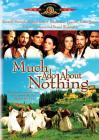
Much Ado About Nothing (1993)
If you've ever thought of Shakespeare as stodgy and dull, forget all your preconceptions: what you might have suffered through in high school bears as much resemblance to Shakespeare done right as "artificially flavored cocoa product" does to the best Swiss chocolate. And let me assure you, Much Ado About Nothing is very much "Shakespeare done right."
Director, actor, and writer Kenneth Branagh brings a dazzling energy to the screen in this production of Much Ado About Nothing. From the very first moments of the film, the play has a joyful, vibrant life to it that can't be attributed to any single factor. From the natural performances of the lead actors to the expansive Italian setting to the creative cinematography and editing, Much Ado About Nothing brings Shakespeare's classic comedy to the screen in grand style.
And it's abundantly clear that Branagh's hand is the one that determines the success of Much Ado About Nothing. Much of the effect of the film comes from what the actors do that is not in the script... all the while being extremely faithful to the original play. Branagh develops Shakespeare's play with the understanding that the original stage directions are minimal (or, more often, nonexistent), and that actors and director must collaborate to create the context in which the dialogue takes on depth and meaning. Branagh's approach is best expressed in the early sequence in which the whole of Leonato's household rushes energetically to get ready for the imminent arrival of the prince Don Pedro (Denzel Washington); none of the action is specified in the play, but the laughing chaos that erupts with everyone pulling off their clothes, splashing through the baths, and dragging their clothes on again in time to greet the returning heroes evokes in miniature the joyful tone that the film will sustain through its entire running time.
Even setting is well-chosen here, as with a Renaissance garden maze that is the location of several important scenes. Its hedge "walls" offer hiding places for the characters when they want to overhear but not be seen in return, and are perfect for sudden entrances and exits. This is the site chosen when Claudio (Robert Sean Leonard), the Prince, and Leonato (Richard Briers) decide to plant the seeds of love in the contrary Benedick (Kenneth Branagh) and Beatrice (Emma Thompson). Benedick thinks he's unseen as he eavesdrops, but we're quite aware that Claudio and the others know he's there (and are counting on it), creating an amusing scene that has one meaning for the duped Benedick and another for those of us who are "in the know."
The experience of the ensemble cast is also very much in evidence. Emma Thompson, Kenneth Branagh, and supporting actors like Briers and Brian Blessed deliver Shakespeare's difficult dialogue as though it were as natural as breathing. This is actually much more important than it might seem: and in doing so, they render the dialogue with natural pacing and emphasis, and make it much easier for the modern viewer to follow.
In contrast, Denzel Washington is the one actor who stands out as not handling the material well. As the Prince, he's not required to deliver as great a dramatic range as the other characters, but his dialogue is noticeably more stilted than the others'. Keanu Reeves, on the other hand, turns in a perfectly fine performance as the evil Don John; it's a nice change from his wide-eyed Matrix-style hero role.
Viewers may be surprised to see Michael Keaton in a... well, peculiar role as the constable Dogberry. I've never particularly liked his part of the film, despite its importance to the plot, but it's true that the "low comedy" moments are as characteristic of Shakespeare as the moments of high drama; all of his plays contain some broadly comedic, usually punning scenes with fools, clowns, or other "low" folk. In part these scenes are intended to vary the tone of the play and heighten the effect of the more dramatic scenes by contrast; they were also Shakespeare's' sop to the "groundlings," the usually illiterate folk who packed the standing-room-only part of the Globe Theater. The physical comedy scenes were sure to get appreciation from this crowd even if they didn't appreciate the more poetic language in the remainder of the play.
In addition to the excellent ensemble acting and lovely production values, what makes Much Ado About Nothing highly re-watchable is that Branagh does justice to the many layers of the original play. Much Ado About Nothing is a comedy, but "comedy" in Shakespeare has a very specific meaning that doesn't include "full of laughs all the way." Certainly, Much Ado About Nothing is lighter in tone than a tragedy like Othello or a history like Henry V, and the witty by-play of Beatrice and Benedick is a central element of the story. But a Shakespeare comedy is defined primarily by its (moderately) happy ending, generally wrapping up with a wedding; it certainly doesn't preclude more tragic events from happening over the course of the story.
It's in the handling of the darker material in Much Ado About Nothing that Branagh really shows his grasp of the play. Despite the light dialogue and happy ending, Much Ado About Nothing hits a sensitive spot with the problematic relationship between the innocent Hero (Kate Beckinsale) and the infatuated Claudio. Even before Don John really gets started on his meddling, the situation isn't all roses. It's clear that Hero's marriage is in the hands of her father, not herself; unlike the defiantly independent Beatrice, she has completely accepted the role that her society has marked for her: that of "good daughter and good wife." Claudio himself, her dashing suitor, is given a dimensionality that includes a darker side: quick to love, he's equally quick to irrational jealousy and vindictiveness. Branagh doesn't let these serious elements overwhelm the overall joyous tone of the film, but he certainly lets us know that they're present. The deft balance of light-hearted wit and underlying seriousness enriches the film enormously.
The DVD
Video
Much Ado About Nothing is presented in an anamorphic 1.85:1 widescreen transfer, preserving the film's original aspect ratio. The transfer is pleasing, if not entirely perfect. Edge enhancement is present in some scenes, though fortunately it's not noticeable in all of them, and some grain is apparent in the print at times. Apart from that, all's well with Much Ado: the print is clean and free of flaws, black levels and contrast are good, and colors are excellent.
In fact, the colors are where the transfer of Much Ado About Nothing really shines, coming across brightly and vibrantly. Much Ado About Nothing is actually not an overly colorful film: the production has been done with a subtle palette showing restraint in its use of primary colors. White and many shades of cream and brown are the most common colors seen in the characters' costumes, while the walls of the villa are a quiet rosy shade and torches in nighttime scenes cast a warm yellow glow. In outdoor scenes, greens and blues are vibrant and offer a pleasing visual backdrop to the characters. In all these cases, the transfer provides excellent support for the various subtle tones of clothing and skin colors, making Much Ado About Nothing into a visually lovely film.
Much Ado About Nothing saw an earlier MGM release that was also anamorphic, though in that release the widescreen version was forced to share the DVD with a pan-and-scan version of the film. Given that the earlier release was of good quality to begin with, is it worth an upgrade? It's been a while since I saw the earlier release, so I can't specify any differences between the transfers, but in the new release, the widescreen version does get both sides of the dual-layer disc (with a well-handled layer change), so, the new transfer certainly won't have any compression issues. I wouldn't necessarily suggest upgrading, though the low MSRP of the new release makes it a reasonable experiment if you want to give it a try.
Audio
Much Ado About Nothing's Dolby 2.0 soundtrack is excellent; while it's certainly a dialogue-based movie, in the case of a Shakespearean adaptation, everything depends on the soundtrack conveying the dialogue with absolute fidelity. Much Ado About Nothing hits the nail right on the head here, with the dialogue always clear, sharp, and completely understandable.
The soundtrack does a great job of involving the viewer, creating an immersive audio environment throughout the film. The overall sound is crystal-clear, with Patrick Doyle's soaring musical score nicely incorporated into the track.
Though it's not an issue of audio quality per se, viewers unfamiliar with Shakespeare may have a bit of a tough time actually following all of the dialogue; fortunately, the DVD can assist. Turning on the English subtitles should help viewers follow the poetic dialogue and thus make the movie more enjoyable on its first watching. I tested out the subtitles in some challenging scenes, and even when the insults are flying thick and fast between Beatrice and Benedick, the subtitles manage to keep pace and to represent the dialogue accurately.
Other audio options include a dubbed French 2.0 track and Spanish mono track, and French and Spanish subtitles along with the English ones.
Extras
I was hoping for more special features in this re-release, but we'll have to be content with a very minor set. There's a 6-minute making-of featurette that's promotional in nature, with a few cast interviews interspersed with liberal clips from the film. A trailer for Much Ado About Nothing is included, along with trailers for When Harry Met Sally and The Princess Bride, and a listing of other assorted MGM titles. The DVD's menus have an attractive movie-themed still image background and are pleasantly straightforward and easy to navigate.
Final thoughts
Much Ado About Nothing is more than a great Shakespeare adaptation; it's a great movie, with a vibrant energy infusing every aspect of the production. Director Kenneth Branagh shows a sure hand with the material in his adaptation of the classic comedy to the screen, and along with Emma Thompson and an excellent ensemble cast, he delivers a captivating performance in the film. Much Ado About Nothing is one of those films that heartily rewards repeated viewing, so with its high-quality transfer, this is a DVD not to be missed.
|



| Popular Reviews |
| Sponsored Links |
|
|
| Sponsored Links |
|
|
| Release List | Reviews | Shop | Newsletter | Forum | DVD Giveaways | Blu-Ray | Advertise |
|
Copyright 2024 DVDTalk.com All Rights Reserved. Legal Info, Privacy Policy, Terms of Use,
Manage Preferences,
Your Privacy Choices 
| |||||||