
| Reviews & Columns |
|
Reviews DVD TV on DVD Blu-ray 4K UHD International DVDs In Theaters Reviews by Studio Video Games Features Collector Series DVDs Easter Egg Database Interviews DVD Talk Radio Feature Articles Columns Anime Talk DVD Savant Horror DVDs The M.O.D. Squad Art House HD Talk Silent DVD
|
 DVD Talk Forum |
|
|
| Resources |
|
DVD Price Search Customer Service #'s RCE Info Links |
|
Columns
  



 
|
|
|
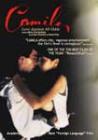
Camila
Camila falls into the category of films that are surprisingly difficult to review. It's very easy to review both very good and very bad movies; it's the ones in the middle that are tough. Camila is particularly difficult to write about, because overall it's simply... bland. Neither particularly good nor spectacularly bad, Camila is mostly just "there."
Set in Argentina in the late 1800s, Camila is a period drama that should offer something for a viewer like me who's fond of historical films, but the film doesn't seem to take advantage of its potential merits. The basic premise of the film is that it's a tragic love story: high-society girl Camila O'Gorman (Susu Pecoraro) falls in love with the Jesuit priest Ladislao Gutiérrez (Imanol Arias). It's a forbidden relationship, of course, but that doesn't stop the couple; unfortunately, the reaction from the Argentinean society is vehemently negative. Despite the dramatic potential in this conflict of individual passion with societal disapproval, my main reaction to Camila was simply lack of interest.
The cultural and political situation is barely hinted at; from what we see in the film, we can gather that there's some sort of governmental trouble brewing, to the point that people feel compelled to wear ribbons proclaiming their allegiance to their side, and brutal repression is used on anyone who steps out of line, especially in breaking the censorship laws. But that's about as clear a picture as we get: it's not evident at all what the situation is, or who the different political groups stand for, or what side the main cast of characters are on.
A tragic love story depends on its effect being built up over the course of the film: the relationship must be believable, the situation must be interesting, and the characters must be ones what we care about. Camila gets off to a poor footing with the introduction of the characters: it's hard to get a feel for Camila's personality among the confusing gaggle of secondary characters around her, not to mention the fact that her (and others') political sympathies appear to be important but are completely unclear. Ladislao is in the unfortunate position of seeming like a cardboard romantic interest; with a sketchy introduction and too-little development of their relationship, the romance between him and Camila feels too much like it was contrived by the writer rather than developing naturally.
"Unrealistic" is perhaps an odd-seeming criticism for a story that was based on a famous real-life story, but for the viewer, the proof is in the pudding: is what we see on the screen believable? In the case of Camila, the story seems to be merely connecting the dots, and by the end, when the film calls on us to feel a powerful sympathy for the young couple, there's very little accumulated feeling. If we haven't been led to care about them up to then, the ending just falls flat.
The DVD
Video
The most striking thing about the condition of the film is simply how dirty it is, especially in the first half of the film. The print is scratched and full of flecks and blobs; it's not a case of seeing the occasional flaw, but rather that every image is downright grungy.
The entire film is also extremely soft-looking; I'm not sure to what extent this is an intentional cinematographic choice, but its effect in this already rather dirty and dull print is to make the image look even less clear. The bright white areas of the film are particularly affected by the softness issue, as there's a great deal of color bleeding across the edges of the images: the white areas literally glow, whether it's someone's shirt or the light coming in from a window. Contrast is adequate, though in very dark scenes it all tends to become plain black.
Colors in general, apart from the extra-bright white, are rather dull and lifeless; the color red, which has a frequent appearance throughout the film and appears thematically important, often looks orangey instead of vibrantly red.
I was very pleased to see that the English subtitles are optional rather than burned-in. They are a nicely readable font, in white with black outlines, and are quite accurate as well as being grammatically correct.
One issue that remains unresolved is the film's correct aspect ratio. While the DVD case claims that it is presented in 1.85:1, the film is actually shown at an aspect ratio that appears to be slightly less than 1.66:1 (non-anamorphic). It doesn't seem to have been pan and scanned, though, and I would suspect that it's simply a case of the packaging being incorrect.
Audio
The original Spanish-language soundtrack is presented in Dolby 2.0. It's marginally better than the video portion of the track, but still not really satisfactory. The dialogue tends to be soft and often slightly muffled, which makes it harder to understand; there's also a slight background hiss in some scenes, and the occasional pop or crackle in the sound as well.
Extras
The special features are minimal on this disc. A text summary gives an overview of the cultural and political background of Camila's Argentinean setting, which will probably be of some help to viewers. It's rather badly proofread, though, with misspellings and incorrect usages appearing. Also included is a set of text production notes, a movie poster, and a selection of "newspaper clippings" from various newspapers reviewing the film. Unfortunately, they're basically just pictures of the articles, and all that's readable is the headlines.
Though the DVD case claims that it includes a trailer and a photo gallery as well as cast and crew information, this is not true.
Optional English subtitles are also included.
Final thoughts
Viewers who are already familiar with the real story that inspired Camila may find the filmed rendition of it more satisfying than those who approach it simply as a film standing on its own. The film does a poor job of setting up a believable situation and characters, which dilutes the emotional impact of the ending. If the film had been given a knockout restoration, the visual impact might have made up for some of the story's inadequacies, but the dirty and fuzzy print instead serves as a distraction. Camila is best as a rental for viewers who find the premise intriguing.
|



| Popular Reviews |
| Sponsored Links |
|
|
| Sponsored Links |
|
|
| Release List | Reviews | Shop | Newsletter | Forum | DVD Giveaways | Blu-Ray | Advertise |
|
Copyright 2024 DVDTalk.com All Rights Reserved. Legal Info, Privacy Policy, Terms of Use,
Manage Preferences,
Your Privacy Choices 
| |||||||