
| Reviews & Columns |
|
Reviews DVD TV on DVD Blu-ray 4K UHD International DVDs In Theaters Reviews by Studio Video Games Features Collector Series DVDs Easter Egg Database Interviews DVD Talk Radio Feature Articles Columns Anime Talk DVD Savant Horror DVDs The M.O.D. Squad Art House HD Talk Silent DVD
|
 DVD Talk Forum |
|
|
| Resources |
|
DVD Price Search Customer Service #'s RCE Info Links |
|
Columns
  


 
|
|
|
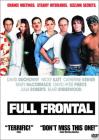
Full Frontal
Director Steven Soderbergh's next film after his big-screen blockbuster Ocean's 11 was a return to his roots of low budget, scaled down filmmaking. Low budget doesn't necessarily mean no star actors with Soderbergh though, as he managed to get Julia Roberts, Blair Underwood, David Hyde Pierce, David Duchovny and others to work under specific conditions and scale pale for this decidedly different take on life in Hollywood.
More obtuse than Altman's Short Cuts, this film is more about everyday life than it is any one story in particular. Julia Roberts and Blair Underwood play actors Francesca and Calvin, who are playing characters in a film within this film. To help set their film world apart from the real, it's viewed through the gloss of Hollywood perfect film, while all scenes set in the "real world" come through with the grain of digital video.
Everyone on the film is connected in some way. Carl (David Hyde Pierce) wrote the screenplay called Rendezvous that Francesca and Calvin are filming. He's married to Lee (Catherine Keener) who is in Human Resources at a large company and is not happy with her marriage. Her sister is a massage therapist who takes a compromising offer from Gus (David Duchovny), a movie producer that produced Rendezvous. Most of the characters eventually wind up meeting at Gus' birthday party near the end of the film.
Despite these connections, things never conclude the way they would in a standard movie. Yes, most of the players wind up together at a party near the end of the film, but they still remain mostly oblivious to the others around. The film serves as a visual diary as the characters observe and deal with the problems in their lives. Also, unlike most Hollywood films, said problems are not overly dramatic or visually compelling. It's a window into the life of a person, pseudo-reality as crafted by one of the finest directors working today.
Having said that, Full Frontal is not a film that most people will like. Without the standard trappings of a summer blockbuster, there's noting more than the skill of the actors to pull you through the film, but they do so with amazing talent. Perhaps Soderbergh's 10 playful rules freed the cast from the trappings of stardom and allowed them to perform at their best, because it's unlikely you'll ever see such a strong performance from an assembled group again.
Standouts of the cast have to be David Hyde Pierce with his porno-named obsessed magazine writer that is insecurely unaware of the marital problems around him as his wife suffers through similar problems. Likewise, one cannot help but notice veteran L.A Law actor Blair Underwood as he continually steals scene after scene from his constant companion Julia Roberts. Of particular note is Calvin's freestyle speech/rap on the current and past state of black leading men in Hollywood which playfully sums up every truth and stereotype that faces black actors without ever being venomous.
Video: The 16:9, 1.85:1 anamorphic presentation makes both the video and film sections look good, but one has to wonder what additional processing was added to the digital video sections. It's meant to be a parallel to the gloss and glitz that film represents, but it's as if it was intentionally dirtied up more than needed. Some of that is likely caused by the use of natural light sources and such, but when taken as part of the film, it's only slightly annoying.
Audio: Similar to the video, the audio plays no role other than reproducing the dialog. The use of a Dolby Digital 5.1 surround track is needless and unnoticeable in this dialog only film. Based upon that, it performs perfectly with every bit of dialog coming from the center being crisp and clean.
Extras: The disc has some truly interesting extras that mostly come from the inventive things that Soderbergh did on set. There are now standard deleted scenes and commentary present, but both offer little entertainment. Soderbergh usually is quite entertaining on his commentaries, but for some reason cannot get things rolling on this one and merely follows along with the film and provides details here and there, as does screenwriter Coleman Hough. The deleted scenes are offer a few good scenes and Hough provides a running commentary on them, but a track by Soderbergh explaining why they were cut would have been nice.
Perhaps the most interesting feature on the discs are the in-character interviews with the cast members. Part of the process of making the film included lengthy interviews where the actors responded as their characters. These narratives were then used over other footage found within the film. As Soderbergh explains in a interview on the DVD, one of David Hyde Pierce's most memorable monologues was purely improvised when asked the question, "have you ever seen a dog get hit by a car?" Footage from the spy cameras that were constantly running is provided, but it's only a few short minutes and not any of the sensational footage the Soderbergh alluded to capturing, since the cast did not know the tiny cameras were present.
The rules for the film are also provided on the disc, and they follow:
If you are an actor considering a role in this film, please note the following:Overall: Soderbergh has crafted another compelling film, but one that defies all convention and Hollywood rules, which is part of the point. Because of this, the film did not find an audience in theaters and likely won't find a much larger one awaiting it on home video, which is a shame. Despite is nontraditional structure, it features some of the finest performances by the involved actors and true sense of experimentation from the director.
1. All sets are practical locations.
2. You will drive yourself to the set. If you are unable to drive yourself to the set, a driver will pick you up, but you will probably become the subject of ridicule. Either way, you must arrive alone.
3. There will be no craft service, so you should arrive on set "having had." Meals will vary in quality.
4. You will pick, provide and maintain your own wardrobe.
5. You will create and maintain your own hair and makeup.
6. There will be no trailers. The company will attempt to provide holding areas near a given location, but don't count on it. ...
7. Improvisation will be encouraged.
8. You will be interviewed about your character. This material may end up in the finished film.
9. You will be interviewed about other characters. This material may end up in the finished film.
10. You will have fun whether you want to or not.
If any of these guidelines are problematic for you, stop reading now and send this screenplay back where it came from.
|



| Popular Reviews |
| Sponsored Links |
|
|
| Sponsored Links |
|
|
| Release List | Reviews | Shop | Newsletter | Forum | DVD Giveaways | Blu-Ray | Advertise |
|
Copyright 2024 DVDTalk.com All Rights Reserved. Legal Info, Privacy Policy, Terms of Use,
Manage Preferences,
Your Privacy Choices 
| |||||||