
| Reviews & Columns |
|
Reviews DVD TV on DVD Blu-ray 4K UHD International DVDs In Theaters Reviews by Studio Video Games Features Collector Series DVDs Easter Egg Database Interviews DVD Talk Radio Feature Articles Columns Anime Talk DVD Savant Horror DVDs The M.O.D. Squad Art House HD Talk Silent DVD
|
 DVD Talk Forum |
|
|
| Resources |
|
DVD Price Search Customer Service #'s RCE Info Links |
|
Columns
  


 
|
|
|
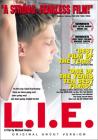
L.I.E.
L.I.E.: it's the title of the film and the abbreviation for the Long Island Expressway, used as the central image in this film about a boy struggling to deal with growing up and dealing with the failings of friends and family. Exactly why the expressway is used in the film is never really evident; it seems to be there rather self-consciously as an artistic element, and ends up being strangely ironic as a symbol of focused travel in a film that doesn't really go anywhere in particular.
L.I.E. isn't badly done, but it lacks something that would pull it all together. Part of the problem is that I was never quite sure what effect the film was aiming for. Much of the film seems to take a "slice of life" approach, as we see a great deal of the main character, Howie (Paul Franklin Dano), in his day to day interactions with his friends as well as the adults in his life. We get a sense of the desperate lack of fulfillment that he feels, so that despite having all his material needs taken care of by his rich father, and despite clearly being an intelligent and sensitive boy with the potential to make something of himself, he feels the need to reject the system, to get into trouble and to refuse any help that's offered to him. We see how the father is too wrapped up in his own problems to do more than hold out a token hand to his troubled son... but also that Howie is too self-absorbed to see his father's pain either.
Unfortunately, the film doesn't really work as a slice of life, perhaps because Howie, while certainly realistic, isn't all that interesting as a character. But what makes a character interesting isn't necessarily just the starting point: characters can develop over the course of a story. In order for that to happen, though, there needs to be some narrative pressure on him, something to force him to act and react, to grow as the film proceeds. The actual storyline of L.I.E. doesn't really provide that, though. The film sets up a series of events that seems at first to fit the bill, as Howie gets into trouble by breaking into a house with his friend Gary, and realizes that he has gotten in over his head. However, this train of events peters out, with what comes afterwards being loosely related to earlier events, but not really developing from them. Howie's encounter with Big John (Brian Cox) is another event that has the potential to give direction to the film: John is an ambiguous figure, partway between sexual predator, needy friend, and parental stand-in, but again it doesn't feel that any real narrative impulse is drawn from his character. Here as in the rest of the film, Howie is allowed to sleepwalk his way through the story, reacting but not changing.
There's also the issue of the sub-plot concerning Howie's father, who is up to something he shouldn't be. The setup for that part of the story conspicuously uses a number of stylistic elements from suspense-type movies: the hidden stash of money, the phone calls to mysterious people, the cover-up. In fact, all the scenes of the sub-plot about Howie's father seem like they came from a different movie entirely. With the rather forced dialogue and a dash of overacting combined with the lackluster attempt at a plot, these scenes never fit well into the overall structure of the film.
L.I.E. benefits from some quite realistic performances from the younger cast members: Dano in particular is completely believable as the lost, frustrated boy struggling to deal with shaky family relationships. The adult actors are rather less successful, with the worst offender being Bruce Altman as Howie's father; all in all, it's a mixed bag of performances.
The DVD is available in both an R-rated edition and an unrated edition, which is has been reviewed here. The running time is 97 minutes for both, because as it turns out all that was cut to turn the film into a "tamer" R version was about forty seconds of a sex scene between Howie's father and his girlfriend. I'm really not sure what possessed the MPAA to originally slap an NC-17 rating on the film; I suspect not so much the sex, but the characters, is what ruffled their feathers. It seems that according to the ratings board, explicit violence and gore is perfectly fine for minors to see... but they mustn't suggest that a film could show male homosexuality (without even showing any sex... just hinting at it) or suggest that older men with sexual interest in younger men (even if they don't act on that interest) are anything other than predatory monsters. Anyway, viewers can do the sensible thing on their own, which is to buy the unrated version; it's the director's preferred cut.
The DVD
Video
L.I.E. is presented in an anamorphic widescreen transfer at its original aspect ratio of 1.85:1. The image quality is good as a whole, though not entirely even throughout the film. The most noticeable flaw is fairly heavy edge enhancement; in some scenes, especially outdoor ones, the image also shows moderate to heavy amounts of noise. Some blemishes in the print also appear scattered throughout the film. Most of the scenes, however, are good-looking, with a clean image; colors are solid and natural-looking throughout the film.
Audio
The Dolby 2.0 soundtrack for L.I.E. is satisfactory overall. The main fault is a slight muffled quality to the sound, making some of the dialogue at lower volume levels a little less clear. I noticed a very faint hiss in the background of one or two very quiet scenes, but it's not apparent at all in most of the scenes and isn't a major issue. The sound on the whole is clear and free of distortion, with dialogue presented in a satisfactory balance with the other elements of the track.
Extras
Fans of the film will be very pleased with the main special features on this DVD, which are two separate audio commentary tracks: one from director Michael Cuesta, and another from actor Brian Cox. The other special features are incidental: two minutes of deleted scenes and a trailer.
Final thoughts
I never had a particularly strong reaction to L.I.E., which I suspect means that the director didn't quite achieve what he was aiming for. It's not a bad film, but it lacks the narrative drive to make something of its theme and characters. The DVD presentation is good, with a nice anamorphic widescreen transfer; interested viewers should consider this a good choice for a rental.
|



| Popular Reviews |
| Sponsored Links |
|
|
| Sponsored Links |
|
|
| Release List | Reviews | Shop | Newsletter | Forum | DVD Giveaways | Blu-Ray | Advertise |
|
Copyright 2024 DVDTalk.com All Rights Reserved. Legal Info, Privacy Policy, Terms of Use,
Manage Preferences,
Your Privacy Choices 
| |||||||