
| Reviews & Columns |
|
Reviews DVD TV on DVD Blu-ray 4K UHD International DVDs In Theaters Reviews by Studio Video Games Features Collector Series DVDs Easter Egg Database Interviews DVD Talk Radio Feature Articles Columns Anime Talk DVD Savant Horror DVDs The M.O.D. Squad Art House HD Talk Silent DVD
|
 DVD Talk Forum |
|
|
| Resources |
|
DVD Price Search Customer Service #'s RCE Info Links |
|
Columns
  


 
|
|
|
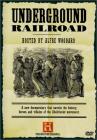
Underground Railroad
The subtitle of Underground Railroad is, in hindsight, rather a tip-off to its flaws. It's "A new documentary that unveils the history, heroes, and villains of the Abolitionist movement." Heroes and villains are all very well in fiction, but it's been my experience that any historical piece that focuses on "good guys" and "bad guys" usually ends up oversimplifying the messy gray areas that occupy most of real history.
Underground Railroad suffers from two major flaws: the lack of content, and the lack of organization. The latter flaw obscures the former to a certain extent, but by the end of the program, both are quite apparent.
The program's organizational problems show up most clearly in an attempt to define what the documentary is actually about. Is it about the history of the abolitionist movement, or just of the slaves' flight to freedom along the "underground railroad"? Is it a collection of mini-biographies of various people who were involved, or is it trying to give a larger picture? Well, in truth, it's never particularly clear what it's about. The documentary is divided into a number of sections, but there's no clear connection between them or any overall structure; the program jumps around and never draws its assorted bits of facts into a coherent picture. Many people are interviewed, but most have only a sentence or two to contribute; the ones we hear the least of are the historians, while the ones we hear the most of are people reminiscing about their long-dead ancestors who fled to freedom along the Underground Railroad.
Which brings us to the program's lack of content. It appears that somewhere along the line in the creation of the program "detail" was mistaken for "information." Indeed, we are told the name of countless individuals involved in the Underground Railroad, often along with specific dates of actions that they took or events in their lives, and nitty-gritty details about their lives and families. But all this has no particular relevance in the big picture; it's just an avalanche of minor detail poured on the viewer, but leaving no insight in its path. Time and again the narrator or an interviewee strives to highlight the pathos in the life story of a particular person, but it dulls on repetition, especially when no meaningful context is given for that person's life or actions.
Conspicuously lacking from Underground Railroad are discussions (or acknowledgement) of larger, more meaningful issues. How did slavery work as an economic system? What made slavery of Africans in the Americas different from classical slavery? How did contemporary ideas about race and biology influence the persistence of slavery? In an apparent effort to keep Underground Railroad as light on content as possible, no ideas like this are even mentioned, much less delved into.
I was also disappointed at the one-note representation of southern slaveholders as sadistic tyrants who brutally abused their slaves. One of the reasons that it was difficult for the abolitionist movement to take hold at first was the counter-example of southern slaveholders who were convinced of the moral correctness of slavery, and who treated their slaves with consideration, even perhaps freeing them in their wills. These slaveholders offered an example that proponents of slavery could point to as an ideal, whereas the brutal, abusive slaveholder could be decried as betraying his duty toward the "lesser" race. Similarly, not all Africans in the south were pro-abolition; some felt that it was their destined place, while others had managed to come up relatively "on top" in the system and didn't want to give it all up for an uncertain future of freedom.
But Underground Railroad doesn't bother to examine the shades of gray, instead painting a clear and inaccurate picture of uniformly evil slaveholders and heroically resisting slaves. It's a shame, because it's in the slow gain of the abolitionist movement against real opposition, and its steady wearing away of the pro-slavery arguments, that we see its real impressiveness. And it's in the stickier issues of slavery and U.S. culture in the 1800s that the most interesting and most meaningful issues lie; if we persist in thinking of events in our past as clear-cut good and evil, then it will be all the more difficult to deal with current events appropriately. Heroes and villains are for the movies; real life deserves a more complex treatment. However, we don't get that in Underground Railroad.
The DVD
Rather oddly, the running time for this DVD is listed on the case as 150 minutes plus extras, but it's nowhere near that long: the program itself is about an hour and a half long; even if the extras are included, the non-text special features only add another 42 minutes.
Video
This History Channel production appears in its original 1.33:1 aspect ratio. All in all, the image is satisfactory. It's not as sharp as it could be, due in part to the moderate level of edge enhancement, and contrast suffers occasionally, but the overall picture is fairly clean, with good colors.
Audio
The Dolby 2.0 stereo soundtrack is about average for a decent television program; though it's fairly flat, the sound is clean and free of background noise or distortion. At times, the voiceover narration isn't as clear as it should be, but on the whole it's satisfactory.
Extras
I was impressed to find that the main special feature on Underground Railroad is a full 42-minute episode from A&E's Biography series, profiling Frederick Douglass. For those who want to know more about his role in the abolitionist movement, this special feature will be of definite interest.
The other bonus features are fairly ordinary text-based material: the Emancipation Proclamation, background information on a court case involving the slave or free status of Dred Scott, a biography of Harriet Tubman, and a historical timeline.
Final thoughts
Underground Railroad might be passable as a very basic introduction to the abolitionist movement in the United States... except for its utter lack of organization and its skimpy amount of content. Viewers who saw it on television and enjoyed it might want to pick it up, though I don't feel that it has much replay value; at least the special features add value, with a full Biography episode on Frederick Douglass included.
|



| Popular Reviews |
| Sponsored Links |
|
|
| Sponsored Links |
|
|
| Release List | Reviews | Shop | Newsletter | Forum | DVD Giveaways | Blu-Ray | Advertise |
|
Copyright 2024 DVDTalk.com All Rights Reserved. Legal Info, Privacy Policy, Terms of Use,
Manage Preferences,
Your Privacy Choices 
| |||||||