
| Reviews & Columns |
|
Reviews DVD TV on DVD Blu-ray 4K UHD International DVDs In Theaters Reviews by Studio Video Games Features Collector Series DVDs Easter Egg Database Interviews DVD Talk Radio Feature Articles Columns Anime Talk DVD Savant Horror DVDs The M.O.D. Squad Art House HD Talk Silent DVD
|
 DVD Talk Forum |
|
|
| Resources |
|
DVD Price Search Customer Service #'s RCE Info Links |
|
Columns


|
|
|
Story of Film: An Odyssey, The
Music Box Films Home Entertainment // Unrated // December 11, 2012
List Price: $69.95 [Buy now and save at Amazon]
In 2011 writer/director Mark Cousins put the finishing touches on his documentary on the history of the cinema: The Story of Film. He subtitled the work An Odyssey, and that's a very apt title. The final work is a meandering trip running 15 hours in length, but it's also an exciting adventure that is very thorough. The bravura work serves as an excellent and comprehensive introduction to the history of the movies, but it also contains a lot for veteran film buffs to discover. It's a wonderful and entertaining film course in a box.
One of the greatest strengths that this series has is that it takes a chronological approach while documenting the history of one of the most popular forms of entertainment today, but only sort of. It's not a linear progression from
That's another of this program's strong points: The Story of Film takes a truly global look the medium. Though
The great thing about having fifteen hours to tell the story is that the
Filled with clips from a myriad of truly great films and many interviews with actors and directors (including Stanley Donen, Baz Luhrman, Lars Von Trier, and Wim Wenders) who mainly talk about films and filmmakers they love rather than their own body of work, this is an enjoyable and informative way to spend fifteen hours.
That's not to say that it's without its flaws however. While there are a couple of small, inconsequential, points where I disagree with Cousins, it did feel like he had a bias against
Cousins, who wrote, directed, and was the cinematographer for the original footage used in the series, wasn't doing enough for the project apparently and so narrated the whole thing too. I think he should have hired a professional voice actor. He's very monotone in his delivery and his
The DVD:
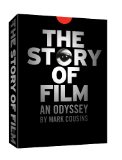
This 15-episode series arrived on an ample five discs. These are housed in a foldout book, with two overlapping discs per page, with a pocket for the booklet (see the section on extras for more information on that). This is all stored in a very attractive slipcase. It's a nice package all together.
Audio:
The stereo soundtrack fits this documentary well. The narration is clean and clear and there aren't any defects worth noting. Some of the vintage film soundtracks have a bit of background noise in a couple of spots, but this is very minor. Unfortunately there are no subtitles.
Video:
The 1.78:1 image looks fine. Since this series is contains a large number of clips from vintage movies and old interviews the source material sometimes shows its age, but the creators were able to track down a large number of quality clips. Viewers will be happy with what they see.
Extras:
There isn't much in the way of extras, just an amusing condensation of the entire series into 90 seconds. While I usually like bonus material I'm fine that there isn't much included on the discs. The series speaks for itself and I didn't feel that bonus material would have improved the package much, though I would have enjoyed seeing some of the unused footage from the interviews that he conducted.
The best extra isn't found on the discs, but rather in side the foldout box. There's a 44-page booklet where Cousins tells how the series came to be made. It's an interesting story. The booklet also includes a list of films clips used for the series, by episode. It's a pretty impressive list.
Final Thoughts:
This is a truly excellent series and one of my favorite documentaries on the history of film. Get this set and for every episode watch a couple of the films profiled and you'll be more educated on film than by taking an introductory college class. A must-see for an film fan. Highly Recommended.
|



| Popular Reviews |
| Sponsored Links |
|
|
| Sponsored Links |
|
|
| Release List | Reviews | Shop | Newsletter | Forum | DVD Giveaways | Blu-Ray | Advertise |
|
Copyright 2024 DVDTalk.com All Rights Reserved. Legal Info, Privacy Policy, Terms of Use,
Manage Preferences,
Your Privacy Choices 
| |||||||