
| Reviews & Columns |
|
Reviews DVD TV on DVD Blu-ray 4K UHD International DVDs In Theaters Reviews by Studio Video Games Features Collector Series DVDs Easter Egg Database Interviews DVD Talk Radio Feature Articles Columns Anime Talk DVD Savant Horror DVDs The M.O.D. Squad Art House HD Talk Silent DVD
|
 DVD Talk Forum |
|
|
| Resources |
|
DVD Price Search Customer Service #'s RCE Info Links |
|
Columns
  


 
|
|
|
Foyle's War - Set 1
Detective Chief Superintendent Foyle (Michael Kitchen) doesn't want his job. It's 1940, and England is faced with resisting an aggressive and powerful German enemy both on the continent and potentially on home soil. Foyle would much rather be doing work to support the war effort directly, but in the meanwhile, he takes his duties as a police officer very seriously. For even though the nation's attention is focused on the war, "ordinary" crime continues unabated... and a victim of murder is equally a victim whether the murderer is a German soldier or a fellow Englishman.
I was surprised to find that Foyle's War is original for television, written by series creator Anthony Horowitz; the stories have a substance and depth to them that I usually associate with productions that are based on novels. Foyle's War – Set 1 includes four 100-minute episodes that each offer an intelligent, thoughtful, and memorable story; this 2002 series shows that British television continues in its tradition of finding outstanding mystery programming.
What makes Foyle's War such an excellent series? A number of things. First off, the episodes feature solid storytelling: an interesting, complex plot that develops consistently over the course of the episode. The stories are intelligently told, and the plot developments and conclusions manage to be both entirely believable and unexpected.
"The German Woman" sets up one of the recurring contrasts of the film, between the sacrifices demanded of the ordinary person and the well-off (in money and connections). Here, the combination of "enemy alien" regulations and general local intolerance seem to have resulted in the murder of a German woman in an otherwise peaceful Sussex town, but Foyle's investigation soon turns up more suspects and a more complex train of events.
"The White Feather" has Foyle encountering what could be a complex conspiracy, as a young girl caught doing sabotage leads to a quasi-political group who could be just expressing perfectly legal opposition to the war, or who could potentially be dealing with the Nazis to end the war with a successful invasion of England.
"A Lesson in Murder" opens with an ordinary suicide that's perhaps not ordinary after all, and a death threat to a local magistrate opens a case for Foyle that's full of strange goings-on. Foyle attempts to unravel a complex mystery in which it seems everyone is hiding something; but who is hiding a motive for murder?
"Eagle Day" moves slightly away from the style of the other episodes, with more of a conspiracy plot than a murder investigation, though there is at least one murder involved, as Foyle is called in when a man is found stabbed to death in the ruins of his house after an air raid. The case leads Foyle far afield, to an art museum in Wales as well as to secret operations of the Royal Air Force in his home town.
The first three episodes are all extremely well done, with very interesting plots that develop continuously over the course of the episode. "Eagle Day" is my least favorite, which is to say that it's still a good episode, but it's not quite as compelling as the earlier three, as its plot is somewhat more loosely structured.
What gives the stories their real substance, though, is not just the "whodunit" part: it's the thoughtful approach to the human issues involved. The episodes uncover touchy issues and face them squarely... and, unlike many shows, doesn't pretend to have any pat, "feel-good" solutions. Foyle's world is full of pain and injustice, and as a police officer, he generally encounters a situation after the damage has been done. He has no magic wand to heal suffering and right wrongs, but on the other hand, he can apply his intelligence and determination to bring justice, at least.
We see that people don't change their nature just because "there's a war on": the tension and threat of the potential German invasion, and the air raids, brings out the best in some, the worst in others, and for the majority, leaves them as before. Foyle himself longs for "more important" work, directly related to the war effort, but he finds himself with plenty to do on the home front, as the inhabitants of England don't refrain from murder, theft, revenge, blackmail, and bribery just because there's a war on. In fact, the unsettled nature of the times seems to encourage anti-social behavior.
We see, too, the astonishing ability of the average person to hate blindly, and his corresponding inability to separate an individual from a group. Since England is fighting against the Germans, all Germans become the enemy... even refugees who fled Germany because they opposed that country's policies and were in danger of imprisonment or death. Revenge is the order of the day: if the enemy army bombs a local building, then punishment is extracted on an innocent who happened to have ties to another country. While fighting to preserve democracy and freedom, the rights and freedoms of many individuals were taken away in the name of the war effort and national security. Necessary? Possibly. Disturbing? Absolutely: especially in an episode like "A Lesson in Murder," in which we see the most chilling reaction of all, that those who dared to raise their voices in criticism might be brutally silenced... by fellow citizens if not by the government.
The most painful aspect of watching these stories unfold in Foyle's War is not the acknowledgment that terrible things were done on the Allied side as well as the Axis side of WWII, but that the very same attitudes and reactions continue to take place today. These issues are not particularly pleasant, but they are very important to come face to face with in modern times just as much as in the show's 1940 setting.
As the title character, Michael Kitchen is one of the strongest assets of the series. He is perfect for the role, playing it in an understated but believable manner, bringing Foyle to life as a distinctive individual. The character is extremely likeable, though not perhaps in the typical way: he is forthright and direct, but also soft-spoken and not given in the least to dramatics; he is exceptionally honest, and clearly both intelligent and sensitive.
Beyond the intelligent stories, the thoughtful approach, and Kitchen's excellent acting, Foyle's War is fascinating in its authentic period setting. All four of the episodes take place in England during 1940; while the stories generally focus on domestic mysteries, the war is always in the foreground, with preparations taking place all around. War movies and documentaries tend to focus on the front lines of the war, but Foyle's War gives a vivid picture of what it must have been like for the English at home, with the constant fear of German air raids (and invasion), and precautions such as the blackout regulations and gas attack drills existing side by side with people trying to get by in day to day life. Foyle's War's 1940 setting is much more than just window dressing; the chaos and disruption of the war effort, the tension and fear in the populace, the uncertainty of the future all come to play in the stories that are told here.
Viewers will be pleased to know that these are the complete, uncut episodes, as seen on television in the U.K.; the U.S. broadcasts on PBS cut the episodes by ten minutes each, a travesty considering the tight construction of these episodes.
The DVD
Video
Foyle's War is presented in an anamorphic widescreen transfer, preserving its original aspect ratio of 1.85:1. Some of the shots are very close-up, giving the impression at first that the image has been zoomed in, but as can be seen from the overall composition of the images, this is just a stylistic choice, one that was probably made with the smaller home television screen in mind.
The transfer is of very good quality overall. Colors are natural-looking, with skin tones as well as other colors appearing just right. The print is clean and free of print flaws, with minimal noise; edge enhancement is minor. Both indoor and outdoor shots look clean and show very little grain.
The main thing holding the image back from a higher score is that there is not quite enough contrast, which is apparent in both medium-lit and darker scenes. The image is also fairly soft, though this doesn't really detract from the picture as a whole, which is quite attractive. I'm quite pleased that Acorn Media has chosen to preserve the widescreen aspect ratio and provide anamorphic enhancement as well.
Audio
Foyle's War has a Dolby 2.0 soundtrack which serves its purpose fairly well, if not perfectly. The sound as a whole is clean, with no background noise; the actors' voices are natural-sounding throughout. The musical theme for the show is a melancholy, wistful tune that fits very well with the overall mood of the series; it is well balanced with the other elements of the soundtrack.
The one issue I had with the sound is that the dialogue tended to be somewhat muted with respect to the remainder of the track. Throughout the episodes (though in some more than others) there were words or phrases said by the actors that I didn't quite catch, even though the overall volume level was at a normal level. On the whole, however, the sound is quite satisfactory.
Extras
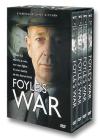
Each of the Foyle's War episodes is packaged in a separate keepcase, with all four DVDs enclosed in an attractive glossy paper slipcase.
Discs 1 and 4 ("The German Woman" and "Eagle Day") each include an eleven-minute interview with writer and series creator Anthony Horowitz, in which he offers some interesting insights into the creation and development of the show. The interview content is different on each disc, even though the same opening sequence is used for both. All four discs also have text production notes (with the same information about the series) along with cast filmographies.
Final thoughts
I was very impressed with Foyle's War: it's intelligent, thoughtful drama with an interesting and realistic World War II setting. The stories have a great deal of depth to them, as Foyle's War takes a mature and thoughtful look at human nature, and offers no easy answers. The series has a high degree of rewatchability due to this depth, as the episodes offer rich storytelling that rewards the viewer with more than just the answer to the mystery puzzle. Acorn Media has given viewers an excellent DVD package, as well, with the episodes featuring an anamorphic widescreen transfer. Foyle's War is highly recommended.
|



| Popular Reviews |
| Sponsored Links |
|
|
| Sponsored Links |
|
|
| Release List | Reviews | Shop | Newsletter | Forum | DVD Giveaways | Blu-Ray | Advertise |
|
Copyright 2024 DVDTalk.com All Rights Reserved. Legal Info, Privacy Policy, Terms of Use,
Manage Preferences,
Your Privacy Choices 
| |||||||