
| Reviews & Columns |
|
Reviews DVD TV on DVD Blu-ray 4K UHD International DVDs In Theaters Reviews by Studio Video Games Features Collector Series DVDs Easter Egg Database Interviews DVD Talk Radio Feature Articles Columns Anime Talk DVD Savant Horror DVDs The M.O.D. Squad Art House HD Talk Silent DVD
|
 DVD Talk Forum |
|
|
| Resources |
|
DVD Price Search Customer Service #'s RCE Info Links |
|
Columns
  



|
|
|
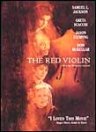
Red Violin, The
The toughest reviews to write are the ones about the best films. Where to start? What to bring to the reader's attention, when it's all so good? The Red Violin is, in short, a perfect movie about the perfect violin. Starting with its creation in the workshop of an Italian master violin crafter, and following the violin over time until it winds up on the auction block in Montreal, we see the human passions and tragedies that have surrounded this masterpiece through all the years of its existence.
The Red Violin is possibly the most structurally perfect film I've seen, interweaving stories set in the past and present in an intricate yet completely natural manner. Not just one, but two frame stories surround the tale of the Red Violin and its passage through the centuries, and these frame stories are perfectly balanced by being on opposite ends of history. One of the framing devices is the fortune told by an old servant woman for Anna, the violin maker's wife, with each new tarot card leading us into another era in the violin's history. On the other side of history, another frame centers around the violin being prepared for auction, weaving together the auction appraiser's detective work to discover the true nature of the violin with the appearance of various buyers who, as it turns out, all have some connection to the Red Violin.
Each of these two frames, that of Anna (Irene Grazzioli) in 17th century Italy and Morritz, the appraiser (Samuel L. Jackson) in modern Montreal, is a full-fledged story in its own right, as well as serving to highlight the rest of the stories. We follow the violin from its origins in an Italian workshop to a monastery orphanage in Austria, where we meet the young prodigy Kaspar Weiss; onward to a band of gypsies whose path intersects with the English maestro of the violin, Frederick Pope (Jason Flemyng), and his tumultuous relationship with his "muse" Victoria (Greta Scacci); and even further onward to China struggling with newly-adopted Communism and a woman (Sylvia Chang) who is torn between her love of music and her country's rejection of Western art. Each of these sections of the film is a brilliant piece in its own right, polished, beautiful, evoking a powerful sympathy with the characters and a sense of the beauty of music and the uncertainty of human life.
The Red Violin is truly an ensemble film; each of the film's five separate sections is balanced with the others, with all the performances completely capturing the viewer's attention. Viewers who are more accustomed to seeing Samuel L. Jackson in action films will be surprised to see how naturally he carries off a completely serious and slightly understated role as the appraiser and music lover Morritz.
The film gets so many things right, from the performances and the music to the sets, costumes, and every little detail. One aspect of the film that I appreciated is that all the characters are presented as speaking in their own language: the Italian characters in Italian, the Chinese in Chinese, and so on (with subtitles supplied, of course). In addition to capturing more fully the atmosphere of each setting, the use of original languages allows for additional depth in showing social relationships. In the Austrian section of the film, it's quite significant that several of the characters speak both French and German; which language is used in which circumstances, and to whom, is very significant.
A richly nuanced and layered film, The Red Violin is as enjoyable (or even more so) on repeated viewings. I watched it for the third time for this review, and I was every bit as entranced by the story as on the first viewing, while also appreciating more deeply the sheer artistry of the film. Nothing about this film is ordinary. The cinematography, for instance, is consistently both beautiful and imaginative, often taking advantage of unexpected angles to capture a scene in the most effective way possible. One of the most challenging things in a film like this is to show the passing of time, and amazingly, The Red Violin takes us from 17th century Italy to the modern day, as well as all over the world, without ever needing to display a caption showing the date or location; the transitional pieces are in themselves little masterpieces.
The Red Violin shows what the film medium can do at its very best. This is a story that is told in a way that would not be possible in any other form: not in a short story or a novel, not in television or a play. The Red Violin won a well-deserved Academy Award in 2000 for its haunting and lovely original score by John Corigliano, but what amazes me is that it wasn't nominated for more awards; director and co-writer François Girard amply deserved recognition, at the least. I suspect that the film simply didn't get enough exposure in its initial run, which is a crying shame for a film that should be held up as one of the best of the best.
The DVD
Video
The Red Violin is presented in its original aspect ratio of 1.85:1, and is anamorphically enhanced. This release of The Red Violin by Lions Gate Entertainment contains an entirely new transfer from an earlier release that was put out by Universal. Since I also owned the Universal release, I was able to do a scene-to-scene comparison and even compare the bit rates of the two releases, which do have significant differences.
The new Lions Gate release is less compressed and has a significantly higher bit rate than the earlier release, and the difference in the transfer is dramatic. I never realized that The Red Violin was such a vibrantly colorful movie: the earlier transfer, as it turns out, was significantly washed-out and had problems with contrast. The higher bit rate in the new transfer is readily apparent in challenging scenes including both brightly-lit and dim areas in the same frame; the contrast is handled perfectly, and the color and lighting balance is superb. Details of shading and bright highlights are captured perfectly as well. Colors across the board are much better, more vibrant, natural-looking and richer; as one striking example, the Red Violin actually looks red as it's supposed to, rather than the reddish-brown of the earlier transfer.
With the praise I've lavished on the new transfer so far, why hasn't this DVD received more than three and a half stars for video quality? One factor is that the new transfer, though it is much brighter and offers better contrast and detail, also shows fairly heavy edge enhancement. Close-up scenes aren't much affected by this, but on many occasions it's very evident, as in the haloes we can see around buildings on the horizon in some shots. There are also a few print flaws that appear, especially toward the end of the film.
The other problem is the subtitles: in a nutshell, Lions Gate messed them up in a big way. As I noted in the main body of the review, all of the characters speak in their own languages, which adds tremendously to the ambiance of the film. Consequently, we need subtitles for the many scenes in Italian, German, French, and Chinese. The earlier release had burned-in English subtitles for all the non-English dialogue; the new release has removed these and substituted player-generated, optional subtitles. All well and good... except that the player-generated English subtitles appear for all the dialogue... including the English. Needless to say, this is very annoying, as it forces the viewer either to suffer English subtitles for English dialogue, or constantly reach for the remote to turn the subtitles on and off. Additionally, the English subtitles are partially in the closed-captioned style, so we get things like (Anna humming) and (heartbeats and heavy breathing) appearing on the screen along with the actual dialogue. It seems to me that the subtitles problem is something that could be, and absolutely should be, corrected by Lions Gate, so I encourage viewers to contact the studio about this problem.
On its own merits, the image of The Red Violin would get four stars; the three and a half stars I've given it here takes into consideration the subtitle problem.
Audio
The Lions Gate release of The Red Violin has a Dolby 5.1 soundtrack. This surprised me at first, since the earlier Universal release had both a 5.1 and a DTS track. While it would have been nice to have DTS on the new release as well, as it turns out, the Dolby 5.1 soundtrack is excellent; there's not all that much difference between it and the DTS of the earlier release.
The two essential elements in The Red Violin are dialogue and music, and both are handled very well here. The dialogue is always clear, distinct, and natural-sounding, and along with environmental effects, shows a good use of spatial separation. The sound is completely clean and natural-sounding, even in the most demanding violin solo sections (performed by Joshua Bell). The outstanding musical score is very well balanced across all the channels of the 5.1 soundtrack, providing a lovely and immersive audio experience.
Extras
The only special feature (apart from a new animated menu) is a trailer for the film, which is accessed, rather oddly, by selecting the Lions Gate logo in the corner of the main menu screen.
Final thoughts
The Red Violin is simply a stunning film, one that belongs in the collection of any film lover. I don't give five stars lightly, but this is one film that amply deserves them. The video transfer is significantly better than the earlier Universal release, with a higher bit-rate reflected in much better colors and overall appearance. In fact, I would give this DVD the DVDTalk Collector's Series rating, if it weren't for the problem with the English subtitles (which I would hope that Lions Gate corrects; if I learn that it has been fixed, I will update the review accordingly). In short, this DVD is highly recommended, both for new viewers and for those who already own the earlier release.
|



| Popular Reviews |
| Sponsored Links |
|
|
| Sponsored Links |
|
|
| Release List | Reviews | Shop | Newsletter | Forum | DVD Giveaways | Blu-Ray | Advertise |
|
Copyright 2024 DVDTalk.com All Rights Reserved. Legal Info, Privacy Policy, Terms of Use,
Manage Preferences,
Your Privacy Choices 
| |||||||