
| Reviews & Columns |
|
Reviews DVD TV on DVD Blu-ray 4K UHD International DVDs In Theaters Reviews by Studio Video Games Features Collector Series DVDs Easter Egg Database Interviews DVD Talk Radio Feature Articles Columns Anime Talk DVD Savant Horror DVDs The M.O.D. Squad Art House HD Talk Silent DVD
|
 DVD Talk Forum |
|
|
| Resources |
|
DVD Price Search Customer Service #'s RCE Info Links |
|
Columns
  


 
|
|
|
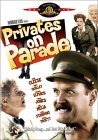
Privates on Parade
The Movie
I generally enjoy movies that cannot be easily pigeonholed into a single genre or category, but even by those standards Privates on Parade is an odd film. The 1982 British film takes place in post-World War II Malaya, where British troops are stationed to halt the onslaught of Communist guerillas. Bible-thumping Major Giles Flick (John Cleese, in a wonderfully subtle supporting performance that reins in most of his inspired comic mania but yet remains humorously pitch-perfect) is in command of SADUSEA (Song And Dance Unit Southeast Asia), a troupe of song-and-dance entertainers who are meant to raise troop spirits. The silliness and high camp-value of the musical numbers -- of which there are many throughout the film -- are juxtaposed against the gravity of wartime reality. While at one moment the men are in drag in a chorus line, at another two of the film's characters are killed in a surprise ambush. The troupe is meant to entertain and raise the spirits of the British soldiers, but their traveling company is used as a way to secretly and illegally supply weapons to Malayan guerillas.
It's a comedy!
Privates on Parade is howlingly funny at times, and at a moment's turn it evolves into something dark and tragic, poignant and heartbreaking. The cast is superb throughout: aside from the aforementioned Cleese, Dennis Quilley is magnificent as the openly-gay Acting Captain Terri Dennis. His penchant for referring to all men by feminine derivations of their name is a scream, but his monologue about how he found out about his partner's death in the war is heart-wrenching. The ferociously attractive Nicola Pagett's portrayal of Acting Lieutenant Sylvia Morgan -- the only woman in the troupe -- is a balanced and nuanced performance that resonates beautifully throughout the movie. But Privates on Parade is a strangely bipolar film; it never fully succeeds as a comedy, nor does work completely as a drama. There is much to like about the film in pieces, but Privates on Parade never truly coalesces into a singular and compelling piece of work. It's a good film, funny and melancholic, horribly tragic then suddenly reaffirming, but what could have been an excellent movie turns out to be little more than a sum of its better parts.
The DVD
Video:
Privates on Parade is featured in a widescreen 1.85:1 video presentation, and the transfer has been anamorphically enhanced. The video displays a few flaws but overall the quality is fairly good. Colors are stable and well-rendered, but there is a slightly washed-out look to the film. The transfer also looks slightly soft, but overall sharpness is maintained at a decent level. Black levels are adequate but could have been stronger. Contrasts and shadow details suffer in darker scenes, but brighter and daytime scenes are much more robust. Compression noise, pixellation, and other transfer-related artifacts are nowhere to be seen. Edge-enhancement is extremely minimal. There are some occasional scratches and debris on the print, but overall the transfer is quite clean.
Audio:
The audio is presented in Dolby Digital 2.0. The overall presentation is adequate and satisfactory, but nothing exceptional. This is primarily a center channel production. Dialog is clearly delivered and reasonably sustained throughout the film, although I turned on subtitles more than once to catch much of the heavily accented and dialect-laden English. Sound fidelity is fairly weak, especially during the song-and-dance numbers, but not unacceptable. Once you accept the film as mono, the better off you'll be.
Extras:
The only extra included is the film's Theatrical Trailer as well as trailers for The Princess Bride: Special Edition, This Is Spinal Tap: Special Edition, and the MGM Means Great Movies multi-trailer.
Final Thoughts
Stick around for the final credits while watching Privates on Parade; the main cast reunites for an inspired reprise of the film's catchy title song, including some inspired Basil Fawlty/Ministry of Silly Walks-esque cinematography from John Cleese. But when the film's best scene occurs during a "breaking down the fourth wall" moment while the film's credits scroll by, one can only sigh at what might have been. I'm not actually panning Privates on Parade as a film; when it works, it works beautifully. But when it lingers and meanders, the film's 113-minute running time seems to drag considerably. Overall, the film is worth seeing but I would not recommend a DVD purchase, especially one as light on the extras as this one. If you're a Cleese fan or enjoy British humor, you might want to give Privates on Parade a rental first.
|



| Popular Reviews |
| Sponsored Links |
|
|
| Sponsored Links |
|
|
| Release List | Reviews | Shop | Newsletter | Forum | DVD Giveaways | Blu-Ray | Advertise |
|
Copyright 2024 DVDTalk.com All Rights Reserved. Legal Info, Privacy Policy, Terms of Use,
Manage Preferences,
Your Privacy Choices 
| |||||||