
| Reviews & Columns |
|
Reviews DVD TV on DVD Blu-ray 4K UHD International DVDs In Theaters Reviews by Studio Video Games Features Collector Series DVDs Easter Egg Database Interviews DVD Talk Radio Feature Articles Columns Anime Talk DVD Savant Horror DVDs The M.O.D. Squad Art House HD Talk Silent DVD
|
 DVD Talk Forum |
|
|
| Resources |
|
DVD Price Search Customer Service #'s RCE Info Links |
|
Columns
  


 
|
|
|
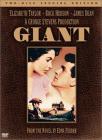
Giant - Special Edition
Edna Ferber's books were tailor-made for long, sprawling multi-generational film epics. I wouldn't be surprised if her novel Giant began 50 years back before Bick and Leslie came on the scene. As it is, this huge George Stevens production starts in the 1920s and spans thirty years or so, introducing an additional cast of characters as the babies of part one grow up. It's one of Elizabeth Taylor's best performances, and surely some of the best work by then untested actor Rock Hudson.
George Stevens' liberal agenda in Giant boils down to the championing of simple human decency over oppressive traditions. His approach to the problem of 'Texan' attitudes won the state's popular approval - mainly by portraying the proud, closed-minded ranchers as friendly and fair-minded. The end of the show is an extended Civil Rights lecture without words, that's one of the best examples of liberal filmmaking.
This two-disc special edition is quite different from the one-disc special edition completed two years ago but only distributed for a short time in Canada. Details below.
Giant certainly is an impressive film. It's a tough job to cast and direct an epic like this convincingly, and George Stevens' skill in balancing the story between sweeping events and intimate character details is remarkable. The first half in particular never seems to be in a rush (except, perhaps, when it hurries to dispose of the interesting Mercedes McCambridge character), and its surface is underpinned with unspoken textures, that seem to have details of their own. Ex child-star Jane Withers plays a rancher neighbor who hoped to marry Rock Hudson; just the hurt look on her face as she makes an effort to be sociable while meeting Hudson's new bride, 'says' a whole chapter by itself.
Stevens avoids making a parody out of the contrast between Maryland landed gentry and the new breed of baron on the plains of Texas - Elizabeth's mother (Judith Evelyn of Rear Window and The Tingler) is a snob, but a pleasant one afforded some dignity. All of the characters introduced in the first half are rich and rewarding, even folksy Uncle Bawley, a role that allows the comic Chill Wills to play straight to good effect.
The Civil Rights theme is used to counter the feudal rule of the Benedicts, and it's given equal time and emphasis. Leslie finds the local Mexican population living in primitive squalor, and when the local whites won't cooperate, betters their lot by bringing in a latin doctor. The liberalism of the film makes for interesting discussion. 1956 is fairly early for the messages we get here about non-whites - Hollywood was just admitting that 'people of color' existed as more than servants. Sidney Poitier was beginning to receive co-star status in a few liberal issue films, a big novelty at the time.
Almost all the Mexicans in Giant are menials or ranch hands, and the writers would have distorted reality if there were a token character who took a bigger role in the first half. Leslie's intervention is a sincere and personal version of the 'society lady does charity' phoniness that's always passed for compassion among the rich. It makes a difference because she actually cares, with a stubbornness equal to the Texan side of the family.
Decades of time must be covered in the second half of the film, in longer strides that that tax the film' structure. The new generation rebels entirely against Bick's Law of Riata. The heir apparent Jordan Jr. chooses medicine over ranching, and Luz's namesake is enthusiastic about cattle but doesn't want to inherit Daddy's spread. Bick did his best to impose his personal vision of reality on his kids when they were small, encapsuled in young Jordan's traumatic horseback ride, a perfect representation of the American Father's attempt to wrest control back from Mother. As adults, all they've really inherited from him is the desire to do what they want with their lives, not a bad legacy, as it turns out.
James Dean's Jett Rink character, the white-trash upstart who uses oil money to become a spoiler tycoon, is an ambivalent villain who balances out the liberal-conservative politics of Giant. Jett is the American dream being held back by entrenched money and class snobbery, and we want him to succeed even though he's a crude yokel. When he starts, he's a peon like the rest of the workers around him, but his ingrained racism runs deeper than the paternalistic thoughtlessness of Bick's ruling class. Here's a New Wealth land baron with the greed and vanity to make the old-money Benedicts seem benign by comparison, and Giant makes sure he gets his comeuppance.
Jett wants the rich man's woman, can't have her and therefore self-destructs like the pitiful lead in a classic tragedy. His story is an energetic but weak part of Giant, mainly because his second-act rise to success has to be sketched so thinly. James Dean's age makeup and performance don't get enough screen time to appear like anything but a skit - part two of this epic simply has to move too quickly to stay interesting. The gag of having him use a sneaky one-two combo to suckerpunch his adversaries shows his arrogant solution to obstacles, and his essential recklessness, but it doesn't compensate for missing character detail. One longs for the visual storytelling of the first half, where a few choice images of Jett pacing out his patch of land seems to encompass the whole story of pioneer America.
The best part of Giant's second half is its follow-through on the Civil Rights thread. Elizabeth Taylor takes second seat to events that integrate Mexicans and Anglos directly through intermarriage. The boneheaded Bick is defeated by his lineage when his prize son turns out to be very non-Texan, a non-masculine Mother's son who becomes a doctor and marries a Mexican-American woman. The eventual Latin reconquest of the West is given a strong omen in Angel Obregon (Sal Mineo). The film is unique in its use of precious running time to detail the humiliation of Young Jordan's wife Juana (Elsa Cárdenas) in a white beauty salon.
Giant resolves its twin themes with a thoughtful maturity. Jett Rink's aura is deflated before he can possess Leslie by proxy, through the daughter who has become infatuated with him. 1 Jordan Junior finds an issue worth defending as his father would, and goes up against Jett with his fists in bonded Benedict tradition.
The final scenes have been discussed forever, and often discarded as cheap liberal moviemaking. They really aren't. Bick Benedict's odd stand for Civil Rights is the payoff of what has taken him his whole life to learn. Some of it comes from Leslie and some from his own children, particularly Jordan Junior's scrap with Jett Rink. The showdown at Sarge's Burgers is a foolish fight, against a tough customer at least twenty years younger than Bick, and it's not as black and white as it appears. "Sarge" is obviously a proud WW2 veteran, for whom victory means the right to own his own diner and run it any way he wants. He didn't make things the way they are, but he shares Jett Rink's hate/fear of Mexicans, and defends his right to discriminate as part of his identity and character. Bick's fight is an attempt to apply old-style frontier justice to his hard-learned values ... a stand he'd probably never take if his own family hadn't become racially diverse. 2
This is what Leslie celebrates when she hugs the unconscious Bick, her hero. He's joined the losing side and won a victory.
Stevens' visual coda, with the two infants side by side in their playpen, is a powerful image that hammers home his essential liberal humanism without speeches. Young Anglo and Mex play, drool and stare together with their huge, hungry eyes. They're the future, which Giant says will be a blending of bloodlines - without predicting harmony or chaos. The Eyes of Texas Are Upon Us, but are they sinister or benign? The image is a gauntlet (a baby mitten?) thrown at the feet of Racial Purity.
Warner's DVD of Giant comes on two discs in the popular folding card and plastic double pak, the one the slides from an outer sleeve. Disc one is a flipper, with the 3 hour, 21 minute film spread across both sides. It has a commentary by George Stevens Jr., Ivan Moffat and critic Stephen Farber, and a docu, George Stevens: Filmmakers who Knew Him, with input from Warren Beatty, Frank Capra, Rouben Mamoulian, Joseph L. Mankiewicz, Alan J. Pakula, Antonio Vellani, Robert Wise and Fred Zinnemann. The inteviews are outtakes from the 1983 feature docu, George Stevens, A Filmmaker's Journey. Disc two has two docus, Memories of GIANT and Return to GIANT, a New York premiere TV special, newsreels of the LA premiere, other newsreels, trailers, production notes, and selected documents.
A couple of years ago, Giant came out in a special edition that was briefly released in Canada and then withdrawn. This was due to George Stevens, Jr., who very closely controls his famous father's legacy. The entire film was encoded on one side of a disc, and 16:9 enhanced. This altered it slightly from its original 1:66 ratio, and is the presumed reason Stevens Jr. killed it. The encoding of such a long film was definitely inadequate, with details compromised and sometimes fuzzy.
Spread out over two sides and given a good bit rate, the new flat transfer will look far better on a normal 4:3 monitor. Blown up on a widescreen 16:9 monitor, it gets slightly softer but still has an edge on the Canadian disc. 4 The verdict comes down in favor of the new transfer, and Stevens Jr.'s intervention.
The docus are a mixed bag, with some passages being unfocused and lingering far too long on individual testimony. There's also a lot of repeated material, especially input from George Stevens Jr.. His annoying introduction that opens the film attests only to his vanity.
The premiere special and newsreels are great for star-watching; in contrast to the organized star parade in the similar special for A Star Is Born, this half-hour sticks Chill Wills and too many celebrities in a cramped space in front of a New York theater. It's fun watching them stumble on and off camera, while the emcees try to deal with camera-crashing charity executives and their wives. The Hollywood premiere newsreel clearly shows Clint Eastwood, then a contract player & relative nobody, in line behind a bigger star. Some interesting documents and correspondence make up another interesting extra.
Few fans were able to buy the earlier Canadian release, but even those who did may want to invest in this improved special edition.
On a scale of Excellent, Good, Fair, and Poor, Giant rates:
Movie: Excellent
Video: Excellent
Sound: Excellent
Supplements: Commentary by filmmaker/Stevens family archivist George Stevens Jr., screenwriter Ivan Moffat, and critic Stephen Farber; Docus: George Stevens: The Filmmakers Who Knew Him, Memories of Giant, Return to Giant"; New York premiere TV special, Hollywood premiere and project kickoff newsreels, 2 Warner Bros. Presents behind the cameras featurettes, Photo and document galleries, production notes, director filmography
Packaging: Card and plastic sleeve case
Reviewed: June 5, 2003
Footnotes:
1. Strange echoes of The Searchers, there - who says American Westerns aren't sexually perverse?
Return
2. The term is used for simplicity, even though I know that the distinctions between white and latin are often not racial.
Return
4. The minors, like Anchor Bay, solved this problem by transferring 1:66 films 16:9, retaining the full height of the image by adding thin black bars on the sides. This solution makes widescreen monitor owners happy, but is less friendly to flat-Earth DVD fans, who would have to accept a substantially smaller image.
Return
| |
|



| Popular Reviews |
| Sponsored Links |
|
|
| Sponsored Links |
|
|
| Release List | Reviews | Shop | Newsletter | Forum | DVD Giveaways | Blu-Ray | Advertise |
|
Copyright 2024 DVDTalk.com All Rights Reserved. Legal Info, Privacy Policy, Terms of Use,
Manage Preferences,
Your Privacy Choices 
| |||||||