
| Reviews & Columns |
|
Reviews DVD TV on DVD Blu-ray 4K UHD International DVDs In Theaters Reviews by Studio Video Games Features Collector Series DVDs Easter Egg Database Interviews DVD Talk Radio Feature Articles Columns Anime Talk DVD Savant Horror DVDs The M.O.D. Squad Art House HD Talk Silent DVD
|
 DVD Talk Forum |
|
|
| Resources |
|
DVD Price Search Customer Service #'s RCE Info Links |
|
Columns


 
|
|
|
Thing from Another World, The
Savant was too young to catch the first wave of classic 50s sci-fi, but guys about ten years older tell me that The Thing from Another World was the big thrill of the day, the kind of picture that convinced kids that The Thing was hiding in their closets. It's a great picture from several overlapping points of view - the so-called 'betrayal' of serious Science fiction, the Howard Hawks angle, even the influence of Howard Hughes.
Thirty-odd soldiers and scientists at the North Pole duke it out with a threat never before encountered, a murderous lifeform from Outer Space. In one stroke, producers discovered that Ideas weren't required to make a successful Sci-fi movie. The mysteries of space and technology could be a quick excuse for scary rubber monsters. The Thing from Another World has plenty of interesting ideas, but what brought the kids in were the high-tension thrills.
Almost everyone loves The Thing from Another World now, but in 1951 it raised the tempers of some usually-cool literary critics who had hoped that the success of Destination Moon and Day the Earth Stood Still was indicative of a new genre dedicated to the level-headed, lofty subject matter of written SF, and not Flash Gordon antics. Howard Hawks' thriller took a scary short story with an interesting and cerebral SF concept - a shape-shifting alien that can duplicate other life forms - and reduced it to a gripping Custer's Last Stand at the North Pole. Two-fisted gun-toting heroes fought tooth and nail with a very pedestrian, Frankenstein-like boogey man. Not only that, but these mostly liberal SF critics didn't like the fact that the show's main conflict pitted soldiers against scientists and unfairly stacked the deck. Kenneth Tobey's airmen are warm, sentimental, funny, and concerned with humanistic ideas like survival, whereas the scientists are intellectual eggheads with values skewed away from what was best for the human race. The soldiers aren't war lovers - they decry the invention of the atom bomb - but the blame for that is implicity placed on those calculating, inhuman scientists. Robert Cornthwaite's suave researcher is fanatically enthused about the obviously dangerous monster, calling it superior to Man in every way. To him, knowledge is more important than lives or even survival.
The Thing from Another World's slick and engaging script presents this conflict with some interesting details, blaming the coldfish Doctor Carrington's misjudgment on overwork. His own associates don't share the depth of his zeal, and the isolated thinker (spoiler) only redeems himself by a sincere and concientious act of bravery. The soldiers know that Carrington 'doesn't think the way we do', and that his attitude is a menace in and of itself, but they respect him for his willingness to fight for his beliefs.
The clever group staging of The Thing presents Howard Hawks' much-discussed 'male professional unit' in its most interesting form. There's no charismatic leader, no Cary Grant (Only Angels Have Wings) or John Wayne (Rio Bravo) to tell us who's right. The excellent Kenneth Tobey, making the best of his one crack at leading stardom, is likeable but lacks the assumed authority of a Star Hero. 1
The rest of the ensemble is inspired. Scotty the reporter is the ubiquitous Douglas Spencer (This Island Earth, The Kentuckian). He's established as having been a daring front-line war correspondent. The fliers are a pleasant bunch, without a dominant alpha male among them. James R. Young is the tough co-pilot. Robert Nichols, a smallish joker (he reads the magazine reference to flying saucers) is a familiar Hawks face and also seen in This Island Earth. William Self, the fellow who didn't know the blanket was electric, became a very big network television executive. Dewey Martin we all know from his starring turn in The Big Sky.
These guys have all bonded because of military and war experience, and they're as cozy in the confines of a cargo plane as when fighting mean green mothers from outer space. The scientists are, by and large, individuals. When Carrington gathers them together, it's a meeting, not a casual, natural gathering of like-minded peers. They have disagreements with each other and with Carrington. They tend to present facts, while the soldiers dispense decisions. When Carrington gives illogical or unwise instructions, his associates meekly obey, instead of snapping back an objection, as one of Captain Hendry's men would. The one scientist with a wife in tow, big John Dierkes (The Naked Jungle, X,the Man with the X-ray Eyes) is the first to defect to the soldiers' camp.
The arctic lab is a little community that needs solidarity and unity of purpose to win its death struggle with the unknown, and the soldiers know that there's no time to argue finer points of morality or philosophy when monsters are banging on the door. This makes The Thing an initial manifestation of the Cold War edict that demands that all citizens are either 'with us, or against us' against a perceived threat. 'United We Stand' yells the bumper sticker, but the real message is that there's an unspoken 'we' out there with the authority to decide policy, and the job for the rest of us is to follow. There's no room for dissenting Carringtons, no matter how sincere they are. This is War. 2
The other equally-notable 50s convention is the presence of women and minorities who mostly serve the men. Our heroine, a typical gutsy-but-sexy Hawks dame with a nickname, is Nikki (Margaret Sheridan). She doesn't lead any sing-alongs (are we sure this is a Hawks movie?), but she does use a coffee pot as an excuse to butt in on the male discussion long enough to add little quips, like suggesting the best defense against a murderous vegetable. There's an almost kinky scene that seems an outgrowth of Hawk's screwball comedies about emasculated men (I Was a Male War Bride again, Monkey Business). Hendry is tied to a chair while Nikki feeds him drinks. Even though he soon gets himself loose, it just shows the lengths he'll go in ditching his pride, to interest his favorite girl.
One thing not mentioned much about The Thing from Another World, is that it's a terrific production. The confined warren of the arctic lab really looks assembled from prefab sections hauled in by plane, and the frequent icy breath of the actors reminds us that the cold up there is real. All the rooms appear to have full ceilings. There are some curious sets with big heat-losing windows (the General's have quaint curtains on them), and some thin doorways open directly between indoors and outdoors in a very unlikely way. "Shut the door, it's 30 below outside". Other than that, we really believe we are where Hawks says we are.
The action is terrific for 1951, especially the 'fire scene', which appears to be occurring just as we see it, in a couple of mastershots with all that kerosene and flames being thrown around. It's pretty creepy to watch the sequence in detail, and note the mass of fire that erupts on and around the mattress in the corner, the one Nikki is under. I'm assuming that the featured players were all replaced by stuntmen for this action. 3
Appearances by The Thing (James Arness) are kept short and abrupt, with the result that he remains a very frightening menace, despite his somewhat ordinary design. In the best shock moment, a quick view through a doorway is enhanced by an optical that slightly diffuses just that area of the picture in which Arness appears. It gives the shot an extra kick of weirdness, a "Did you see that?" quality.
I've never been very interested in the 'controversy' over who directed The Thing from Another World. It's obviously Hawks, or the whole thing was planned and rehearsed by him. Editor Nyby needed a credit to join the director's guild and Hawks helped him out. If anything, it shows Hawks' willingness to disassociate himself from The Thing - he'd invented the Sci-fi monster picture, and (I'm guessing) didn't value it at the same level as the rest of his work. It had no stars, wasn't going to win any awards, etc. He was probably right. Once the Sci-fi pictures had become sterotyped as made of little more than a flashy poster and a rubber monster, with no-name casts, most mainstream directors stayed away from them.
Warners' DVD of The Thing from Another World is an okay but not stunning disc. The one laser disc that reinstated the scenes trimmed for a reissue, could only present them in much-degraded 16mm. It was easy to see what had once been cut out (as with the long cut of The Big Sky on TCM). Here, it almost looks as if the cut scenes have been improved in telecine, but the scenes around them de-sharpened slightly to make a better match! This probably isn't the case, and lazy compression has softened things a bit, but even the final scene, with Scotty finally getting on the radio, looks slightly soft and washed-out. Also, there are 3 or 4 unaccountable breaks in the film, where frames are missing.
This is a 1951 movie, so it's definitely pre-Scope and pre-widescreen, but the titles all have fat dark bars top and bottom, with a soft edge. They matte off perfectly to 1:78. Of course, when the film proper starts, Hawks' (or Nyby's) compositions fill the frame and need to be projected in 1:37.
Dimitri Tiomkin's jolting, aggressive music, with its sharp notes and theremin accents comes across in all its violent glory. It must have scare kids in '51 before the story even got going. It's a great score, staying out of the way of the drama, but blasting in whenever the audience needs to be shaken up.
Savant has been given a good rundown on the missing and now recovered material in The Thing from writer and Thing aficionado, Robin Brunet. He tells me that before this disc, the only way he could obtain a truly complete version was to edit one together himself. Here's his rundown of the re-instated material, for purists (and the curious like me):
The first restored scene is Captain Hendry's briefing at General Fogarty's headquarters. The restored part is less than a minute long. It includes a messenger who enters with a weather report, and Fogerty's pithy remark that, for all he cares, Hendry can "maroon" newspaperman Scott at the North Pole.
The second, third and fourth restored scenes were the biggest cuts to The Thing when it was released in '53, and represent a major shift in the tone and narrative of the movie. The second restored scene runs several minutes and consists of Hendry enjoying a shave in the barracks. Ned Scott voices growing frustration over his inability to transmit his story to the outside world and there's more banter between Hendry and his-co-pilot.
The third restored scene occurs immediately after the barracks sequence and involves dialogue between Hendry and Nicki in the mess room (Nicki: "What does that bogey man in the cake of ice really mean?"). The scene culminates in Nicki inviting Hendry to her office and he promising that she can tie his hands together for decorum's sake.
The fourth restored scene is the longest: it is the pivotal 'drinking scene' between Nicki and Hendry in her office. It is a typically Hawksian touch reminiscent of his finest films and adds a romantic undertone to the film that the truncated version only hinted at.
Without these three scenes, The Thing was essentially an action film, jumping from the point where the block of ice is stored away directly to the moment when the electric blanket is thrown over it. Film historians such as Leonard Maltin have long warned fans to avoid the edited version of The Thing, but up until the DVD release there has been little if any opportunity to view the film in its entirety.
To confuse matters further, some historians have argued that edits to The Thing were an urban myth. This is because the film was long said to have included a scene during its initial run in which the creature's victims were shown hanging upside down in the greenhouse. In fact, that scene was never shot. Since journalists over the years mistakenly claimed this scene was 'edited out' for the re-release, historians have countered that no such cuts were made for the re-release - oblivious to the fact that major chunks of the narrative were dropped for the sake of trimming the film's already lean running time.
Warners has also restored some minor 'lost' shots, including a location shot of Hendry's crew and dogsleds climbing across a ridge towards the buried saucer; and a half-minute of dialogue restored to the scene in which the scientists gather around an exhausted Dr. Carrington (who mentions his 'minor' skirmish between himself and Hendry).
Hope this is of interest to your readers - Robin Brunet
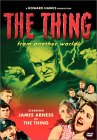
The package box artwork adds a closeup of James Arness as the Thing to the old don't-show-the-monster ad art. The movie itself is almost devoid of closeups, even more than the usual Hawks effort. A pretty crummy-looking trailer consists almost completely of alternate takes, including several unused angles from the fire scene.
On a scale of Excellent, Good, Fair, and Poor, The Thing from Another World rates:
Movie: Excellent
Video: Good -
Sound: Very Good
Supplements: Trailer
Packaging: snapper case
Reviewed: August 7, 2003
Footnotes:
1. Kenneth Tobey was always fine in small masculine bits in pictures, particularly one comedy scene in Hawks' I Was a Male War Bride. Hawks made two 'Winchester' pictures, this and The Big Sky, neither of which had superstar male leads. The Thing from Another World seems to have been conceived as an exploitation picture about a monster, the kind of thing a big star wouldn't get involved with anyway. As it was distributed by RKO, one can see Howard Hughes pushing his then-favorite leading man for 'small' movies, Charles McGraw, and being turned down. It's nice that Tobey got the part, as it makes the movie a true ensemble, instead of the typical setup of The Star backed by 20 'supporting players'.
I think this made the story even more unpredictable for 1951 viewers - there's no absolute certainty that a leading player like Tobey isn't going to become a victim of the bloodsucking carrot. (The other angle that probably sold Hughes on helping make the film is of course the aviation angle. Those fliers act and talk 100% authentic.)
Return
2. It's more than a bit disconcerting when Dewey Martin enforces Hendry's order for Carrington to back down by brandishing his rifle, calmly hinting that he threatens to use it. When I was a kid, I thought this was really cool. Now, it's caveman aggression - the kind of naked force powerless kids seek guns to attain. It also stands as a cool symbol of the nation, coming out of war, now feeling entitled to use armed force to quell dissent.
Return
3. There are two unintentionally funny moments during the Thing's final attack (spoiler). The defenders have barricaded a hallway door with 4x4s and strong braces, to keep it from being opened. But when Arness enters, the door proves to open the other way, a gag right out of Abbott and Costello meet Frankenstein!. A major continuity point follows immediately: Arness stomps in, each foot landing with a blast of Tiomkin's mickey-mouse'd music. The barricade is now a pile of random lumber on the floor before him. We cut to the nervous defenders. We then cut back to Arness, and now there's a new 4x4 beam lying just under his right arm, ready to pick up! There, now I've ruined the scene for everyone!
Return
| |
|



| Popular Reviews |
| Sponsored Links |
|
|
| Sponsored Links |
|
|
| Release List | Reviews | Shop | Newsletter | Forum | DVD Giveaways | Blu-Ray | Advertise |
|
Copyright 2024 DVDTalk.com All Rights Reserved. Legal Info, Privacy Policy, Terms of Use,
Manage Preferences,
Your Privacy Choices 
| |||||||