
| Reviews & Columns |
|
Reviews DVD TV on DVD Blu-ray 4K UHD International DVDs In Theaters Reviews by Studio Video Games Features Collector Series DVDs Easter Egg Database Interviews DVD Talk Radio Feature Articles Columns Anime Talk DVD Savant Horror DVDs The M.O.D. Squad Art House HD Talk Silent DVD
|
 DVD Talk Forum |
|
|
| Resources |
|
DVD Price Search Customer Service #'s RCE Info Links |
|
Columns
  



 
|
|
|
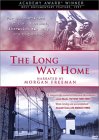
Long Way Home, The
The liberation of thousands of Jewish people from Nazi concentration camps at the end of World War II is usually viewed as the end of a crisis, not the opening up of new ones. But for a large part of the population of Europe, both Jewish and non-Jewish, "going home" was problematic at best: with homes destroyed, families dead, and livelihoods vanished in the economic chaos of the war and post-war reconstruction, where would they go, and how would they live? For the newly freed Jews, it was even more difficult to pick up where they left off; rampant (and often violent) anti-Semitism had not stopped just because Hitler and his Nazi party were no longer in control. The Long Way Home, as its title implies, takes a look at the post-war experience of the European Jewish population, and their struggle to find a new home to start their lives again.
The film makes an effort to show what life was really like for the surviving Jews, who found themselves living in "displaced persons" camps that were little more than new concentration camps. As the documentary develops, we see how the idea of Israel became a goal for thousands of illegal immigrants wending their way out of Europe to head into Palestine, while the ever-growing issue of the Jewish "displaced persons" served as pressure for the official formation of the state of Israel.
The Long Way Home makes extensive use of archival footage from the 1945-1948 period that the film covers, along with still photographs. The overall narration, voiced by Morgan Freeman, is occasional rather than constant; much of the exposition of the documentary is done through actors reading excerpts from letters and journals written by a variety of individuals involved with the events described. Interspersed through this retrospective material are a number of present-day interviews with people, reflecting on the events that they lived through.
With its wealth of material at hand, and its focused topic, The Long Way Home seems to have what it needs to be a solid documentary. However, I found that two main failings hold it back.
First of all, The Long Way Home is a film that, at two hours of running time, really ought to have been no more than an hour long. The pacing is agonizingly slow; for every snippet of interesting information, we get a large chunk of less interesting material, often repeating ideas or impressions that have already been presented. The film also overuses the technique of letting archival footage run without commentary; after a certain point, it loses its emotional impact. I suspect that the intention here was to emphasize what the Jewish post-war experience was like, by lingering on the individual impressions of many different people, but it doesn't quite work. The documentary doesn't follow any particular individuals, so despite the various interview clips and excerpts from diaries and letters, the program as a whole feels rather impersonal and distanced, while at the same time, lacking the narrative impulse that a more focused structure would have provided.
The other, and more severe, flaw in The Long Way Home is how unbalanced the presentation was. I'm not talking about the tight focus of the film on the Jewish experience, which in itself is perfectly satisfactory. Rather, I'm referring to the film's disregard for the historical, social, and political context of that experience. Everything is shown from one angle, and one angle only: that of the Jewish refugees who wanted a new home. This is apparent even early in the program; for example, although thousands of non-Jewish refugees shared the camps with the Jewish refugees, these people are only glancingly mentioned in the film, and the problems faced by the Jews are treated as if they were unique. But while their religious and ethnic identity did make the Jewish situation somewhat different, I found it distressing that the film basically ignored the existence of so many others who had similar problems of homelessness, destitution, and psychological trauma.
When it comes to the political context of the events discussed in the film, there's a similar lack of balance. Much is made of Britain's denial of increased immigration to Palestine, for instance, but there's no discussion of the reasons why the British government might reasonably reject this proposal. Even I can see that the immediate influx of a hundred thousand or more destitute refugees into a fairly small country would have had profound destabilizing effects on that country's economy and society, but this is not even mentioned, much less dealt with.
The Long Way Home ends abruptly in 1948, with thousands of Jewish refugees headed to the newly-created state of Israel. It's treated as a happy ending, even a fairy-tale one: after almost being exterminated as a people, the Jews finally have a home. However, this feel-good conclusion once again neglects some important context. If Israel had been a real-life case of "and they lived happily ever after," the film would have more of an excuse for ignoring the issues raised by the creation of this new nation... but a glance at a history book will tell us that Israel has been far from a peaceful state, with conflicts arising from Israel's aggressive behavior as a nation as well as from the Jewish-Arab antagonism that was far from resolved by dividing Palestine.
There's certainly plenty of fruitful material to consider here. At what point do people cease to be invaders, and become simply the co-inhabitants of a region? In The Long Way Home, the point of view of the Arabs living in Palestine is completely ignored; they are consistently presented as interlopers in Palestine, despite the fact that the film does mention that they'd lived in the region for more centuries. To what extent can the Jewish immigration into Palestine be reasonably viewed as an invasion? We only see the issue from the immigrants' point of view, and we're told nothing of how the influx of refugees affected the region's economy or culture. Are there any easy, clear answers? In truth, absolutely not: if there were, the Middle East would be at peace today. But The Long Way Home tries to present the complex and painful dilemma of the post-war refugees as a simple problem, easily solved by the creation of Israel. No matter what answer the film eventually arrives at, it would have been a much better and more substantial program if it had made more of an effort to show other points of view, and to represent the issues in a more realistically complex way. As it is, The Long Way Home ends up not doing justice to its material.
The DVD
Video
The Long Way Home is presented in a 1.33:1 aspect ratio, although it's listed as being widescreen on some Internet sites. I'm not absolutely sure that this is its correct aspect ratio, but I would say that it probably is; the framing looks correct.
Most of the footage dates from the 1945-1948 period, so it's to be expected that it's not of the best quality, but the archival footage does look reasonably good. The black-and-white material is clearly worn, with scratches and flaws heavily apparent, and with some parts of the footage very soft and blurry, but it's watchable. The present-day interview footage looks satisfactory; it's not as sharp or as natural-looking as it could be, but it's all we really need for talking heads. Overall, The Long Way Home isn't visually impressive, but it's adequate for the material it's presenting.
Audio
Viewers have a choice of a Dolby 5.1 and a Dolby 2.0 soundtrack for The Long Way Home. The various voiceovers play the greatest part in the soundtrack, with interviews taking up the slack, so there's not a lot to demand from the track other than clarity. The Dolby 2.0 track is satisfactory for the most part, although the sound isn't as clear as I would have liked. The Dolby 5.1 is the better track, with nicely clear dialogue and voiceovers throughout the film.
Extras
A photo gallery, biographies of the filmmakers, and a trailer for the film are included. A non-skippable trailer for In Search of Peace, another documentary from Koch Lorber, plays automatically before the menu screen appears.
Final thoughts
Despite its rather one-sided approach to the material, it's undeniable that The Long Way Home does provide insight into an aspect of post-World War II recovery that is not very well known. Given that it's a bit overly long for the actual information content that's provided, the film has a fairly low repeat viewing value. It would be a good rental choice for viewers who are interested in the subject, or who are interested in World War II and its aftermath in general.
|



| Popular Reviews |
| Sponsored Links |
|
|
| Sponsored Links |
|
|
| Release List | Reviews | Shop | Newsletter | Forum | DVD Giveaways | Blu-Ray | Advertise |
|
Copyright 2024 DVDTalk.com All Rights Reserved. Legal Info, Privacy Policy, Terms of Use,
Manage Preferences,
Your Privacy Choices 
| |||||||