
| Reviews & Columns |
|
Reviews DVD TV on DVD Blu-ray 4K UHD International DVDs In Theaters Reviews by Studio Video Games Features Collector Series DVDs Easter Egg Database Interviews DVD Talk Radio Feature Articles Columns Anime Talk DVD Savant Horror DVDs The M.O.D. Squad Art House HD Talk Silent DVD
|
 DVD Talk Forum |
|
|
| Resources |
|
DVD Price Search Customer Service #'s RCE Info Links |
|
Columns
  


 
|
|
|
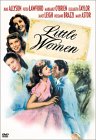
Little Women (1949)
Louisa May Alcott's classic novel of family life, Little Women, has been brought to the film or television screen a number of times. The 1949 version followed sixteen years after 1933's black-and-white production starring Katherine Hepburn; its main merits seem to have been that it was in Technicolor, and that its cast included such popular actors as June Allyson (Jo), Elizabeth Taylor (Amy), Janet Leigh (Meg), and Peter Lawford (Laurie). While the 1933 version has a distinct charm of its own as well as offering some good performances, Mervyn LeRoy's 1949 remake seems a little bit lost.
For what is supposed to be a period piece, 1949's Little Women does remarkably little to evoke the time and place of the original story, which takes place around the U.S. Civil War. The costumes and sets are more or less appropriate, but I couldn't shake the feeling that this was very much a reflection of 1949, not 1868. As performed by their respective actors, the "little women" of the title could have walked off the set of any other film being done that same year; while I can see that the film might be trying for a theme of "family is universal," the contemporary feel really is overdone. Similarly, several of the minor changes to the original story aren't really necessary unless they're to make the "old" story more easily digestible for a 1949 audience. Jo's beloved "Professor," for instance, is supposed to be an older man, and certainly much older than her more socially acceptable beau, Laurie, but in the film he's about the same age as Jo and Laurie, sapping the relationship of much of its meaning in the context of the story.
Rather curiously, the story seems to follow the 1933 adaptation very closely as to which key scenes from the book are filmed; many of these scenes are even set up and filmed in exactly the same way. It's as though the 1949 film is basically an "update in color" of the earlier production. And there's no particular reason for the carbon-copy approach, either. The original novel is quite long, and contains a substantial amount of material that doesn't make it into either version of the film, including some excellent dramatic scenes of the sibling rivalry between Jo and Amy; in the novel, the two are much more at odds than the film would suggest, and so their eventual "reconciliation" is much more meaningful.
As a slice of family life, the story of Little Women contains both tragic and happy moments. The 1949 Little Women seems determined to emphasize the happier, lighter side of the story; while it still contains Beth's tragedy (it would be pretty much impossible to cut that and still have a recognizable Little Women), the March family's poverty, and Jo's struggle to become a writer, these are merely shadows on an otherwise very cheery story. Broad comedy also takes a larger role than I'd expect, starting with the opening scene of Jo falling on her face in the snow, and continuing with various comedic touches throughout the film. I didn't find this approach to telling the story to work particularly well; the four March girls all have their quirks, but exaggerating them for comedic effect just makes them more stereotyped and less believable. While Meg is basically colorless, Beth (Margaret O'Brien) is simply too good to be believed (which is admittedly a problem in the original novel as well), Amy is a cartoonish caricature of a vain young lady, and Jo herself is an exaggerated tomboy, so much so that we don't really get a sense of tension between her desire to be free and act as she pleases, and the constraints of society.
Nonetheless, Jo ends up being the saving grace of the film; June Allyson's energetic performance is a breath of fresh air in scenes that are otherwise overloaded with sappiness or just plain bad acting (with Elizabeth Taylor being the prime offender in that department). In the end, this version of Little Women ends up being watchable but uninspired.
The DVD
Video
The 1949 release of Little Women is presented in an aspect ratio of 1.33:1, which is acceptably close to the original 1.37:1. All in all, the transfer clocks in at above average for a film of its era, but certainly not one without issues. The print appears to be in fairly good condition; some small print flaws appear throughout the film, but they aren't very distracting. A moderate amount of noise is more of an issue; it's especially visible in shots that have large amounts of a solid color (such as sky). The noise and some edge enhancement also contribute to the overall lack of sharpness of the image. Close-up shots and medium-distance shots generally look nicely clear, but in long-distance shots, the lack of detail further out becomes quite evident.
Colors look reasonably good throughout the film; they're not quite natural-looking at times (skin tones are a touch too reddish, and other colors are a bit muted), but considering that this is one of the earlier Technicolor films, Little Women's colors come out quite well. Contrast is handled very well, with no problems at all; both brightly-lit and darker scenes have a nice balance of light and shadow, with sufficient detail.
Audio
One area in which the transfer shines is in its soundtrack. While the Dolby mono track certainly doesn't offer the "surround" experience of modern films, the fact is that this dialogue-driven film really doesn't require anything special in that department anyway. The sound is clear and always clean, with the dialogue coming across as crystal-clear throughout the film. While I felt that the musical score was a bit cheesy, in technical terms I can't complain about its balance with the dialogue: the music is always supportive of the dialogue, and never overpowers it.
A French mono soundtrack is also provided, along with subtitles in English, French, Spanish, Portuguese, Japanese, Chinese, Bahasa, Thai, and Korean.
Extras
The main special feature included on this DVD is an audio-only track with the Lux Radio Theater production of Little Women, from March 13, 1950. June Allyson, Margaret O'Brien, Janet Leigh, and Peter Lawford reprise their film roles for this radio broadcast. The audio quality is quite good, though the material is likely to be of interest only to devoted fans of the film.
The other bonus material consists of a trailer for the film, a short text essay on the different film adaptations of Little Women, a list of the film's Academy Awards (although "list" seems not the right word; the film won a single Oscar, for Best Art Direction/Set Direction in Color), and a cast and crew list.
Final thoughts
The 1949 film version of Little Women is in no danger of becoming the definitive version of Alcott's novel; while it has its merits (mainly a lively performance by June Allyson as Jo), it's uneven overall, and seems to evoke 1949 much more effectively than its putative 1868 setting. Fans of the actors may enjoy this, and families will find it a moderately entertaining, if slightly bland, option for viewing together. It's a good choice as a rental.
|



| Popular Reviews |
| Sponsored Links |
|
|
| Sponsored Links |
|
|
| Release List | Reviews | Shop | Newsletter | Forum | DVD Giveaways | Blu-Ray | Advertise |
|
Copyright 2024 DVDTalk.com All Rights Reserved. Legal Info, Privacy Policy, Terms of Use,
Manage Preferences,
Your Privacy Choices 
| |||||||