
| Reviews & Columns |
|
Reviews DVD TV on DVD Blu-ray 4K UHD International DVDs In Theaters Reviews by Studio Video Games Features Collector Series DVDs Easter Egg Database Interviews DVD Talk Radio Feature Articles Columns Anime Talk DVD Savant Horror DVDs The M.O.D. Squad Art House HD Talk Silent DVD
|
 DVD Talk Forum |
|
|
| Resources |
|
DVD Price Search Customer Service #'s RCE Info Links |
|
Columns


|
|
|
Doctor Zhivago (2002)
In the years before the Russian Revolution, Yury Zhivago lives in comfort and security; though an orphan, he is brought up by his loving aunt and uncle alongside his cousin Tonya, who seems destined to become his wife. After becoming a doctor, Yury (Hans Matheson) envisions a life that allows him to pursue his two passions: healing the sick, and writing poetry. But Russia is stirring with the beginnings of the revolution, and Yuri will soon find himself caught up in the profound changes in society. At the same time, his path crosses that of Lara (Keira Knightley), a young woman whose life has been altered by her relationship with the powerful Komarovsky (Sam Neill).
The 2002 television adaptation of Boris Pasternak's novel Doctor Zhivago is a respectable effort, one that offers a reasonably entertaining story despite not quite reaching the high mark of profound drama that it seems to have been striving for. Doctor Zhivago has two interconnected stories: the personal lives and loves of its characters, and the effects of the Russian Revolution of 1917. The story is sharply critical of the revolution; examples of brutality and injustice done in the name of "the people" abound. The overthrown Czarist regime is not given any prettier a treatment, however: we see the horrific waste of lives in World War I as well as the horrors done by the Czarist supporters against the revolutionaries.
The historical aspect of Doctor Zhivago is probably the most well crafted part of the film. Throughout the film, we see snippets of actual film footage of the events of the time; these are deftly blended into "aged" modern footage that then does a reverse fade from black and white to full color. The effect is of history coming to life, reminding us that the long-ago struggles, sacrifices, loves, and losses were part of the lives of real people.
It's the love story that's supposed to take center stage, though, and here Doctor Zhivago falls a little flat. Two relationships are key to understanding the struggles of the characters: that of Yury Zhivago and Lara, and that of Lara and Komarovsky. However, neither of these really feels completely believable.
The chemistry between Yury and Lara is a bit problematic, perhaps because Alexandra Maria Lara does such a good job of making Yury's wife Tonya utterly charming that his married life seems by far the better choice. I think the film is suggesting that true love is sometimes mysterious, spontaneous, and seemingly illogical, but nevertheless tremendously powerful; it's just that the relationship between Yury and Lara doesn't quite capture that magic.
Sam Neill does a decent job of making Komarovsky a rather ominous figure, but he hasn't been given enough screen time to really fill out the character. He's obsessed with Lara, but we don't really understand why, or to what extent; likewise, he's painted as a dangerous, evil man, but apart from his strange relationship with Lara, we don't see his darker side. He's implicated in the death of Yury's father, but the story only briefly sketches out what happened, and from what we see, he comes across as unpleasant but not necessarily evil. As it's presented in the film, Komarovsky's pursuit of Lara is harassing rather than truly threatening; there's really no sense that he holds any real power over her.
At three hours and 45 minutes, Doctor Zhivago does run a bit too long, with some of its scenes feeling slightly bloated. On the other hand, structurally it works reasonably well; it's one of the rare instances of a long production that doesn't sag in the middle. The first half is moderately interesting, but it's the first part of the second half that's the most engaging, as we see Yury and his family dealing with the effects of the revolution. The film does lose its impetus in the last forty minutes or so, though; the ending would have been a lot more effective it if had been edited down.
Doctor Zhivago is officially unrated, but the DVD case indicates that it is "recommended for mature audiences." There's a considerable amount of violence in the film (it does take place during the Russian Revolution) and some rather gruesome scenes.
The DVD
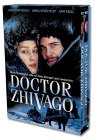
Doctor Zhivago is a two-disc set, with the two DVDs in their own keepcases inside a glossy paper slipcase.
Video
Doctor Zhivago is presented in an anamorphic widescreen transfer, at its original aspect ratio of 1.85:1. The picture is reasonably good; colors look clean and natural, and contrast is satisfactory in well-lit scenes. Scenes with lower light levels are problematic, though: contrast suffers a bit, and the image becomes very soft and grainy.
Audio
The Dolby 2.0 sound is, like the video transfer, satisfactory without being exceptional. The dialogue is generally clear and understandable, but the overall sound is slightly flat, and at times the dialogue does become slightly muffled. English subtitles are offered.
Extras
About seventy minutes of interviews are included, divided between the two discs. Disc 1 has the cast interviews: Hans Matheson, Keira Knightley, Sam Neill, and Kris Marshall (Pasha). Disc 2 has the crew interviews: Giacomo Campiotti (director), Andrew Davies (writer), Anne Pivcevic (producer), and Andy Harries (executive producer). The crew interviews are the most interesting, as the cast interviews tend to be fairly pedestrian. We also get a photo gallery, filmographies, and a text biography of author Boris Pasternak.
It's best not to look at the menu screens for too long: they're animated with clips from the film, and contain rather substantial spoilers.
Final thoughts
The 2002 miniseries version of Doctor Zhivago didn't knock me out, but it was worth watching, particularly for its vision of life in the tumultuous years before, during, and immediately after the Russian Revolution. I'd suggest this as a solid rental choice.
|



| Popular Reviews |
| Sponsored Links |
|
|
| Sponsored Links |
|
|
| Release List | Reviews | Shop | Newsletter | Forum | DVD Giveaways | Blu-Ray | Advertise |
|
Copyright 2024 DVDTalk.com All Rights Reserved. Legal Info, Privacy Policy, Terms of Use,
Manage Preferences,
Your Privacy Choices 
| |||||||