
| Reviews & Columns |
|
Reviews DVD TV on DVD Blu-ray 4K UHD International DVDs In Theaters Reviews by Studio Video Games Features Collector Series DVDs Easter Egg Database Interviews DVD Talk Radio Feature Articles Columns Anime Talk DVD Savant Horror DVDs The M.O.D. Squad Art House HD Talk Silent DVD
|
 DVD Talk Forum |
|
|
| Resources |
|
DVD Price Search Customer Service #'s RCE Info Links |
|
Columns
  


 
|
|
|
Man Who Laughs, The
It's not often that one gets a chance to discover a great silent movie in good condition. The Man Who Laughs is a superior costume drama with macabre overtones; it's an excellent example of the artistic silent cinema that was wiped out by the coming of sound. Direction, design and acting are superb. Conrad Veidt's performance is the equal of Lon Chaney and the film as a whole much more satisfying than Universal's earlier Hunchback of Notre Dame and The Phantom of the Opera.
Kino enhances its stable of quality silents with this 1999 Italian reconstruction. Pulling from European sources, the restorers have pieced together a good-looking version complete with risqué material not shown in the United States.
Carl Laemmle's brand of Universal Horror really began with this classy costume drama, which gathered an excellent cross section of talent both European and American for a hybrid German Expressionist scare picture. Whereas most of Universal's later horror films would be affected by one kind of compromise or another, The Man Who Laughs received the benefit of the Studio's absolute faith. There's no need for excuses here.
Laemmle returned once more to a French classic by Victor Hugo, about another grotesque character struggling for happiness in a historic setting. The notion that roving gypsies called 'Comprachicos' steal children is combined with a cruel royal punishment to provide an unnatural plight for young Gwynplaine. His lips have been cut away to leave his face in a permanent open-mouthed grin. 1
Yet Gwynplaine grows to adulthood as a noble fellow, a performer for the warm-hearted Ursus. The pathos stems from his doubts about whether he should marry the blind Dea (top-billed Mary Philbin). She's unaware of his appearance. How can he be sure she loves him for who he is?
The main plot is an exciting swirl of decadence and deceit among the upper classes. Gwynplaine's existence is an opportunity for court schemers to discredit Duchess Josiana, a wanton noblewoman who bathes in the nude (a surprising sight in this 1928 film) and entertains herself by being pawed by 'ruffians' at a public fair. Olga Bacalanova of Freaks plays her with an ample dose of heavy-breathing sensuality. Her perverse delight at the sight of Gwynplaine is as morbid as anything in Tod Browning.
The Man Who Laughs has a good story and acting combined with superior direction that has none of the creakiness of ordinary silent film fare. Ace director Paul Leni (Waxworks) knows how to balance impressive static compositions with dynamic motion. His camera moves with mobs of people at the public fair, and stays locked in formal rigidity at Queen Anne's court. Camera angles are too expressive of character emotion and period atmosphere to be merely decorative, as is the case with much of the earlier Phantom of the Opera.
Conrad Veidt's Gywnplaine is treated by Leni with a strange ambivalence. His appearance is partially hidden yet never used for shock value. Jack Pierce's makeup consists mainly of a set of slightly oversized teeth with a wire rig to hold Veidt's mouth in a painful-looking grimace. Just as we think we're getting used to it, another disturbing angle comes along. It's not as extreme as the frightening face of Mr. Sardonicus, a film clearly inspired by this one. But there's still the creepy disconnect between Veidt's mouth and eyes to keep us off balance. Gwynplaine's eyes go through a range of expressions, but his mouth remains fixed in a disturbing, Joker-like grin; it's as if the face is saying two things at the same time. King James said he had this atrocity done to a small boy so that he would spend his life 'laughing' at his condemned father. The story contrasts a corrupt nobility with the more caring common life, and the tension between the two worlds is built into Gwynplaine's countenance.
The gimmick of Gwynplaine's disfigured face therefore makes perfect thematic sense. In classic German Expressionism, physical deformity is a manifestation of inner complexity, a kind of expressive character shorthand, as with Rotwang's gloved fist in Metropolis. Like Orlac's hands, Gwynplaine's face is the key to his conflicted soul. He lives by exploiting his appearance on stage, but his face betrays him at court when his peers in the House of Lords immediately decide that he's scorning both them and the Queen. Leni perfectly directs Gwynplaine's moment of exalted self-affirmation, when he rears up against the assembly and declares himself a man first and a Queen's subject second. It's a great moment.
The story has melodramatic twists that are as fun as anything in Orphans of the Storm. Gwynplaine is arrested, and Dea & Ursus are banished. Gwynplaine's installation in the House of Lords is a grand & lavish ceremony that turns into a chase scene. The blind Dea intuits when her love is near and falls into despondency when she thinks he's dead. Mary Philbin's sincere performance offsets the illogic of Dea somehow never finding out about Gwynplaine's face: she intuits minute emotional problems but doesn't notice anything different about the man she embraces daily. Silent audiences surely liked the welcome cliché of Gwynplaine's dog coming to the rescue at opportune moments. He must have been concocted by Victor Hugo for the same reasons that made Rin Tin Tin so popular. 2
Cesare Gravina gives a hearty performance as Gwynplaine's benefactor, sort of a Gepetto character who keeps the heart of the film going. The odd family of Ursus, Dea and Gwynplaine is as emotionally satisfying as anything in D.W. Griffith. Olga Baclanova is a good deal plumper than she is four years later in Freaks, but she mangages to be convincingly seductive without looking ridiculous, even 75 years later.
Kino's DVD of The Man Who Laughs comes appointed with extras that give us the history and context around the film. Bret Wood's informative mini docu relates the film to German Expressionism and makes a good case for it being the first exemplar of the Universal style that would soon result in Dracula and Frankenstein. Writer/historian Wood pitches his arguments for the film perfectly; it's a rare thing when a film scholar shows such good documentary instincts.
An insert essay by John Soister adds to the historical detail, including the sad fact that the great director Leni died of blood poisoning only a year later. Home movies show 'Connie' Veidt at home with his daughter Kiki and guests Emil Jannings and Greta Garbo. There's a text section with the concluding chapter of Hugo's book (it ends rather differently) and large galleries of stills and ad materials. Finally, a comparison feature shows us how the domestic and export versions of the film differed, especially in Olga Baclanova's racy bath scene.
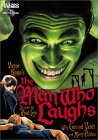
The picture quality is good, almost always steady and sharp, and with only fleeting bits of damage. The restoration is from Italy, and the master here may be a converted PAL transfer as the blurring and motion artifacts can be a bit distracting. At 110 minutes, the film speed looks correct; the movie is synchronized with its Universal part-sound audio track that includes carefully cued music, sound effects and crowd walla - and also a pop song near the ending. The studio involvement is signalled by an additional Uni logo next to Kino's on the DVD case; the cover illustration by Vince Evans should be made into a poster.
Kino's dedication to silent film raises one's hopes that more legendary masterpieces will surface on DVD. The European restorers in Germany and Italy have done us a great service, and I hope the success of these Region One DVDs will encourage new versions of other great pictures presently viewable only in poor quality. Tops on Savant's wish list? Pabst's Pandora's Box, a powerful film that looks radiant in stills, but drab in contrasty 16mm prints.
On a scale of Excellent, Good, Fair, and Poor, The Man Who Laughs rates:
Movie: Excellent
Video: Very Good
Sound: Excellent
Supplements: Docu, home movies, stills & ads, version comparison, novel excerpt
Packaging: Keep case
Reviewed: October 30, 2003
Footnotes:
1. I suppose the gypsies are Spanish in origin, as 'comprachicos' literally means 'purchase children'.
Return
2. The dog's name is Homo, which makes for some inadvertently bizarre intertitles. I guess this proves that in 1928 'homo' wasn't a common slur - or does it?
Return
| |
|



| Popular Reviews |
| Sponsored Links |
|
|
| Sponsored Links |
|
|
| Release List | Reviews | Shop | Newsletter | Forum | DVD Giveaways | Blu-Ray | Advertise |
|
Copyright 2024 DVDTalk.com All Rights Reserved. Legal Info, Privacy Policy, Terms of Use,
Manage Preferences,
Your Privacy Choices 
| |||||||