
| Reviews & Columns |
|
Reviews DVD TV on DVD Blu-ray 4K UHD International DVDs In Theaters Reviews by Studio Video Games Features Collector Series DVDs Easter Egg Database Interviews DVD Talk Radio Feature Articles Columns Anime Talk DVD Savant Horror DVDs The M.O.D. Squad Art House HD Talk Silent DVD
|
 DVD Talk Forum |
|
|
| Resources |
|
DVD Price Search Customer Service #'s RCE Info Links |
|
Columns
  


 
|
|
|
General & Steamboat Bill, Jr., The
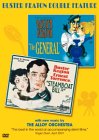
Savant only intended to watch maybe half an hour of The General before an appointment, and found it too good to leave. This new Blackhawk DVD combines the supremely entertaining silent film with another of Buster Keaton's better pictures, the next year's Steamboat Bill, Jr.. If you're already a Keaton fan, both the picture quality and the choice of soundtracks - creative modern re-imaginings by the Alloy Orchestra - will appeal mightily. If you haven't seen the pictures, you're in for a great time.
The General
Image/Blackhawk
1927 / B&W / 1:37 flat full frame / 76 min. / Street Date October 21, 2003 / $24.99
Starring Buster Keaton, Marion Mack, Glen Cavender
Cinematography Bert Haines, Dev Jennings
Art Director Fred Gabourie
Editors Buster Keaton, Sherman Kell
Written by Al Boasberg, Clyde Bruckman, Charlie Smith, Paul Girard Smith, Buster Keaton adapted from The Great Locomotive Chase by William Pittenger
Produced by Buster Keaton, Joseph M. Schenck
Directed by Clyde Bruckman
It's hard to encapsule Keaton's achievement in The General. It's a comedy with an epic background that keeps slapstick and historical accuracy in perfect balance. It's playful but mature, making war its subject without being cavalier about Union-Confederate differences. Officers and soldiers aren't buffoons, and the scenes of commanders sending their men into battle aren't played for laughs. There's one moment after a terrible blunder that prefigures The Bridge on the River Kwai. We cut back to the officer staring at his terrible mistake. It's funny, but situationally funny - the actor doesn't undercut his character to get a laugh.
The General is technically better made than most modern action films. The story is established in two brief scenes before Johnny's train is stolen, and from then on it's wall-to-wall action filmed around the difficult proposition of locomotives in motion, not the most trustworthy of props. The movie has an art director but was really planned by Keaton and his engineer-associates, inventing clever camera angles that made use of parallel tracks and clever camera mouns. It was shot on location in Oregon and became an expensive labor of love.
The action is breathtaking because Keaton is in physical peril in at least 80% of the shots. Hanging onto a train in motion is risky enough, but climbing all over it and leaping from car to car shows Keaton easily equalling the risk factor of someone like Jackie Chan, a good comparison figure. Sitting on the locomotive's cow catcher may look simple, but in reality it's too easy to slip or snag a shoelace and get oneself run over. Think of that when Buster stays in character around the tons of deadly machinery.
An example of the risk involved is seen when Buster sits on the drive arm of his locomotive, one of those horizontal rods connecting the wheels. A railyard worker eases the throttle, giving us the cute image of Keaton swinging up and down as the drive arm rotates. It looks easy, but accelerating an old engine like that from a dead stop is no easy task for the engineer; one time out of three the wheels spin and the drive arm goes nuts. (We see it happen later in the show.) It's like letting out the clutch of a Ferrari in third gear - you're going to either stall or peel rubber. I may be exaggerating, but Keaton could very well have been ground into mincemeat.
The gags during the chase are much more than simple jokes. They all make sense and were derived from the historical locomotive chase from the Civil War. (Disney made a version in the late 50s with the North as the heroic side. Fess Parker played Anderson.) The destruction of telegraph cables and the sabotage of the rails are all real. The technical layout and timing of some of the gags - such as the firing of a rail cannon and the impact of its shell near a train half a mile away, in one shot - would tax a modern stunt coordinator.
The General lets Keaton play 'trains' with real trains, but he comes up with mechanically-oriented visual gags that are breathtaking in their simplicity. The raiders carefully link their locomotive to the back of Buster's train ... and we truck to the right to see Buster foiling them by unlinking the last car. Buster is confronted with the impossibility of a box car appearing and then disappearing from the rails in front of his engine, unaware of the converging side tracks that bring it off and then on-line. I haven't seen René's Bataille du Rail, but for sheer technical cleverness, The General still beats out later films like Frankenheimer's The Train. It's inspiration is felt even in Peckinpah's The Wild Bunch, when William Holden gives his locomotive a farewell salute. Real Boys love trains.
Keaton and Bruckman's jibes at the military are light, but wryly stated. The only time they're lampooned is when a dozen uniforms argue around a twisted switch that has stalled their progress. The officers shouting creates chaos until an ordinary railroad man (a real man, in Keaton terms) solves the problem with one whack of a fire axe. There's no substitute for a pro who knows what he's doing.
Keaton's movies frequently had racist jokes, but in The General Johnny Gray has a lot of fun with the stereotype of the helpless Southern Belle. Marion Mack is thrown about like a sack of potatoes, mussed up, and knocked down by a water spout. Johnny constantly shows his exasperation for her judgment - jettisoning a piece of fuel wood because it has an unsightly hole in it, for instance. He finally throttles her, and then kisses her instead. Sure, it's primitive, but what a perfect expression of male-female relationships?
Andrew Sarris once favorably compared Keaton to Sam Fuller and Jean-Luc Godard. A cigar burns a hole in a tablecloth, giving Johnny Gray a cameo view of his lady love, now a prisoner. Both later directors echoed this effect (Fuller framing a woman down a gun-barrel) but Keaton's is the only use that's un-forced & natural. And in the 'artificial' context of a silent comedy.
Image's The General looks fine. It's a very good transfer of what appear to be original materials, with original intertitles as well. Blackhawk cinema wrangler David Shepard has determined the correct sound speed to be 26 fps, and he should know ... I thought that the 24fps standard would have been set by 1927. Some Shepard silent features come with a choice of scores, but this edition has only an excellent one by the Alloy Orchestra. It concentrates on percussive rhythms and captures the always-changing (almost musical in itself) pace of the railroad chase. Sound effects and subtle readings of gags are worked into the music.
Steamboat Bill, Jr.
Image/Blackhawk
1928 / B&W / 1:37 flat full frame / 70 min. / Street Date October 21, 2003 / $24.95
Starring Buster Keaton, Tom McGuire, Ernest Torrence, Tom Lewis, Marion Byron
Cinematography Bert Haines, Dev Jennings
Editor Sherman Kell
Produced by Joseph M. Schenck
Written by Carl Harbaugh
Directed by Charles F. Reisner
Not quite in the same league as The General but an excellent comedy with some of Buster's best character work and most famous sight gags, Steamboat Bill, Jr. makes a fine second feature. Keaton and Charles Reisner quickly sketch a complicated backdrop for the comedy plot: a bustling riverboat town where the local bigwig has monopolized all commerce. With his bright new craft, King has his sights set on scuttling Bill Canfield's broken-down scow of a steamboat. Keaton gets plenty of comedy by contrasting old and new, rich and poor, but succeeds best in the story thread of the very non-manly Junior proving his mettle to his rough-tough dad.
There are some offensive jokes here, and not just eyebrow-raising gags where circumstances make Junior look like a foppish pansy to dad. Keaton prances around with his college ukelele to entertain a baby, but Bill Senior thinks he's just a Tiny Tim-style fairy. Keaton's initial appearance, with a moustache and beret like a Frenchman, and a little dotted tie, is hilarious. The real PC trouble comes in mistaken identity gags, where Bill accidentally thinks a black man might be his son, etc. It's kind of shocking to see Keaton run to a stranger, and then turn away because the man can't possibly his father. The man has a big nose, and therefore must be a Jew. The anti-Semitism is shocking, but the truth is that 20s films of all stripes were rife with this kind of material - and from the predominantly Jewish film industry, too.
Buster has some great scenes finding a new costume. In the hat-choosing scene, he momentarily tries on his familiar pork-pie skimmer, and discards it in horror! Structurally, the movie is nowhere as sleek as The General, but it has some of Keaton's most famous scenes. Wind machines, breakaway sets and hair-raising sight gags are the highlight of the storm sequence, the one where Buster skids ten feet on his face, with his legs straight up in the air. The wind blows him from his hospital bed, into a barn, and out into the storm again, as if he had dreamt himself into a surreal carnival spook ride.
The capper is the unequalled gag of a two-story wall falling so that an upstairs window perfectly frames Buster as it slams into the ground. This was a job for surveyor's instruments; Keaton had little education but must have had total faith in mechanical physics. An inch out of line (in the structure-warping wind, remember) and he'd have been hammered like a tent peg.
The rest of the story is conventional but pleasing. Ernest Torrance and Marion Byron are fine as Buster's comedic foils, and the film ends well enough. Its highlights remain in one's memory forever, especially that storm scene.
Image's copy of Steamboat Bill, Jr. is the equal of its companion feature. This one runs at 24 fps; by 1928 I'm sure that speed was standardized, at least in America. The Alloy Orchestra turns in a playful score using fewer percussive rhythms than the companion show, but has its own odd melodies hammered out on banjos and metallic-sounding instruments. The syncopated musical sound effects augment the comedy at every turn.
Savant heartily recommends this Keaton single-disc double bill, especially to viewers unfamiliar with the comedian's amazing talents. There's nothing better to show a house-ful of relatives at a holiday gathering, as everyone loves the comedy, and people can feel free to talk without ruining the presentation!
On a scale of Excellent, Good, Fair, and Poor, The General & Steamboat Bill, Jr. rate:
Movie: Excellent
Video: Very Good
Sound: Excellent
Packaging: Keep case
Reviewed: November 2, 2003
| |
|



| Popular Reviews |
| Sponsored Links |
|
|
| Sponsored Links |
|
|
| Release List | Reviews | Shop | Newsletter | Forum | DVD Giveaways | Blu-Ray | Advertise |
|
Copyright 2024 DVDTalk.com All Rights Reserved. Legal Info, Privacy Policy, Terms of Use,
Manage Preferences,
Your Privacy Choices 
| |||||||