
| Reviews & Columns |
|
Reviews DVD TV on DVD Blu-ray 4K UHD International DVDs In Theaters Reviews by Studio Video Games Features Collector Series DVDs Easter Egg Database Interviews DVD Talk Radio Feature Articles Columns Anime Talk DVD Savant Horror DVDs The M.O.D. Squad Art House HD Talk Silent DVD
|
 DVD Talk Forum |
|
|
| Resources |
|
DVD Price Search Customer Service #'s RCE Info Links |
|
Columns

 
|
|
|
Lord of the Rings - The Two Towers (Extended Edition), The
It's always hard to approach a film that's been as eagerly awaited as The Lord of the Rings: The Two Towers. I'd initially been deeply resistant to the idea of any films of The Lord of the Rings at all: how could a filmmaker capture the magic of Tolkien's great work? As it turned out, The Fellowship of the Ring far exceeded any expectations I'd had, simply knocking me over with its beauty and power. With an opening like that, then, The Two Towers is in the unenviable position of following up on a masterwork. It's also worth pointing out that, with 43 minutes of footage that didn't appear in the original release, the Extended Edition is most definitely a re-visioning of the theatrical edition; in this review, I'm considering the Extended Edition entirely on its own merits, without reference to how it worked in its first cut. (Don't worry, I'll also talk about the differences between the two versions, later in the review.)
The Two Towers has a problematic place in the story of The Lord of the Rings. It's the middle third of a long novel, and it was never intended to stand alone. Although The Lord of the Rings is popularly considered a trilogy, in fact it is one novel: Tolkien conceived and wrote it as a single work, and its common appearance in three volumes derives only from the fact that 1950s bookbinding technology wasn't really up to the challenge of publishing Tolkien's work in a single paperback volume. In fact, the title "The Two Towers" is not Tolkien's own. He gave the title The Lord of the Rings to the book as a whole, but the titles of the individual volumes were added by the publisher when the book was split up; Tolkien even admitted that he wasn't sure what two towers, exactly, the title referred to (the film settles on the tower strongholds of Sauron and Saruman, but in the book there are other candidates as well).
And so The Two Towers is in a tough spot. It doesn't have the charm of discovery that's such a large part of the appeal of The Fellowship of the Ring, as it introduces little new of significance; nor does it wrap up any of the storylines. Director Peter Jackson has shown himself to be committed to preserving Tolkien's essential vision, so in bringing The Two Towers to the screen he had to grapple with the issues of adapting the middle third of a novel so that it would stand by itself, without fundamentally altering the story; as with The Fellowship of the Ring, though, Jackson has made a number of structural and plot alterations throughout the film.
The Two Towers is purely a continuation of the story as set up in The Fellowship of the Ring, and so it leaps directly into the story as left off in the first film, with the orcs who have kidnapped Merry and Pippin given chase by Aragorn, Legolas, and Gimli. As a result, there's none of the gradual build-up of interest in the story and characters that worked so well in the first film: we're tossed head-first into the story and expected to fully engage with it, without the film having taken the time to establish itself and develop its dramatic tension.
What the film does do, right away, is introduce quite a few new characters. As Aragorn and company head into Rohan, we get tossed into the problems of the royal house of Rohan: its king, Théoden, is under the evil influence of Saruman through his henchman Wormtongue. The king's son is wounded in a battle with orcs, and the king's loyal nephew has been banished, while his niece remains behind trying to care for the ailing king. This sounds a lot clearer in summary than it actually plays on screen: the characters are rather hastily introduced, and the Rohan sections of the film have the odd quality of feeling both rushed and overly drawn out. I have no idea how any viewer who wasn't already familiar with the story would follow who was whom: the only reason I could keep track of kings, nephews, nieces, and heirs was that I've read the book a number of times and knew the story and characters very well ahead of time.
Running parallel to this story is that of Merry and Pippin, kidnapped by orcs and then lost in the Forest of Fangorn, and the continued quest of Frodo and Sam toward Mount Doom. The latter storyline is really the only one that develops the fundamental storyline of The Lord of the Rings: the Ringbearer's journey. Aragorn's encounter with the Riders of Rohan and, simultaneously, Merry and Pippin's encounter with the Ents of Fangorn, are essentially lead-ins for two major set-pieces: the attack on Isengard and the defense of Helm's Deep. In both cases, we get a spectacular scene in terms of pure visual effect. The attack on Helm's Deep in particular is well done, with the hordes of attacking orcs and their demonic-looking siege machinery facing off against the few human defenders.
However, neither this scene nor the scene of the Ents attacking Isengard have anything like the emotional punch of the first film. I think it's because we have little or no emotional connection with what's happening. In the first film, when the Fellowship is attacked by the Ringwraiths, we are fully involved, fully committed to these characters and concerned about what happens to them. The dangers they face are on a smaller, more intimate scale, and so it's easier to relate to them. In The Two Towers, those intimate dangers are scaled up to full war, and in the process become strangely impersonal. Thousands of orcs crash up against Helm's Deep; hundreds of defenders die. But these are just nameless people of Rohan; intellectually we sympathize with them and want them to win, but there's no emotional connection with these people whom we hardly know. In the attack on Isengard, it's perhaps telling that the two characters whom we might connect with, Merry and Pippin, ride out the attack safely perched atop Treebeard's shoulders: out of danger, merely passively watching the carnage, they're a perfect stand-in for the viewer.
(As an aside, I'll point out that "carnage" is exactly the right word to describe the combat sequences, and I'm shocked that The Two Towers received a PG-13 rating. The rating explains that it's for "epic battle sequences and some scary images." I'm not sure how the MPAA differentiates "epic battle" from regular battle, because in The Two Towers we get a number of very graphic, bloody images, including on-screen decapitations. I wonder if orc cannibalism qualifies as a scary image? Maybe not, since we see flying pieces of the orc, but not the whole thing... Honestly, this is a movie that should have gotten an R rating.)
The very best part of The Two Towers, hands down, is the part of the story that follows Frodo and Sam on the way to Mordor. This thread of the story is energized by the one truly new, significant story element to appear in The Two Towers: Gollum. By allying themselves with Gollum, Frodo and Sam put themselves in a dangerous position: to what extent can they trust him? Frodo's pity for Gollum wars with Sam's loathing of him, and we can appreciate both impulses; Gollum is both pathetic and frightening. As the story develops, the inner battle between his two "selves," Gollum and Sméagol, is very effectively presented, and Gollum develops into a fascinating and three-dimensional character. We have to wonder... where exactly is he leading Frodo and Sam? Will he betray them, or will Frodo's mercy enable Gollum to turn away from the addictive pull of the One Ring?
While I thoroughly agreed with the changes that Jackson made to the original material in adapting The Fellowship of the Ring to the screen, I can't say that I feel the same way about The Two Towers. On the one hand, he's pretty much stuck with the plot as it stands; on the other hand, some of the changes he does make don't seem to benefit the story.
One distracting change is the additional element of juvenile humor throughout the film. The Lord of the Rings is a fundamentally serious story, and trying to play for laughs in the middle of this epic just feels wrong. In particular, Gimli the dwarf is presented here as much more of a comic character, which dilutes the effectiveness of the character as established in the previous film. Not surprisingly, the humorous elements that do work reasonably well are things like Gimli and Legolas' competition over who kills more orcs... which was in the original story. On the other hand, the more physical humor just feels out of place.
While the humorous elements affect the overall tone of the film rather than the plot, there are also several noteworthy changes to the plot... several of which serve to draw out story elements that are presented in a fast-paced manner in Tolkien's original story. The encounter of Aragorn, Legolas, Gimli, and Gandalf the White with the Riders of Rohan is significantly expanded from its presentation in the novel. The banishment of Éomer is an entirely new element, taking its origin from a disagreement that's merely mentioned in the original book; likewise, the death of the king's son is handled entirely off-stage in the book, but is given an extended treatment in the film, including a funeral. This expansion doesn't really benefit the story at all; we're left with a jumble of characters and incidents that serve to camouflage the real point of the episode, which is the very effective scene of Gandalf's shattering of the spell over Théoden. To a lesser extent, Frodo and Sam's encounter with Faramir is changed, and not advantageously; the main elements are the same, but the film adds an extended and unnecessary flashback to show Faramir's relationship with Boromir and his father, as well as a battle scene in a Gondorian city; Jackson's Faramir is much less heroic than Tolkien's, which is fine, except that in the film, Faramir's decision to release the hobbits is thus much less clearly motivated than in the original novel.
Yet with all the expansion of some areas of Tolkien's story, Jackson has left out other elements that would have added significant interest to the film; until we see The Return of the King, there's no way to know whether he plans to omit them entirely, or add them into the third installment. In The Two Towers as written, Merry and Pippin are reunited with Gandalf after the fall of Isengard, and as they depart from Saruman's citadel, there's an ominous incident with Saruman's Palantir (the globe by which he communicates with Sauron). The film version omits this. Similarly, in the original novel, Frodo and Sam make it all the way to Cirith Ungol and travel through the dark, secret passage into Mordor. Instead, Jackson chooses to end the film as Frodo, Sam, and Gollum are released by Faramir to continue their quest, with Gollum feeling betrayed by Frodo. It's a reasonable note to end on, but there's no reason we couldn't have cut out a lot of the intervening material and continued the story up to Cirith Ungol.
We can see, then, that Jackson has also taken a free hand with the structure of the story. Since the opening of The Two Towers was transplanted to the end of the film version of The Fellowship of the Ring, what these omissions mean is that this enormously long film is actually covering only the middle of The Two Towers as originally written... leaving out some of the most interesting parts. Apart from cutting out some of the material and expanding other parts, Jackson has also changed other elements of the story's structure. In the original text of The Lord of the Rings, the first half of The Two Towers follows exclusively the remainder of the Fellowship (Aragorn, Legolas, and Gimli in Rohan, Merry and Pippin in Fangorn), while the second half focuses entirely on Frodo, Sam, and Gollum in their travels toward Mordor. In the film adaptation, Jackson decides to follow a more conventional narrative structure, alternating between the stories of Aragorn and company, Merry and Pippin, and Frodo and Sam. This actually changes the focus of the story considerably: in the book, it's clear that Frodo and Sam's journey is the more important element, with as much narrative time spent on their story as on all the other characters' adventures combined; in the film, however, this emphasis disappears.
So yes, The Two Towers is problematic. It's still reasonably entertaining, if considerably over-long; the disappointment comes partly from the fact that it doesn't live up to the high standards of The Fellowship of the Ring (which is perhaps inevitable), and partly from the fact that Jackson doesn't handle Tolkien's work with anywhere near the deftness that he did in the first volume, in which all his edits and adaptations were spot-on.
The part of the movie that really works for me is Frodo and Sam's journey toward Mordor, and their reluctant alliance with Gollum. This is where the film actually builds on what has gone before. We're at the small scale, where two very ordinary people are facing the fact that their lives have been irrevocably changed by events in the wider world; both Frodo and Sam long to abandon their burden and return to the safety of the Shire. It's here where we see real courage, as day after day Frodo bears up under the growing weight of the One Ring, and Sam doggedly accompanies him; this is the part of the story that's moving and meaningful, far more so than the hue and cry of the more traditionally courageous warriors in battle. It's this, and the fact that The Two Towers is the next step in a story that we want to see through to the end, that makes it worth watching.
The extended edition
This review so far has considered The Two Towers: Extended Edition as a whole, without considering which parts appeared in the theatrical cut and which have been added for the Extended Edition. Now we'll take a look at the differences between the theatrical and extended cuts of the film. For the Extended Edition, 43 minutes of new material has been seamlessly integrated into the theatrical version of the film; some scenes are entirely new, while others are extensions of existing scenes.
The 15 completely new scenes are "Elven Rope" (an incident on Frodo and Sam's journey); "Massacre at the Fords of Isen" (our first introduction to Éomer); "The Song of the Entwives", "Ent Draft," and "Don't Be Hasty, Mastery Meriadoc!" (all scenes with Merry and Pippin among the Ents); "The Heir of Numenor" (a short scene between Gandalf and Aragorn); "The Funeral of Theodred" (the burial of King Théoden's son); "Brego" and "One of the Dúnedain" (scenes between Aragorn and Eowyn); "The Ring of Barahir" (showing the return of Wormtongue to Saruman); "Sons of the Steward" (the flashback to Faramir and Boromir in Gondor); "Fangorn Comes to Helm's Deep" (a short scene after the battle); "The Final Tally" (a humorous scene between Gimli and Legolas); "Flotsam and Jetsam" (another scene with Merry and Pippin); and the self-explanatory "Farewell to Faramir." If you've read my entire review up to this point (and haven't just skipped ahead!) you'll note that many of these scenes are ones that I pointed out as being unnecessary or counterproductive. Notice how few of these new scenes involve the central characters; in particular, the added material in the Rohan section is entirely superfluous. After getting to know and care about the characters of the Fellowship, why would we be interested in extra footage of new secondary characters?
A substantial number of existing scenes have also been extended throughout the film. The expanded scenes are concentrated mainly in the middle third of the film, but involve all three story threads to some degree. The scenes with added material are "The Taming of Sméagol"; "The Uruk-Hai"; "The Burning of the Westfold"; "The Banishment of Éomer"; "Night Camp at Fangorn"; "The Passage of the Marshes"; "The White Rider"; "The King of the Golden Hall"; "A Daughter of Kings"; "Of Herbs and Stewed Rabbit"; "Dwarf Women"; "The Evenstar"; "Helm's Deep"; "The Window on the West"; "The Forbidden Pool"; "The Glittering Caves"; "The Battle of the Hornburg"; "The Retreat to the Hornburg"; and "The Last March of the Ents." These additions mostly serve to add greater detail to events that are already fairly well established in the story; whether or not you find them worthwhile probably depends on how interested you are in that part of the story.
The DVD
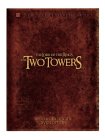
The Extended Edition of The Two Towers is a four-DVD set in the same very attractive case as the Extended Edition of The Fellowship of the Ring. The four DVDs are packaged in a fold-out cardboard case that fits inside a very sturdy glossy cardboard slipcase. The "ancient book" appearance fits the tone of the film very well, and the conceptual art by Alan Lee on the fold-out disc case is lovely.
The film itself is spread over two DVDs, with the special features on the third and fourth DVDs.
Video
As with The Fellowship of the Ring, The Two Towers is presented here in its original widescreen aspect ratio of 2.35:1, and is anamorphically enhanced. The image quality is excellent, but it doesn't reach the almost-perfect mark that I gave to the first film.
The print is in absolutely pristine condition, with not so much as a speck of dirt appearing anywhere; there's also no noise to be seen in the image, even in challenging open-air shots with wide expanses of clear sky. For the most part, The Two Towers takes place in the open air or in well-lit locations, so there aren't very many challenging scenes in terms of contrast; however, the dimly-lit Forest of Fangorn and the nighttime battle at Helm's Deep do show that the contrast is handled quite well. Fully dark areas are appropriately black, while different levels of light and shadow are also captured nicely.
The color palette of The Two Towers can best be described as "subdued": the dominant colors are gray, pale yellow, and brown. I'd take this to be a deliberate move on Jackson's part to create a tone for the film: the first film, starting in the Shire and moving to Rivendell, was rich with bright, vibrant colors, appropriate to the lives of the hobbits and elves. In The Two Towers, I think he's aiming for a more war-weary, desolate effect to go along with the conflicts that are raging in Middle Earth.
Where The Two Towers strays from the path of excellence is in its level of clarity. Some edge enhancement is visible at various points throughout the film, though not all of the time, and on the whole the image is just not quite as sharp as it could be (or as The Fellowship of the Ring was). The level of detail is not as high as it should be, giving the image a slightly soft appearance, with "busy" long-distance shots in particular showing the lack of clarity.
This impression of overall softness is borne out by the bit rate of The Two Towers. Sampling the first DVD reveals an average bit rate of around 8.1 Mb/s, while the average falls to around 7.4 Mb/s on the second DVD. This is slightly lower than the bit rates for The Fellowship of the Ring, which consistently hovered around 8.5 Mb/s. The Two Towers also shows slightly more compression than The Fellowship of the Ring, with its quantization figure averaging around 6.6, while the first film's quantization was around 5.5. It's not surprising that The Two Towers is more compressed: the amount of detail and movement in scenes like the march of the Ents and the battle for Helm's Deep surpasses anything we saw in the first movie, so it would be necessary to compress it further to keep the bandwidth down. I'm surprised, though, that the bit rate was kept at a fairly moderate level and not allowed to go higher for a better image.
Audio
While the video transfer of The Two Towers is "merely" excellent, the soundtrack is without a doubt absolutely fantastic. The highlight of the three audio choices is a DTS 6.1 soundtrack: we're talking about serious surround sound here. Not only do we get fully immersive sound landscapes, with effects like rain falling or wind blowing all around us, but the directional surround is used to perfection. In several scenes you'll think that you have mounted warriors riding across your living room on their way to appear on the screen, not to mention the ominous tramp, tramp, tramp of ten thousand orcish soldiers creeping up behind you and all around you.
The sound balance is outstanding as well, with special effects, dialogue, and music all perfectly integrated into the overall soundtrack. Volume levels are balanced correctly throughout the film as well; this is especially difficult to get right in a film that combines quiet dialogue scenes with thundering battle, but here it comes off very well indeed.
While the DTS track is the best of the three, the Dolby 5.1 soundtrack is a close second; it doesn't have quite the sense of immersion and richness of the DTS track, but it's very good indeed. Even the Dolby 2.0 track sounds reasonably good, though of course it doesn't have the surround effects that are so outstanding in the other tracks.
The only quibble I have with the soundtrack of The Two Towers is a purely aesthetic one: I didn't find the musical score to be nearly as good as in The Fellowship of the Ring. The distinctive musical themes of the first film have given way to a blander score that verges on "generic epic." However, this is a purely subjective impression and it doesn't have anything to do with how the music sounds in its audio transfer... which is fantastic.
Extras
If you've seen the gargantuan selection of bonus material on The Fellowship of the Ring, you might reasonably think that Peter Jackson and company had used up most of their stock of special feature material, so that The Two Towers would have a more modest selection. However, you'd be wrong.
The first special features that you'll encounter are the audio commentaries that accompany the film itself on the first two DVDs. Viewers have four different tracks to choose from: director Peter Jackson and the writers; the design team; the production and post-production team; and the cast. With a total of about 40 participants, the commentaries feature just about everybody who could have anything to share about their experiences on the film.
It's on the third and fourth DVDs that we get to the bulk of the special features, under the heading of "Appendices." Each of these discs has a "play all" feature as well as the option to view the featurettes separately.
The first disc of the Appendices starts with a brief introduction by Peter Jackson, giving us a quick overview of the filming experience, before we jump into the bonus material.
The first featurette is "J.R.R. Tolkien: Origins of Middle Earth" (30 minutes), which brings in various Tolkien experts and script co-writer Phillippa Boyens to talk about Tolkien's relationship with fellow fantasist C.S. Lewis, the linguistic basis of The Lord of the Rings, and other topics related to The Two Towers in particular. Next is a 20-minute piece called "From Book to Script: Finding the Story," in which Jackson and others discuss their thoughts on the structure of the story and the changes necessary to make it work on screen.
"Designing and Building Middle Earth" is actually a category of its own, with three separate featurettes within. "Designing Middle Earth" is a substantial 45-minute documentary on the overall design of the film's world, with an emphasis on the creation of the detailed sets such as the Rohan area. "Weta Workshop" is equally long (43 minutes) and focuses on the overall design process along with the costumes, appearance, and equipment of the armies that appear in the film. A final section of "Design Galleries" has two sections, one for the "Peoples of Middle Earth" and another for the "Realms of Middle Earth." Each of these galleries is a collection of conceptual sketches for various characters and locations in the film; selected images also have an audio commentary from the artist associated with them. Viewers can choose to view these images separately or to use the "slideshow" feature, which will play the commentaries automatically as the appropriate image appears.
One of the most interesting sections of the Appendices is the next one, which deals specifically with the character of Gollum. There are four sections here. The most interesting is a 40-minute documentary called "The Taming of Sméagol," which takes a look at the creation of the Gollum character from conceptualization through early design tests and the development of the full CGI character, to the voice-acting of Andy Serkis. The next section, "Andy Serkis Animation Reference," is a short clip of Serkis' live-action performance as Gollum, which was used as a guiding reference for the CGI animators; it's shown in split-screen with the final CGI Gollum performing the same scene. After this, we get a three-minute piece showing how one of the producers had to stand in as the live-action Gollum at one point; apparently this was funny at the time, but it seems to be a "you had to be there" kind of thing. Lastly, we get a design gallery with artists' audio commentary on selected images.
The next two sections focus on the locations of Middle Earth. The "Middle Earth Atlas" is an animated map that allows you to select one of four groups (Frodo and Sam; Merry and Pippin; Legolas, Aragorn, and Gimli; and Gandalf) and see their progress across Middle Earth, with clips from the film shown at selected points. It's very much a "filler" kind of special feature, and not really worthwhile. Fortunately, the final section on this DVD is more interesting. "New Zealand as Middle Earth" is a collection of short featurettes showing where specific Middle Earth locations were filmed in New Zealand.
The fourth and final DVD of the set is also loaded with interesting bonus materials. We start with three sections under the general heading of "Filming The Two Towers." The first is a 21-minute featurette called "Warriors of the Third Age," which goes behind the scenes of the stunts for the film. The next piece, "Cameras in Middle Earth," is a substantial documentary (1 hour 7 minutes) that basically covers the entire filming process of The Two Towers. Despite the title, it doesn't just focus on cinematography, but covers a variety of different aspects of the creation of the film, and is probably one of the best pieces to view if you only have time to see a few of the bonus features. Finally, we get a gallery of production photos with audio commentary for selected images.
The next section, "Visual Effects," is also a heading for several different featurettes. A 27-minute featurette on Weta Digital takes a look at the creation of the digital effects for the film, while the "Abandoned Concepts" section shows a gallery (with selected commentaries) for the "Slime Balrog" and "The Endless Stair." Under the heading of "Miniatures" we actually get three more sections, starting with "Big-atures," a 21-minute look at the small-scale (but still quite substantial) miniatures for various sets. "The Flooding of Isengard Animatic" is an early conceptual animatic in which the general idea of the Isengard scene is shown using fairly crude models and mock-ups; we have the option to see it by itself or in split-screen with the finished scene. Lastly, we get a design gallery of miniatures with selected artists' commentaries.
After this section, we get a stand-alone featurette called "Editorial: Refining the Story," a 21-minute piece discussing the challenges of editing The Two Towers, before moving to the "Music and Sound" section. Here we get two featurettes on the general sound design and musical scoring of the film: "Music for Middle Earth" and "The Soundscapes of Middle Earth," running 25 and 21 minutes, respectively. Filling out this section is an intriguing sound demonstration using a clip from the battle of Helm's Deep: the scene plays with the option of listening to any one of seven different separate sound elements in isolation (such as weapons fire, music, or dialogue), plus an eighth that puts them all together for the final track.
The Appendices wrap up with a nine-minute featurette called "The Battle for Helm's Deep Is Over," which appropriately enough deals with the post-production for the film.
Final thoughts
Looking back on my thoughts about The Two Towers: Extended Edition, it's clear that while The Two Towers is problematic in part due to its place in the story of The Lord of the Rings, and due to some of Peter Jackson's choices of what material to omit, most of the issues with the film come from the extended material. Nearly three quarters of an hour of additional footage is certainly enough to significantly change the structure and pacing of a story... and while I found the extended footage in The Fellowship of the Ring to make a great film even better, in The Two Towers it seems to have diminished the effectiveness of the film as a whole.
What makes The Two Towers: Extended Edition a potentially worthwhile purchase for any fans of the films, even if they prefer the theatrical cut, is the bonus content. There's a total of more than six and a half hours of documentaries included here... without even counting the four full-length audio commentaries or the numerous design galleries and miscellaneous self-paced features.
If you are a big fan of special features (and particularly if you loved the bonus content in The Fellowship of the Ring: Extended Edition), you should consider this set as highly recommended. From my point of view, though, the film itself is always what's paramount. The Two Towers is an important part of the story of The Lord of the Rings, and it has its strong points, but it is also problematic in a number of ways, and the Extended Edition of the film tends to play to its weaknesses rather than its strengths. I'm going to stick with a straight "Recommended."
|



| Popular Reviews |
| Sponsored Links |
|
|
| Sponsored Links |
|
|
| Release List | Reviews | Shop | Newsletter | Forum | DVD Giveaways | Blu-Ray | Advertise |
|
Copyright 2024 DVDTalk.com All Rights Reserved. Legal Info, Privacy Policy, Terms of Use,
Manage Preferences,
Your Privacy Choices 
| |||||||