
| Reviews & Columns |
|
Reviews DVD TV on DVD Blu-ray 4K UHD International DVDs In Theaters Reviews by Studio Video Games Features Collector Series DVDs Easter Egg Database Interviews DVD Talk Radio Feature Articles Columns Anime Talk DVD Savant Horror DVDs The M.O.D. Squad Art House HD Talk Silent DVD
|
 DVD Talk Forum |
|
|
| Resources |
|
DVD Price Search Customer Service #'s RCE Info Links |
|
Columns


 
|
|
|
Last Laugh, The
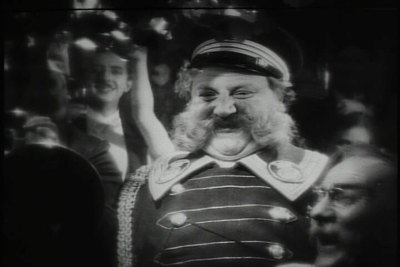 Two years after filming Nosferatu, F. W. Murnau made one of the most impressive films of the silent era, which helped lay the groundwork for modern cinema. In 1924's The Last Laugh (entitled Die Letzte Mann in German which translates to "The Last Man," a much more appropriate title in more ways than one) Murnau liberated the movie camera and sent it souring.
Most silent movies were shot with a camera on a stationary tripod. Cameras were still cranked by hand, and cranking at a constant speed was easiest to do that if the camera was stationary. So most films of the time did not have any camera movement. There was a occasional pan or tilt, but it was very rare to see anything that involved moving the position of the camera. Though Murnau was not the very first director to include moving shots in a film, he was the first to use them as frequently and to such effect. In this movie the camera isn't a silent observer, it is part of the story. The camera rolls through crowded rooms and out doors, it flies through the air and out of windows. Never before in cinema has camera work made the viewer feel so much a part of the action.
The innovative camera work was enough to make this movie a classic, but Murnau wasn't satisfied with that. He was also able to make The Last Laugh a truly silent film, a story told solely through the actors expressions and reactions. There is no dialog or intertitles (with one exception that I will discuss later.) The entire story, which is very easy to follow, is told through the actors performance of their craft.
The story is a simple yet powerful one. An old, unnamed doorman (Emil Jannings) at a posh hotel is proud of his position. He has a long regal coat with tassels and shiny buttons, and he takes his job very seriously and performs it with pride. He is admired by all of the people in the run down neighborhood where he lives because of his respectable job.
During a heavy rain one day, he takes in a heavy chest by himself rather than waiting for assistance to better serve the guest. He sits down for a moment to catch his breath afterwards, and the assistant manager sees him. The next day, when arrives at work, he finds someone else performing his duties. The assistant manager calls him in and informs him that he is too old to be the door man, but if he would like to stay employed, he can be the attendant in the men's washroom. He is stripped of his coat.
Jannings is crushed. To have had such a respected position and then falling so low is more than he can face. He can not bear to let the others from his neighborhood know, so he sneaks back at night and steals his coat back. After this, he spends his days being humiliated in the washroom, and changes into his coat after work to go home. But he can not keep this pretense up for long.
In order to fully discuss this film, and the only intertitle card, more of the plot than I would like has to be revealed. If you'd rather not find out what happens, skip down to the "End of Spoiler" notation.
Spoiler:
It is eventually found out that the doorman has lost his position. When it is revealed, he becomes the laughing stock of his block and leaves. Having no where to go, the man hunches over in a corner, his only friend the night watchman who covers him with an old cloak. At this point, the only title card is the movie is displayed: "Here the story should really end, for, in real life, the forlorn old man would have little to look forward to but death. The author took pity on him and has provided a quite improbable epilogue."
There is then a newspaper clipping stating that a local man has inherited a fortune. We see the doorman in the hotel's restaurant stuffing himself on fine food and wine. The night watchman, dressed in fine clothes, joins him, and the two eat enjoy living a life of luxury while the hotel staff who had treated the doorman so poorly look on in envy.
End of Spoiler
Again, as with Murnau's other German films, the cast was impeccable. The whole movie clearly rested on the shoulders of Emil Jannings who is able to breath life into the character of the doorman. You can feel his crushing defeat as the coat is taken off of him. The fact that the entire plot is very easy to follow without any dialog is a testament to Jannings' ability as an actor.
Of course the startling camera work and cinematography needs to be mentioned. The movie was filmed by one of the greatest German cinematographers of the silent era, Karl Freund. Freund would go on to film such classic as Metropolis, the fantastic All Quiet on the Western Front (1930,) Tod Browning's Dracula (1931) and many more. He would spend the end of his career as the head cinematographer on the I Love Lucy TV show where he developed the three camera system for recording TV shows that is still in use today. His ability really shines through in this film. He came up with many of the unique techniques used to film movie, including being suspended by a rope and pulley system and being rolled around in a wheel chair to obtain the tracking shot at the beginning of the movie. A truly beautiful film.
The Last Laugh is a very powerful movie, that transcends its melodramatic origins, and becomes not only a moving story, but art as well.
The DVD:
Audio:
The sound track was provided by a the Olympic Chamber Orchestra conducted by Timothy Brock who composed the score. The stereo mix was clear and free of hiss. The full orchestra added a lot to the enjoyment of this film. The score was very appropriate, nicely accenting the scenes on the screen, without being overpowering. Just what I want in a silent film score.
Video:
The video quality for this film was very good, with only very minor print damage. Some of the bright highlights were a little too bright, resulting in some loss of detail but nothing too damaging. The image is a little soft overall, but not overly so, and could have been shot that way, though my guess is that it wasn't. A very nice looking film, with only minor flaws.
The Extras:
This disc contains a photo gallery and the original German intertitle cards for the caption near the end as well as the newspaper clipping.
Final Thoughts:
This simple tale of a man whose identity and self worth were measured by his job is as strong today as it was when it was filmed in 1924. Jannings is an extremely talented actor, and this is one of his best roles. (He would win the very first Best Actor Academy Award in 1929 for his performances in The Way of All Flesh and The Last Command.) With this film Murnau created a masterpiece of international cinema, silent or otherwise. Highly recommended.
|



| Popular Reviews |
| Sponsored Links |
|
|
| Sponsored Links |
|
|
| Release List | Reviews | Shop | Newsletter | Forum | DVD Giveaways | Blu-Ray | Advertise |
|
Copyright 2024 DVDTalk.com All Rights Reserved. Legal Info, Privacy Policy, Terms of Use,
Manage Preferences,
Your Privacy Choices 
| |||||||