
| Reviews & Columns |
|
Reviews DVD TV on DVD Blu-ray 4K UHD International DVDs In Theaters Reviews by Studio Video Games Features Collector Series DVDs Easter Egg Database Interviews DVD Talk Radio Feature Articles Columns Anime Talk DVD Savant Horror DVDs The M.O.D. Squad Art House HD Talk Silent DVD
|
 DVD Talk Forum |
|
|
| Resources |
|
DVD Price Search Customer Service #'s RCE Info Links |
|
Columns


|
|
|
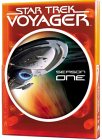
Star Trek Voyager: Complete First Season
Under the command of Captain Kathryn Janeway (Kate Mulgrew), the Federation starship Voyager is on a mission to find a group of Maqui rebels... until a freak energy wave throws both them and their quarry 70,000 light-years across the galaxy. Faced with a voyage home that would take most of their lifetimes at their starship's regular speed, the Voyager crew must find a faster alternative, while also trying to survive in a totally unknown part of the galaxy. And so begins Voyager's journey...
Originally airing in 1995, the first season of Star Trek Voyager launched while Deep Space Nine was also running, just as DS9 had begun during Next Generation's run. After Deep Space Nine's deeply plot-driven story, with its ongoing story developing over the course of entire seasons, Voyager offers an entirely different experience. In many ways, Voyager hearkens back to the episodic storytelling style of the original Star Trek or of Next Generation, with its self-contained episodes in the context of a single starship exploring the frontiers of space. Within the overall context of their search for a way home, with each new episode the crew faces a new problem and resolves it. A purely episodic structure has its strengths, such as the ability to tackle a wide variety of plots and themes, but it also means that the show can't build much on past stories.
To its credit, Voyager seems to have learned a few tricks from Deep Space Nine, with a touch of continuity stitching together the episodes and creating a sense of a larger overall story. The combination of the Maqui and Starfleet crews creates a large potential reservoir for story conflicts and character development right at the outset; while the merge is superficially complete fairly early on, with all the characters donning Starfleet uniforms, later episodes show that this is to a large extent just plaster over enduring differences. For instance, in episodes like "Prime Factors" the conflicting attitudes of the Maqui crewmembers ends up having a great effect on the story.
We also see that Voyager is willing to start building story continuity out in the Delta Quadrant. While the first half of the season has the crew encountering new races and new situations in each episode, when we get to "State of Flux," Voyager re-encounters the hostile aliens from the first episode, and more importantly, takes a dramatic and irreversible course with one of the secondary characters.
Another trick that Voyager seems to have wisely borrowed from DS9 is its willingness to introduce a darker touch when necessary, something that's hinted at in the very first episode when Tom Paris is recruited from a Federation prison. And on a larger scale, an interesting aspect of Voyager's premise is that is sets the series up in a context of failure. If their overall mission is to get home, then every episode in which they attempt to get home must, by necessity, end in failure. Where Voyager has learned well from DS9 is that failure is often as interesting as success... or even more so. If we always assume that things will turn out well in the end, it's difficult to create narrative tension. (It's not impossible, of course: just think of the Next Generation episodes with Captain Picard in trouble. We know he survives, but we're still interested in how he manages it.) When a series introduces the possibility of missions failing, of characters not getting what they want, and of events turning out in unexpected ways, then it gets a lot easier to develop and sustain narrative interest in each episode.
In the end, what makes or breaks Voyager is the quality of the individual episodes; are they entertaining? The answer is a solid (and, for this Next Generation and DS9 fan, surprising) "yes." Each episode offers 45 minutes of fun, quite well crafted science fiction; the stories are imaginative and often provide a few surprising twists along the way. In "Time and Again," for instance, a time travel story involving a potential violation of the Prime Directive turns into quite a fun ride for the viewer, as our ideas of what "really happened" (or "will happen" or "would have happened" – time travel is hard on verbal tenses) keep changing as more and more of the story develops. "Ex Post Facto" turns into a murder mystery (complete with a wry homage to the classic trope of "assemble the suspects in the drawing room"). "Emanations" starts off with what seems like an archaeological discovery, but soon develops into a first contact situation in which there are no clear-cut right or wrong answers. "Eye of the Needle" is another quite entertaining story in which a wormhole raises hopes of a journey home but also a host of difficulties if the crew is to make use of their discovery.
That's not to say that everything is working perfectly. Some plot devices get overused: time travel and weird singularity effects appear with reckless abandon in the first few episodes, for instance. As far as the characters go, the aliens Kes and Neelix remain a little awkward, as if the writers weren't sure how to make them work. While Neelix is not as annoying as I feared he would be (I am a hard sell when it comes to comic relief), the Neelix-free episodes do tend to be better than the ones in which his character plays a role. And not all the stories work as well as others; "The Cloud," for instance, is very light-weight, and the holodeck adventure "Heroes and Demons" is oddly unfocused and never really comes together. However, all in all the fifteen episodes here (counting the double-length pilot as one episode) offer a solid package of entertainment for both existing Voyager fans and new viewers.
The DVD
Voyager: Season 1 is a five-DVD set; all 15 episodes from the first season are included, and appear on the first four DVDs of the set, with the fifth disc reserved for special features.
The packaging for Voyager is quite distinctive. The DVDs are held in a "book" of hard plastic pages, with one DVD per page, much like Deep Space Nine's packaging, except that there is no "cover." Instead, there's a slip-on case in two parts, one that fits over the top of the book, and another that fits over the bottom. On the one hand, it's starting to get irritating that companies feel the need to reinvent the wheel with each new series' packaging, and the separate slip-on pieces are a bit of a nuisance. On the other hand, one very nice touch is that the list of episodes, complete with air date and production number, is printed on the back of the slipcase, making it very easy to refer to.
The overall package is very slim, which is a definite benefit. The hard plastic DVD pages are an eye-popping neon orange, which actually looks much nicer in reality than it may sound; it's certainly distinctive.
Video
Paramount has consistently offered outstanding transfers of the Star Trek series, and Voyager is no exception. Colors look excellent, with vibrant, rich primary colors balanced by natural-looking skin tones and deep blacks. The print is spotlessly clean and free of noise, though I did see a faint touch of grain on a few occasions. The image is occasionally slightly soft, but overall it offers a pleasing level of detail, with no traces of edge enhancement as far as I could see. This is undoubtedly "as good as it gets" for image quality, and fans of the show will be very pleased to see just how good that is.
The episodes are presented in their original aspect ratio of 1.33:1.
Audio
The Dolby 5.1 soundtrack for Voyager offers a similarly excellent listening experience. Dialogue is crisp and clear, music and environmental effects are always correctly balanced in the overall track, and the surround channels do get put to use reasonably often for special effects. A Dolby 2.0 soundtrack is also provided, along with optional English subtitles.
Extras
The final disc of the set contains the special features, and a nice assortment has been gathered; both long-time fans and new viewers will find these features worth seeing. They're all short featurettes, similar in style to what was presented in the DS9 and Next Generation special features, but they're long enough to be interesting.
"Bridging the Unknown: Season 1" is a 10-minute look at the origins of Voyager and its place in the sequence of Star Trek shows. Following that are two featurettes that focus on the character of Captain Janeway. "Voyager Time Capsule: Kathryn Janeway" is a 15-minute piece that includes interviews with Kate Mulgrew from both 1994 and 2003, reflecting from two different perspectives on the experience of getting the role. "The First Captain: Bujold" is an 8-minute featurette that reveals the casting process for the captain's role, including the first actor who was chosen before Mulgrew got the part. This is particularly interesting, as it includes clips from portions of the first episode that were shot with "Captain Bujold" instead of Captain Janeway. We also get "Cast Reflections: Season 1," a 9-minute collection of interviews with other members of the cast reflecting on their experience as part of a brand-new Star Trek series.
After that, we move to featurettes that focus on other elements of making the show. "On Location with the Kazons" is a 5-minute look behind the scenes at the location where the Kazon encampment from "The Caretaker" was shot. "Red Alert: Visual Effects Season 1" is an interesting 10-minute featurette in which visual effects supervisor Dan Curry discusses the challenges of the special effects for the first season of Voyager. "Launching Voyager on the Web" (6 minutes) takes a look at Paramount's use of a website to promote the show before it aired, and "Real Science with Andre Bormanis" (9 minutes) has Voyager's science consultant discussing the use of real science to ground the fiction of the show. Lastly, we get a photo gallery.
There are (as far as I could tell) four "hidden files" in the special features section, two each on the first two menu screens of the special features. They are accessed by moving the selection cursor around until you hit an unlabeled green blip on the outline of Voyager, which leads to the hidden clip. About five minutes' worth of extra material is hidden this way. It's an annoying waste of time – real special features should be clearly labeled and easy to access – but at least the pixel-hunting has been cut down from the excesses of the DS9 sets.
Voyager has attractive, spoiler-free menus, but unfortunately the animations are not skippable; it may be cute to see the starship zoom over the screen the first time, but on subsequent viewings it gets very annoying to have to wait for the animation to finish.
Final thoughts
The episodic adventures of Star Trek Voyager offer a different viewing experience from the dense, highly story-based Deep Space Nine that preceded it, but there's plenty of room in the Star Trek universe, and in viewers' collections, for both approaches. I came to Voyager: Season 1 without any great expectations, and I was very pleasantly surprised to find a collection of quite entertaining stories.
Viewers will be very pleased with the excellent image and sound quality here; the attractive transfer and Dolby 5.1 sound make for a nicely immersive viewing experience. With about an hour and 15 minutes' worth of interesting special features, Voyager isn't completely "loaded," but it does offer a nice look at the making of the series and what was involved with getting Season 1 on the air. Overall, I'll give Star Trek Voyager: Season 1 a strong "recommended": fans of the series will most definitely want to pick up this set, and viewers who enjoy Star Trek and science fiction in general will want to seriously consider this set as well.
|



| Popular Reviews |
| Sponsored Links |
|
|
| Sponsored Links |
|
|
| Release List | Reviews | Shop | Newsletter | Forum | DVD Giveaways | Blu-Ray | Advertise |
|
Copyright 2024 DVDTalk.com All Rights Reserved. Legal Info, Privacy Policy, Terms of Use,
Manage Preferences,
Your Privacy Choices 
| |||||||