
| Reviews & Columns |
|
Reviews DVD TV on DVD Blu-ray 4K UHD International DVDs In Theaters Reviews by Studio Video Games Features Collector Series DVDs Easter Egg Database Interviews DVD Talk Radio Feature Articles Columns Anime Talk DVD Savant Horror DVDs The M.O.D. Squad Art House HD Talk Silent DVD
|
 DVD Talk Forum |
|
|
| Resources |
|
DVD Price Search Customer Service #'s RCE Info Links |
|
Columns
  


 
|
|
|
Charley Bowers
This is a wonderful set of DVDs. It allows you to not only see some intelligent and very imaginative animation but also to study Bowers style and the way it changes over time. Presented in chronological order (with the exception of two early cartoons that are included at the beginning of the second disc,) these shorts are filled with fantastic inventions, and wildly creative, surrealistic animation. The best of them are classics, while even the more mediocre efforts fun to watch.
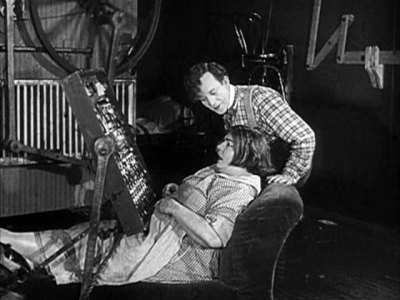
Not a lot is known about Charley Bowers. It is rumored that he ran off (or was kidnapped) and joined the circus at a very young age and became a tightrope walker. He eventually found his way into animation, and directed and animated a large number of Mutt and Jeff cartoons based on the popular animation strip. Having cut his teeth on cel animation, Bowers proceeded to stop-motion animation. Most of his movies are filmed in "The Bowers Process," a method of animation that allowed live actor to interact, albeit in a limited fashion, with the animated objects. This process he invented, coupled with his wild imagination, allowed Bowers to create these wonderful shorts that are still amazing to look at today.
Most of these shorts are live action two reel comedies with at least some stop-motion animation. The last four shorts are all stop-motion pieces with no actors.
The set contains the following films, all of which have superior image quality:
Egged On (1926): After being hit on the head with an egg, Charlie decides that anyone who can create an unbreakable egg will make a fortune. He designs, gets funding, and builds a contraption that will turn a regular egg into one made of rubber. He calls his investors in to see his invention, but poor Charlie has run out of eggs and has to scramble to find some more.
At first glance, this is a fairly straightforward slapstick short with a lot of broken eggs. But it on closer inspection, there are a lot of unusual gags that involve props. Putting the rubber egg through the wringer and then opening it to see the yoke and white was almost like a magician's trick. The highlight of this short is a great stop-motion scene where a basket of eggs all hatch into miniature cars. This is a wonderfully irreverent film. Grade: A
He Done His Best(1926): Charlie wants to marry his girlfriend, but has to ask her father's permission first. The father owns a restaurant, and thinks that Charlie is asking for a job and puts him to work washing dishes in the kitchen. Things go from bad to worse when the rest of the staff find out that Charlie isn't a member of the Kitchen Mechanics Union. Not wanting to work with a scab, they all quit. That leaves poor Charlie to man the entire restaurant by himself. To ease his burden, he invents a machine that allows one person to handle all the duties, from waiter to chef.
Charley is still trying to find a character. The personality of his 'inventor' changes a little with this film. Some Chaplin inspired pathos at the end. Grade: A
A Wild Roomer(1926): Charlie is an inventor at a rooming house. His grandfather has left his entire fortune to Charley on the condition that he perfects his invention within 48 hours. If he doesn't have a working model in that time; his uncle inherits all the money. Of course, the uncle sets out to sabotage Charley's efforts.
Again, this movie has some impressive stop motion animation in it. I really enjoyed the machine in action, especially when it created a rag doll. This short was fun, but you can tell that Charley is still having trouble getting the feel of making two-reelers. The film started out with things disappearing from the boarding house mysteriously. That entire plot is ignored after the first minute or two. I'm not sure if it was padding or if it was footage from an earlier aborted film. Grade: B+
Fatal Footsteps (1926): There is a dance contest, with $10,000 going to the winner. Charlie is a farm hand who has his sight on the prize. He invents some spring-loaded dancing shoes, but the farmer is the president of an anti-dancing league who disapproves of such frivolity.
This short didn't work as well as the others. Charley spends a good amount of the film practicing his dance moves, which is humorous at the beginning, but quickly gets old. He's still working on getting a personality for his inventor. While in other shorts Charley inventions were the means win a girl's hand, here he is oblivious to the farmer's daughters advances, even when she dances around his bed dressed as a Spanish princess. The invention in this movie was not the main focus, the crazy dancing was. Bowers was trying something different in this outing, and it didn't fully work. Though the story arc was slightly more developed in this film, the action wasn't as humorous. The animated section was the shortest of any of his films. Grade: B
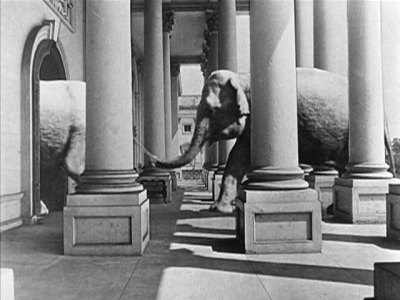 Now You Tell One (1926): "The Citizens United Against Ambiguity" have formed a liars club. Every year various chapters compete for the liar of the year award. One member is very doubtful of his branch's chances of success until he sees Charlie trying to kill himself. Bringing him back to the club, Charley relates how he had invented a chemical that would allow him to graft any two plants together, and make them both grow at an amazing rate. He made an eggplant which yields a hardboiled egg and salt when cut open, and can grow a fully decorated Christmas tree. Charley goes out to the country to sell his invention door to door. At every stop something goes wrong and he makes no sales. But he runs into an attractive young woman whose house is overrun with really tough mice. Always willing to help a woman in distress, Charlie decides to try to grow something that will be able to take on the army of mice.
This was a great short. The story held together well, and there were more jokes than his earlier shorts. It was well paced, and just hung together very well. The Keatonesque gag at the end was one of the best jokes that Charley came up with.
Bowers also returned to putting the emphasis on the odd inventions, wisely realizing that his strength lay in his imagination. Grade: A+
Many a Slip (1927): Charlie is a crazy inventor who isolates the germ that causes banana peels to be slippery. He realizes that if he can kill this germ, he will have invented the no-slip peel, a great boon to mankind. He treats many peels with all sorts of formulas. After each treatment, he puts the peel in a place where someone is sure to step and it and watches.
Another great film. There was a running gag of everything being labeled "Patent Applied for." First it is on his inventions, then on such mundane things as pillows and stairs. The animation starts taking a smaller role, with the animated slippery germ being fairly short. Grade: A
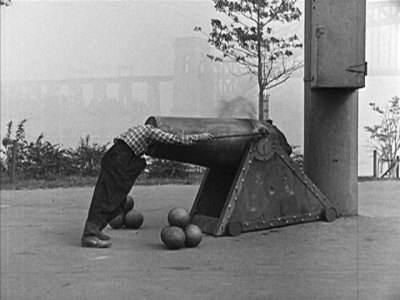 Nothing Doing (1927): Charley wants to marry his girlfriend, but her father will only allow her to marry a police officer. So he goes down to the station and joins, but he ends up causing as much trouble as the crooks.
Charlie is not an inventor in this film, and the short lacks the creative spark that his other films had. He is trying out another type of character, this time a resourceful though unobservant average Joe.
Bowers has been putting more jokes and gags in these later films. This one has a great "I Want You" poster as a recruiting aid for the police force: "Join the Police Force and See the City!" In this film it seems as if he was trying to make a more mainstream comedy. The surreal aspect is almost totally absent, a very brief stop-motion scene with boxing cats being the only bizarre feature in this film.
There is a little emulsion damage in the beginning of this movie. The image is soft and lacking detail. The contrast is less than the other shows on this disc, but it soon clears up. Grade: C+/B-
Grill Room Express (1917): The second disc starts off with some of the cel animated cartoons that Bowers did before he went to live action comedies. This is a series of gags in a diner, a typical cartoon from the period, with very simple backgrounds and slightly jerky motion. The artwork is very good. Grade: B
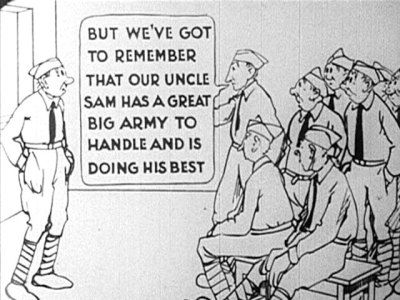 AWOL (1918): This cartoon takes place in Europe after WWI. Some soldiers are gripping that they haven't been sent home since the armistice has been signed. One goes out joy riding with a woman and ends up getting in trouble. It is more of a morality play than a comedy, though there are some funny bits. The simple figures are realistic looking. Grade: B
Say Ah-H! (1928): Charley gets an ostrich egg for the boss' breakfast, but no one can seem to open it. It turns out to be solid all the way through because Charley has been feeding the birds cement. After being chastised, he feeds the ostrich some ground up farm tools. It lays an egg from which a very strange (animated) bird hatches.
It looks like Charley was still trying to find a role he could fit into. This is a very different character for Bowers. Here his motions are slower, and he has pasty makeup on. His look and acting is very reminiscent of Harry Langdon. The animation of the bird was excellent, as usual for Bowers, and it was nice to see his return to surrealist comedy. The wooden bird that takes up a good portion of the film was satisfyingly odd.
One unusual thing about this piece is that there was no piano score present. It was totally silent. There is also a title card at the beginning of the film saying "Part Two." I'm not sure what happened to part one, or it Bowers was even connected to the first chapter.
There are a couple of instances in this short that have significant emulsion degradation. It was so bad I'm surprised they were able to get the film through a projector. It is too bad that this film had such decomposition since the preserved footage was excellent. Grade: B+
It's a Bird (1930): The only talking movie that Charley Bowers stared in. Charley is a "breaker and loser" at a junkyard. He has to break up the old cars and then lose the pieces. He hides the parts in moving vans and in the trunks of cars, but he has a hard time getting rid of all of them. Then he hears of an animal that could help him out: A metal eating bird. So Charley he sets out to capture one of these rare animals.
This is one of the best shorts on this DVD, easily my favorite. The plot had good internal consistency, and was very well paced. The capture of the metal eating bird was funny, as was the bit with Charley 'losing' the junk parts. But the highlight of this short is the amazing animation. In one bit, a regular sized chicken egg hatches, and a full sized car is released. There is good synchronization of the bird's mouth movement and its speech. If this hadn't been lost for years, it would be considered a classic today. Ironically, this was the last live action work Charley Bowers would do. Grade A+
Believe it or Don't (1935): This short is made entirely of stop-motion animation, as the rest of the film in this set are. This piece consists of several short gag pieces strung together; peanuts perform in a peanut circus, a car hatch out of an egg, a drunken lobster plays the xylophone.
This looked like a very low budget effort. Gone were the actors and quality sets. It looks like this was filmed on a kitchen table with cardboard sets, which it might very well have been. While I viewed this I couldn't help wondering what Bowers had been doing during the five years between his last short and this one. Bowers seemed to be mining his own work a little with this movie. He has another car-hatching-from-an-egg gag that was done better in Egged On and It's a Bird. The other bits fell flat, and the quality of the animation looked a little cruder.
The picture on this one was also worse than the other shorts. It had less contrast, and there were some vertical scratches across the frame. It is still watchable, but not to the standard set by the other shorts on this DVD. Grade: C
 Pete Roleum and His Cousins (1938): This is an interesting color short Bowers did for the oil industry. It is a look at petroleum use in the past and present. Anthropomorphic oil drops are used to illustrate all the uses of petroleum products. Not really funny, but the dancing oil drops made the film decidedly unusual. Grade B-
Wild Oysters (1940): A short released by Paramount. Some mice living in a house have to avoid the cat while trying to get some milk. A more standard type of humor, but it still has an edge. The oysters leaving their shells and attacking the mouse was unusual and funny. Grade: B
A Sleepless Night (1940): While his mother is out, a young mouse eats up all the cheese. To hide this from his mother, he replaces the missing cheese with soap. His mother doesn't realize a switch has been made, and eats the soap causing bubbles to emerge whenever she speaks.
This looks very similar to Wild Oysters, though it's not a Paramount film. The mice looked a little different, but seemed to be the same family. It was obvious that this short originally had a soundtrack to it, but it has apparently been lost since there is no soundtrack with this film, not even a musical score. This wasn't as entertaining as the previous short, though the soundtrack many have improved my opinion of it. Grade: C+
The DVD:
Audio:
All the shorts are presented with a two channel mono piano score. Some of the shorts also had the option of a 5.1 soundtrack. This surround sound mix consists of accordion music and should be avoided at all costs. I was astounded that someone would go to the trouble to mix an accordion in 5.1, but apparently they did. (I don't think my sub was activated at all during the short time I listened to this track. Accordions don't put out a lot of bass, last time I checked.) The music just does not go with the images.
The piano score was very clean and went well with the films. The music didn't seem to be composed for the shorts specifically, though I could be wrong. I don't recall any added sound effects, but that is not necessarily a bad thing. The talking pictures all sound clear, though there is some pops and other minor audio imperfections. Nothing that would be distracting though.
Although Bowers worked in America, most of these short were discovered in Europe, and they all have French intertitles. These are translated in optional English subtitles. The sound films all have the original English audio track.
Video:
The video quality for this set is excellent. It does vary from film to film, but overall I was very pleasantly surprised. In general, the contrast was very good, and the picture clean and clear. There was great detail and crispness. Most of the films had minor specks of dirt and the occasional scratches, but these didn't distract from my enjoyment of the films. Occasionally a short would have some footage from a lesser print. A Wild Roomer used a secondary print that was softer and had less contrast for a few minutes, for example, but this only occured a couple of times. Considering that most of these movies were made over 75 years ago, this DVD looks wonderful.
The Extras:
Looking for Charley Bowers: A 15-minute featurette that discusses how the Bower films were rediscovered. The extra starts with an interview with Raymond Borde, the person who found the first films stored away by an old gypsy. He talks about how hard it was to identify Bowers. Louise Beaudel from the Cinematheque Quebecoise is interviewed as well. This is a very interesting bonus film. It really illustrates how little is known about Charley Bowers.
Photo Gallery: A minute and a half reel of production photos and stills from his films, including some that are lost. The pictures are very clear and detailed. I usually just glance at the photo galleries on DVDs, but I found myself pausing the disc to get a better look at some of these.
Final Thoughts:
Before viewing this collection, I had only seen an excerpt from one Bowers film that was in poor condition. But the snippet for It's a Bird that I saw made me yearn for more. This collection is a wonderful addition to any collection of silent film or animation. Bowers animation is very good for the period, and his surrealist style is entertaining. The prints and transfers are excellent. A wonderful set. DVDTalk Collector Series.
|



| Popular Reviews |
| Sponsored Links |
|
|
| Sponsored Links |
|
|
| Release List | Reviews | Shop | Newsletter | Forum | DVD Giveaways | Blu-Ray | Advertise |
|
Copyright 2024 DVDTalk.com All Rights Reserved. Legal Info, Privacy Policy, Terms of Use,
Manage Preferences,
Your Privacy Choices 
| |||||||