| Release List | Reviews | Price Search | Shop | Newsletter | Forum | DVD Giveaways | Blu-Ray/ HD DVD | Advertise |

| Reviews & Columns |
|
Reviews DVD TV on DVD Blu-ray International DVDs Theatrical Reviews by Studio Video Games Features Collector Series DVDs Easter Egg Database Interviews DVD Talk TV DVD Talk Radio Feature Articles Columns Anime Talk DVD Savant HD Talk Horror DVDs Silent DVD
|
 DVD Talk Forum |
|
|
| Resources |
|
DVD Price Search Customer Service #'s RCE Info Links |
|
Columns

  

|
 |
Savant Review:Full Moon in Blue Water
|
||||
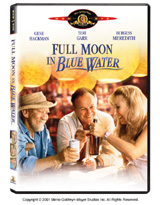
A total no-show in 1988, this quirky comedy-drama was received as (sigh) yet another Gene Hackman vehicle. A bit earlier, it was Michael Caine who was grinding out as many pictures a year as possible. Critics who ignored the show must have been looking for characters more forceful than the misfits pictured here. Full Moon in Blue Water creates an interesting tone and becomes an unusual, emotionally satisfying romantic comedy.
Full Moon in Blue Water succeeds in creating a specific tone that buoys a script with a few too many one-act twists. Most of the actors are excellent and the subject matter is fresh. Gene Hackman is moody and sympathetic as a heartbroken guy who can't see that he's loved and needed. A soft-hearted soft touch, he's attracted a group of misfits. Floyd takes responsibility for The General, an unpredictably coarse, wheelchair-bound dotard with a loud voice and a vivid imagination. Burgess Meredith has some of the funniest lines in the picture, but never tries to steal scenes by being adorable. A young Elias Koteas The Thin Red Line plays the unstable handyman, a troubled young man of diminished mental capacity who's easily taken in by the locals and who desperately wants to be somebody. Terrified of being re-committed to the asylum, he's devoted to taking care of The General but needs help to avoid bad decisions. Koteas comes across as a more loveable Robert De Niro type, and makes a pitfall of a character into an asset. Teri Garr's heyday as a romantic foil was almost over, but she's the best thing in Full Moon in Blue Water. An over-the-hill bus-driving spinster, you get the feeling that Louise is in love with Floyd because he's the one decent romantic prospect in a backwater of louts and pervs. She also has exactly the ambition and drive he needs to make the Blue Water go again, if she can just motivate him. This puts her in the awkward position of throwing herself at him again and again, much to the chagrin of her disapproving mother. Louise is a sensible powerhouse, who can eject the bar leeches who suck up Floyd's liquor on 'credit', and who can see the possibilities in a man and a night spot everyone else has given up for dead. Because she's no floozy, the scenes where she uses sex to try and rekindle Floyd's interest are touchingly positive, instead of seeming cheap. They call shows like this 'character driven', and Full Moon in Blue Water is a nice collection of originals. The supporting cast is more broadly drawn. The evil real-estate shark (Kevin Cooney) is certainly credible, but the dully-written local sheriff (David Doty) comes on a bit thick. What the critics probably complained about was the dramatic wind-up of the show, which involves several predictable twists - the one non-spoiler being that Floyd is being pressured to sell the Blue Water because local crooks know its value skyrocket once a new bridge to the mainland is announced. There's also a standoff with a confused, dangerously upset Jimmy that is nicely handled but more than a little pat. The carefully managed tone, it must be admitted, suffers a bit at the finale. An end-credit coda gives us a very happy ending, but it does seem a bit tacked on. The fact that the wheelchair-bound General is suddenly dancing, seems a bit forced. Full Moon in Blue Water concentrates on its peaceful pleasures and refuses to let dramatic fireworks or show-off writing spoil its lazy pace and warm but imperfect characters. It may have been a bust on the big screen, but it's a very pleasant diversion on DVD. Director Peter Masterson, the father of Mary Stuart Masterson, is best known for The Trip to Bountiful, but spent his career as an actor playing mostly soldiers. Writer Bill Bozzone's credits are even shorter, and he remains a mystery. MGM Home Entertainment's DVD of Full Moon in Blue Water is modest package, nicely appointed with a 16:9 transfer that makes it look very handsome indeed. As director Masterson frames many of his shots on the wide side, instead of concentrating on coverage closeups and singles, the extra picture definition and the approximation of the theatrical matting of 16:9 are big assets - on videotape, the open-matte transfer was just too loose. The so-so original trailer is included, and that's it. But there's no reason to complain when an almost-forgotten film like this comes to disc in such a nice presentation.
On a scale of Excellent, Good, Fair, and Poor,
Review Staff | About DVD Talk | Newsletter Subscribe | Join DVD Talk Forum |
|

| Release List | Reviews | Price Search | Shop | SUBSCRIBE | Forum | DVD Giveaways | Blu-Ray/ HD DVD | Advertise |