|
|
|
|
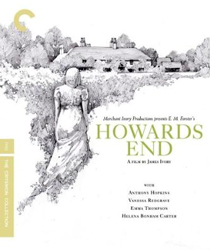
The passing of producer Ismail Merchant has brought more attention to the long string of quality films he produced with his directing and writing partners James Ivory and Ruth Prawer Jhabvala. Perhaps their most prestigious success is 1992's Howards End, a near-flawless adaptation of a complex E.M. Forster novel about the separation of classes in England in the first decade of the twentieth century. It and A Passage to India might be called studies in English priggishness, but screenwriter Ruth Prawer Jhabvala is scrupulously fair to all of Forster's characters. Although stories about class tensions tend to favor the younger generation as more enlightened, in Howards End young people are the worst prigs as well as the most foolish liberals. Howards End is a more demanding but also more rewarding experience than Merchant Ivory's previous hit A Room With A View. Pleasant Londoner Margaret Schlegel (Emma Thompson) becomes fast friends with the ill Ruth Wilcox (Vanessa Redgrave), whom she met on a German vacation. They easily surmount a social gaffe from the summer before, a brief engagement of Margaret's impulsive sister Helen (Helena Bonham Carter) to a Wilcox son. The Wilcoxes are a successful business family thanks to the stewardship of the industrious but closed-minded Henry Wilcox (Anthony Hopkins). When Ruth dies her relatives are horrified to find a will deeding her ancestral home to her new friend Margaret, and they quickly destroy it. Young Helen involves herself in helping a downtrodden clerk, Leonard Bast (Samuel West). She solicits unfortunate advice from Henry that causes Bast to lose his job. All of this happens while the decent but resolutely intolerant Henry Wilcox makes plans to wed Margaret. After a great deal of unnecessary suffering Ruth's will is finally honored, but in an ironic and roundabout way. Families are collections of people that often work against their own best interests. If Howards End were a modern miniseries it would simply be about a pack of greedy relatives struggling for possession of a choice piece of real estate, the Howards End of the title. E.M. Forster's novel, adapted with typical excellence by Ruth Prawer Jhabvala, gives us a complex web of characters in a particular social situation. Director Ivory's lavishly appointed vision of Edwardian England at its height is remarkable when one considers the film's relatively low budget. Without the aid of CGI, we're treated to convincing visual portraits of London and the green countryside. The adorable Margaret Schlegel admits that she talks too much. She's practical and open to change, and the possibility of an advantageous marriage outweighs the fact that, as much as she admires the gentlemanly Henry Wilcox, getting along with him is going to be a struggle. Henry is polite and fair in his own way -- he presents his wife's last-minute will before his family in a neutral tone. We can see the disappointment on his face when his sons immediately declare it a fake, even though he certainly doesn't want to honor it either. Henry can be imperious with his kin and is apt to become obstinate and unreasonable under pressure, and his engagement to Margaret has many stressful moments. The movie is uncommonly kind to its characters. Some might consider Vanessa Redgrave's sickly Ruth a spoiled businessman's wife yet her personality is almost angelic. Ruth's children are inconsiderate brats overly concerned with their inheritances. One son seems to be warped by his father's domination and itches to exercise his privileges over others. But Margaret's headstrong "progressive" sister Helen is little better. She initially connects with the poor Leonard Bast over a common interest in music and literature, seeing him as a sort of civic improvement project. Although we know Bast to be a brooding dreamer unlikely to excel in his work, in her eyes he is a deserving case. Concluding that Bast's entire situation is the result of bad faith on the part of Henry Wilcox, Helen makes scenes and causes unnecessary trouble for Henry, who sticks to his self-serving philosophy that the poor are better left to fend for themselves. The story so intertwines the fates and faults of the Wilcoxes, Schlegels and Basts that it is difficult to decide who exactly is responsible for the tragedies that result. The unfolding of events is as absorbing as drama gets, and every seeming coincidence is in fact sustained by logical cause and effect. The outcome is as unpredictable as real life -- who survives and who perishes, and what becomes of the proud and the humble. The acting is difficult to over-praise. Emma Thompson, Vanessa Redgrave, and Anthony Hopkins (fresh from The Silence of the Lambs) are fascinating to watch. Helena Bonham Carter is as frustratingly meddlesome here as she is adorable in The Room With A View. Samuel West plays the starving clerk without straining for sympathy and Nicola Duffett does well in the problem role of his wife Jacky. The actors playing Hopkins' immediate heirs have perhaps the most difficult parts to play. The sons and wives are a hateful pack of ingrates obsessed with inherited wealth. Some of them squirm uncomfortably under Henry's domination, yet none are simple villains. Author Forster's indictment of English attitudes does not extend to his picture of English justice. Being the heir of a millionaire doesn't spare a character the consequences of an unintended killing. The film was nominated for nine Oscars and won three, for best Art Direction, Jhabvala's splendid script adaptation and Emma Thompson's acting. The film was abundantly honored at other awards ceremonies as well; Ms. Thompson also won the Golden Globe. The Criterion Collection's Blu-ray of Howards End is a classy update of a release from an earlier line of Merchant-Ivory titles. In some cities the handsomely filmed show was originally released in 70m. Cinematographer Tony Pierce-Roberts and director James Ivory approved the picture and the HD master audio. The disc is also available in a DVD edition. Criterion producers Kim Hendrickson and Marc Walkow have secured a bounty of extras. A documentary gathers input from Helena Bonham-Carter, designer Jenny Benson and Luciana Arrighi, James Ivory and the late Ismail Merchant. A second featurette examines the film's designs in greater detail. The Wandering Company gives us a half-hour history of the unique company Merchant-Ivory Productions. Also included are an original promotional featurette and a trailer. In his essay for the insert booklet, critic Kenneth Turan complains that dignified classics like Howards End are not properly appreciated by film writers looking for more sensational fare.
On a scale of Excellent, Good, Fair, and Poor,
Howard's End Blu-ray rates:
Reviews on the Savant main site have additional credits information and are often updated and annotated with reader input and graphics. Also, don't forget the 2009 Savant Wish List. T'was Ever Thus.
Review Staff | About DVD Talk | Newsletter Subscribe | Join DVD Talk Forum |
| ||||||||||||||||||