|
| ||||||||||||||||||||||
|
|
|
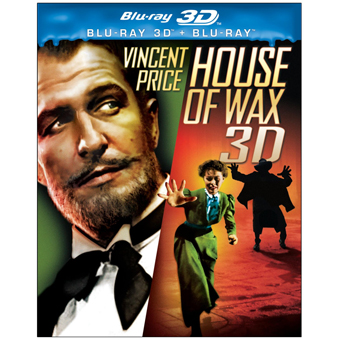
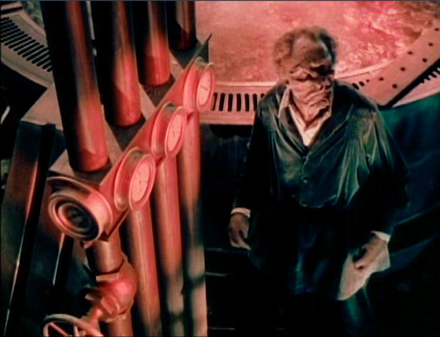
I reviewed a Warners DVD of House of Wax ten years ago, lamenting that home video seemed to be avoiding 3D. The new wave of stereoptical movies changed all that, and 3D has taken a pretty firm hold on movie screens, along with ticket prices. Although the penetration of 3D video into home theaters isn't very deep, the enthusiasm is certainly there. Almost exactly a year ago Warners gave us Hitchcock's Dial M for Murder in 3D, and now they have come through on their promise to deliver this exciting Vincent Price thriller. Could the remarkable Kiss Me Kate be next? The movie is a remake of the dandy 1933 Pre-code horror movie Mystery of the Wax Museum, which is included as an extra. More on the original bona fide classic Mystery below. House of Wax begins in 1900 after the unexplained burning of a wax museum. Professor Henry Jarrod (Vincent Price) turns up out of nowhere with a new and even grander wax museum attraction, just as Lt. Tom Brennan (Frank Lovejoy) and Sgt. Jim Shane (Dabbs Greer) are trying to solve several mysterious disappearances. Sue Allen (Phyllis Kirk) gets involved when her girlfriend Cathy Gray (Carolyn Jones) vanishes, and seemingly reappears as a statue of Joan of Arc. Suspicion begins to center on the kindly, crippled Jarrod, just as he decides that Sue would be the perfect 'model' for a new exhibit. 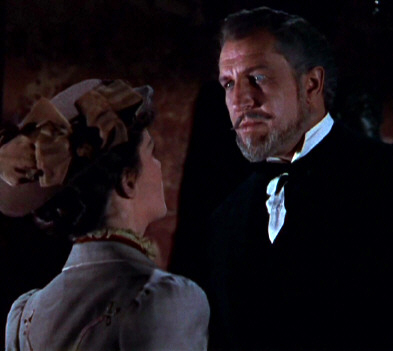
This gaudy shock show was made at a time when new horror movies had all but vanished from American screens. Thus the creepy aspects share screen time with quaint period touches, glossy cinematography and diversions to show off the 3D effects, like a row of Can-Can dancers and a paddleball artiste aiming his paddle directly at the camera. With his cultured voice and theatrical phrasing, Vincent Price is a perfect candidate for the new face of horror, a career transformation that would take hold six or seven years down the line. Phyllis Kirk is a good choice as the brave heroine, who lets out a really piercing scream at the climax. The film is without a strong male lead, leaving Price with no real competition. Sincere but colorless cop Frank Lovejoy struggles to find out what we already know, and the female lead's boyfriend almost gets his head lopped off in a guillotine. A young Carolyn Jones is fine as an unlucky girlfriend, and an even younger Charles Bronson (still billed as Buchinsky) is instantly recognizable as a granite-faced, deaf mute henchman. Well, it beats playing another Indian. The film's horror mostly amounts to a handful of Boo! moments, mostly when people or objects suddenly intrude into the frame. Curiously, Vincent Price's excellent horror makeup ceases to be scary through overexposure. We get a clear look at the bogeyman early and often. This makes the big 'reveal' scene anti-climactic. Lon Chaney's Phantom of the Opera has no competition. House of Wax was the most successful of the 3D pictures released in the craze that caught hold in early 1953, only to dissipate after only a year. Savant was there for a 1971 reissue at Grauman's Chinese Theater. I thought I was watching the true old-fashioned Polaroid setup, but it was actually a new 70mm side-by side projection system. To me, it looked great. The cameramen and director André De Toth make sure that the 3D effect is present at all times. Although the frequent lunges at the camera during fights, and obvious gags like the paddleball barker at the front of the Wax Museum worked quite well, the really effective scenes were the opening conflagration and some atmospheric stalking scenes. A thick fog appeared to extend into the theater, just as claimed in the propaganda, making us feel as if we really were in a dark nighttime street. The stereophonic sound helped, too. The 3D has been mastered much the same as the earlier Dial M for Murder disc. The color work and digital re-alignment of the images are much improved, reportedly clearing up some flaws that appeared in the theatrical prints. The overall verdict is that the 3D is a lot of fun -- the film seems to know that it's selling a diverting new experience as well as a story. Warner's 3D + Blu-ray of House of Wax is a bright and colorful restoration of this unique show. The gaudy WarnerColor image is rich and detailed. For a fascinatingly detailed rundown on the 3D experience, I refer readers to the 3-D Film Archive's coverage of the House of Wax release. Bob Furmanek's text contains more prime research than I've ever seen on the film. It also clarifies things that are a little fuzzy in the disc's new extras: the WarnerPhonic sound system was indeed impressive, but it soon disappeared. 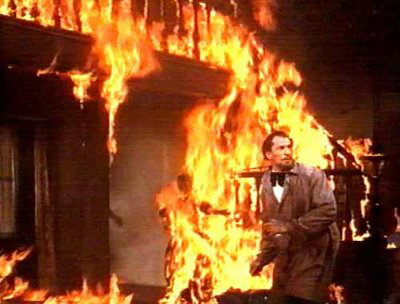
The extras lead off with a documentary called Unlike Anything You've Seen Before!, which gathers a fine group of spokespeople to extol the virtues of the studio's plunge into 3D. Agent and photo archivist David Del Valle has warm memories to share of Vincent Price, as does the actor's daughter; notables Bob Burns and Joe Dante offer appraisals of the horror makeup, the film's best scare effects and the experience of seeing it new 'back in the day.' The docu also goes into technical detail, showing us the workings of Warners' Naturalvision camera system and explaining how the 70mm 3-D reissue in the early 1970s worked. David Del Valle and docu producer Constantine Nasr provide a full commentary to offer more opinions and praise for the film. The exciting original trailer works overtime promising a fantastic 3D experience, and newsreel footage of the Hollywood Premiere gives us a glimpse of some interesting stars, plus Bela Lugosi getting the camera's attention with a giant gorilla on a chain. Horror fans have mixed feelings about this footage: Vincent Price is in the theater claiming the horror crown while Lugosi essentially has to busk on the sidewalk to get attention. The 1933 Mystery of the Wax Museum has been included as an extra. The encoding is the same standard-def presentation that accompanied House of Wax on DVD years ago, with the same color transfer. The show was filmed in 2-Strip Technicolor. Warners reportedly has several good negative sources to work from but hasn't gotten around to doing a full restoration of Mystery. Web forum fans have been quick to spread the word that this old transfer is, well, 'all wrong.' The show plays quite well, but the color is indeed off: the original combined salmon-colored tones with dull greens. The art direction was designed to work around this limitation, like an old 2-color magazine spread. Perhaps a well-intentioned telecine colorist opted to 'fix' the color, dialing in dark blues wherever he could. Mystery of the Wax Museum is one of the top attractions of the original Depression-era horror craze. Set in contemporary New York (1933), has smooth-talking Lionel Atwill waxing enthusiastic over the beauty of gorgeous Fay Wray. German Expressionist visual touches are contrasted with the wisecracking banter of the unstoppable Glenda Farrell, an almost-forgotten leading lady who would soon be eclipsed by Joan Blondell. Many horror purists decry the smart talk, but the Pre-code attitude is delightful, especially the way Farrell stands up to her verbal match, editor Frank McHugh. At one point she comes this close to snapping out, "Son of a b ...!" A drug-addiction sidebar had to be dropped for the remake. A master sculptor (Arthur Edmund Carewe) is seen craving his fix like a rabid dog. The cops give him a brutal 3D (third degree interrogation!). The force is openly corrupt. When Farrell uncovers a coffin packed with bootleg liquor, she demands her share before the cops can take it all! |
|||||||||||||||||||
Review Staff | About DVD Talk | Newsletter Subscribe | Join DVD Talk Forum
Copyright © MH Sub I, LLC dba Internet Brands. | Privacy Policy
Subscribe to DVDTalk's Newsletters
|
| Release List | Reviews | Forum | Blu-Ray | Advertise |