|
| ||||||||||||||||||||||
|
|
|
Let's hear it for good-old honest American vulgarity. Not the Down- South Hee Haw kind, but the New Yawk immigrant stew of bawdy license that in the early 20th century became Burlesque. D.H. Lawrence fought a literary censorship battle, but the battle of the Lower East Side was waged in the teens and early twenties over the right for good, solid Americans (some of whom had learned English) to enjoy bawdy entertainment aimed at the libidos of sex-starved working-class souls straight off the boat. How many movies are there about this subject? Well, just one, really. 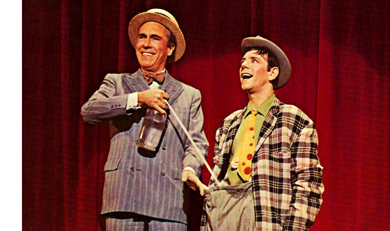
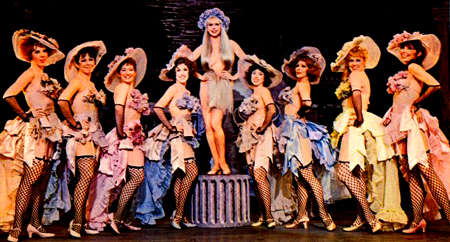
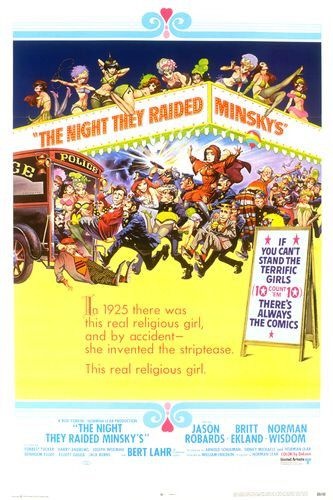
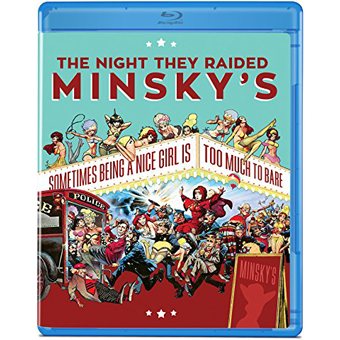
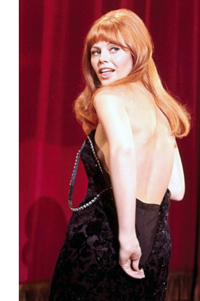
The Night They Raided Minsky's is an unique comedy musical about a subject as far from the concerns of 1968 as one could get: New York burlesque in the 1920s. A labor of love and affection by Bud Yorkin and Norman Lear, Minsky's gathers a top-flight cast for a consistently funny and affectionate look back at the 'naughty' entertainment of an earlier era. The much-maligned film is known as a notorious failure 'rescued' by its editor, but the funny performances and great music are what persist in the memory. Known as "The Poor Man's Follies", the lineup of jiggly, overweight chorines croaks out Minsky's signature song: "Take ten terrific girls, but only nine costumes, and you're cooking up something grand..." Minsky's Burlesque proprietor Billy Minsky (Elliott Gould of M*A*S*H) is in a frazzle because his father and landlord Louis (Joseph Wiseman of Dr. No disapproves of his sinful show and will not renew the lease. Meanwhile, self-appointed censor Vance Fowler (Denhom Elliott) attends every performance, gathering evidence to justify calling in the NYPD for a vice raid. Top banana comic Raymond Paine and his patsy Chick Williams (Jason Robards Jr. & Norman Wisdom) continue to star in vulgar sketches and sing off-color songs, all of which feature Minsky's less-than-chaste chorus girls. The audience of mouth-breathing lowlifes eats it up at matinee prices, and are easy prey for the hucksters that work the house between acts. Rachel Elizabeth Schpitendavel, an Amish girl (Britt Ekland of The Wicker Man) delights in the theater's forbidden dancing and love of life: she's run away from home "for to be a dancer". Rachel inspires Raymond and Chick to dream up a beautiful scheme to counter Fowler's threat of a raid: knowing full well that Rachel will perform one of her innocent dances from the Bible, they bill her as "Mademoiselle Fifi, The Girl That Drove a Thousand Frenchmen Wild." The good plan comes up against a couple of problems. Raymond has his mind set on seducing Rachel, even if it threatens his partnership with Chick. Bootlegger Trim Houlihan (Forrest Tucker) decides that Rachel is his private property. Oh, and one other minor snag: Rachel's fire-breathing fundamentalist father Jacob (Harry Andrews) has come to rescue his daughter from the Sodom and Gomorrah of the Lower East Side. 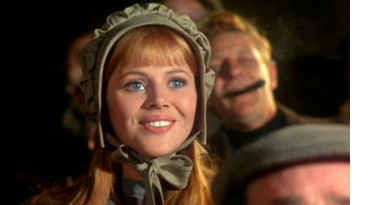
In The Night They Raided Minsky's outdated vulgarity becomes affectionate. The jokes are too cute and too antiquated to be offensive; it's humor that our great-grandparents probably smiled at, coarse or not. Virginal Rachel Schpitendavel gazes with wonder on what we know to be a line of painted porcine trollops, each more unbelievable than the next. The 'cute' one has rolls of fat bulging over her skimpy costume, and the others are overage disasters in heavy denial. The film's attitude toward them is flat out hilarious. When the silver haired emcee-tenor introduces the lineup, he asks one gum-chewing woman, "Is it a sin to be so friendly?" She shoots him a look that could peel paint. Doubts as to the authenticity of all this are quashed by the inclusion of vintage B&W footage of a real burlesque line-up. Lear and Yorkin's Minsky chorus is a perfect match. Critics have opined that Jason Robards is miscast, but his song and dance routines with comedian Wisdom are terrific. Robards also handles the seduction comedy well. His Raymond Paine eventually impresses us as an essentially unhappy man transformed by his persona as a burlesque star. Actor Norman Wisdom has the most experience in this vein of comedy, having come from a British music hall tradition. His routine explaining funny business to Rachel seems modeled on Donald O'Connor's Be a Clown act from Singin' in the Rain. Britt Ekland was never a major talent but the role of the farm-fed hick come to Sin Town is an excellent fit for her. The boys lust after Rachel, marveling at the rarity of a girl who knows the Bible, "a book that civilians read on Sundays." In the film's haute-vulgar finale, abuse from the man she loves turns Rachel into the 'inventor' of the strip tease. 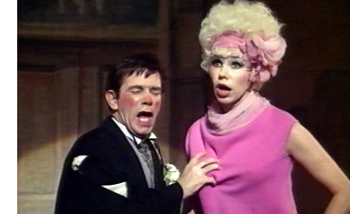
The casting is flawless. Forrest Tucker is a suitably comic bad guy, teasing Denholm Elliott's pinch-faced, repressed bluenose with questions about what exactly offends him: "Is it that the girls jiggle, Fowler? What parts of them jiggle, Fowler?" Joseph Wiseman and Harry Andrews clash as an orthodox Jew and a fundamentalist Christian who worry that they might not pray to the same god. "What kind of father are you, who would permit his son to run such a sinful establishment?" "The kind of father who would not permit his daughter to dance in Minsky's Burlesque." Smaller parts are covered with good performances by Gloria LeRoy, Joe E. Marks and Jack Burns. Nominal director William Friedkin was not considered the film's main creative contributor. In his career biography, editor Ralph Rosenblum assures us that after the The Night They Raided Minsky's rough cut was assembled in script order, it just sat there, dead and uninspiring. Known as Woody Allen's editorial mentor, Rosenblum restructured the film, giving it its catchy, jittery rhythm. Scenes start in the middle and end before they're finished; most of the comedy sketches have been chopped up into bits. Rosenblum also contributed several fast-paced montages that shuffle unused film bits with well-chosen newsreel film from the 1920s. The main title is a manic flutter-cut unseen this side of experimental films. The picture pops from B&W to color and back again, mixing up the new footage with the old. Interestingly, the first image is of an elevated train, looking forward to director Friedkin's The French Connection. 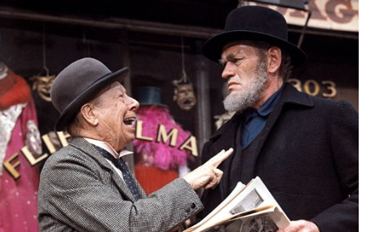
The film never slows down, and its content can't quite keep up with its own sprightly pace. One of the clever conceits is that the burlesque performers behave just as madly off the burlesque stage as on. Editorial overkill tires us out during a third-act brawl that pits Chick & Raymond against Forrest Tucker's gangsters. It's intercut too aggressively with a jarring jazz vocal in a speakeasy. Punches to the face are slam-cut with silent footage of chimneys crashing to the ground. We've already had our fill of that kind of thing. One thing is sure, Rosenblum went radical on Billy Friedkin's movie, seizing the opportunity to become its auteur in post-production. The constant parade of grainy shots indicates optical blowups used to create new close-ups, effectively re-directing Friedkin's work. We wish we could see more of the original scenes peeking through the (clever) re-cutting. After all the sophisticated tricks, the flash-cuts to the body stand-in for Ms. Ekland's two-second nude scene is the phoniest thing in the movie.
The editorial flimflam adds an air of desperation to the proceedings, the most obvious example of which is also the film's biggest heartbreak. Original burlesque headliner Bert Lahr is adored as the original Cowardly Lion. He plays Professor Spats, a backstage liability always begging to perform. Spats was intended to fill-in for the missing Raymond Paine in the big Midnight performance, and to surprise everyone by providing a show-stopping number to cap both the movie and Lahr's legendary show-biz career. But Lahr died only a couple of weeks into production, before much of his part was filmed. As it is, Bert Lahr makes a good entrance, reads a few choice lines spread throughout the story,
Nobody tires of the terrific original music by Charles Strouse, the composer of the Broadway shows Bye Bye Birdie, Applause and Annie. The main theme is both inspiring and touching, setting up nostalgia for a theatrical tradition that's been extinct for eighty years. The Night They Raided Minsky's has tenuous connections with a Barbra Streisand musical TV special The Belle of New York Street, a nostalgic look at pop hits of long-ago New York. One of the episodes features dancing girls called "The Beef Trust Chorus" and Jason Robards is present to contribute a major performance. Even more tangentially, Streisand's then-husband Elliott Gould has a major Minsky's role as the nervous showman. The Night They Raided Minsky's is funny, sexy and tune-worthy. It's also doubly interesting in the context of today's media culture. Comedy has dipped far, far deeper into the depths of smut than anything dreamed up on the Burlesque stage. The movie begins with an announcement from Rudy Vallee complimenting the viewer for being "a real mature audience". We can't help but feel nostalgia for a tradition that none of us witnessed first-hand. |
|||||||||||||||||||
Review Staff | About DVD Talk | Newsletter Subscribe | Join DVD Talk Forum
Copyright © MH Sub I, LLC dba Internet Brands. | Privacy Policy
Subscribe to DVDTalk's Newsletters
|
| Release List | Reviews | Forum | Blu-Ray | Advertise |







 and then disappears. In some scenes he's replaced by a double. For a conclusion, the double picks up a fallen seltzer bottle on an empty stage. An indifferent shot of Lahr appears to be a leftover fragment from an unrelated shot, a stage wait before Friedkin said "Action" or after he said "Cut."