| Release List | Reviews | Price Search | Shop | Newsletter | Forum | DVD Giveaways | Blu-Ray/ HD DVD | Advertise |

| Reviews & Columns |
|
Reviews DVD TV on DVD Blu-ray International DVDs Theatrical Reviews by Studio Video Games Features Collector Series DVDs Easter Egg Database Interviews DVD Talk TV DVD Talk Radio Feature Articles Columns Anime Talk DVD Savant HD Talk Horror DVDs Silent DVD
|
 DVD Talk Forum |
|
|
| Resources |
|
DVD Price Search Customer Service #'s RCE Info Links |
|
Columns


|
 |
Horror OF Dracula
|
||||
Hammer's follow-up to its enormously successful The Curse of Frankenstein bested the first film in all departments and was an even bigger international success. With Peter Cushing and especially Christopher Lee in much improved roles, and Terence Fisher finally finding a story that allowed him to work at full creative capacity, Horror of Dracula (known simply as Dracula everywhere but here) is the Singin' in the Rain of horror films - a show that transcends its genre and sums up what's great about screen terror.
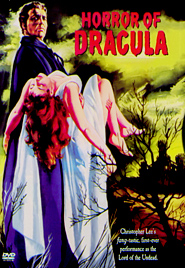
The Curse of Frankenstein made waves with its bloody charnel house surgery; this thriller added an explicit sexual component to the classic vampire tale. The buzz centered on the Technicolored stakings, but the real impact of Horror of Dracula was in its conception of the vampire-victim relationship. There really weren't that many vampire movies before Hammer's outing, and most of them were made under the American censor code that forbade the kind of heavy-breathing seductions seen here. The classic Bela Lugosi situation has him waxing vampiric over swooned, unconscious ladies. Lugosi's attacks were always elided by cutaways to his staring eyes or timely fades to black, and in the three vampire films he made, his victims were invariably zonked out under hypnotic spells more effective than novocaine. Tod Browning's 1931 original kept its heroine fairly chastely dressed, considering it was pre-code, but the Spanish-language version gave hints that Carlos Villarías' victim Lupita Tovar was sexually 'knowledgeable' - she's dressed more provocatively, and when she senses Dracula nearby, her breathing becomes more rapid. "I'm having a hot flash", she sighs, in what must have been a very racy scene for Latin audiences. Hammer's Dracula made much more explicit the seduction-rape fantasy that underlies vampire mythology. Christopher Lee is not a horrid ghoul like Nosferatu. He's an aristocrat like Lugosi, but more of a contemptuous brute than someone who'd attend the opera. Lugosi's ladies trembled in uncomprehending fear, and their men-folk gallantly did their best to protect them. In Horror of Dracula, the female victims openly enjoy their master's visits, throwing wide their windows and lying back on their beds in anxious anticipation. They conspire with Dracula against their own fathers and husbands for the privilege of being savaged by the haughty, feral vampire king. The result is an artistic and commercial triumph over the censor: technically, all that's happening is that necks are being bitten, but what viewers experienced were sensual, mostly consensual rape scenes. 1This is still Christopher Lee's greatest performance, combining his knack for elitist hauteur, with his excellent pantomime skills. After a decade of mostly inappropriate casting, he shows unmistakable star power, commanding the screen with every appearance. For victims, Horror of Dracula provides a trio of actresses who create portraits of eroticism rarely attempted by later 'liberated' vampire films. 3 Valerie Gaunt was a token victim in The Curse of Frankenstein, but with just a few seconds of screen time as Dracula's bride, she etches a vibrant picture of duplicitous female wiles. The obsessive lust that comes over her eyes as she gets face-to-jugular with Jonathan Harker is unforgettable. Carol Marsh made film history starring with Richard Attenborough ten years earlier in the crime drama Brighton Rock; here her teen tragedy is played out in the Victorian era. To get her way, she falls back on childish petulance, but we read her precocious sexuality loud and clear. When she throws the doors open, the midnight chill enters her bedroom with the falling leaves (beautiful, but dead), yet she doesn't care ... the all important HE is coming. She awaits Dracula as if he were a teenaged lover - only sexier. Melissa Stribling's Mina is even more interesting. She's first seen as a prim and conventional housewife, content to stand anonymously behind her bourgeois husband. But when Mina starts her affair with Dracula, the change is remarkable. She blooms to life, and her eyes and smile betray a satisfaction that doesn't come from keeping the silverware polished, or lighting Arthur's cigars. When she receives Dracula in her bedroom, breathless and dumbstruck, the scene is pure domination and submission. Peter Cushing's Van Helsing is his best role; he carries the bulk of the picture with dignity, seriousness, vitality and a very pronounced sense of righteousness. He's the perfect authoritarian father, patient and gentle with little Tania (Janina Faye, later of Day of the Triffids) yet sufficiently cool-headed to face off unarmed against the Prince of Darkness. His character is aided by the script's reduction of Dracula's powers - no shape-shifting or turning into a wisp of smoke here. Van Helsing's insistence on the existence of Dracula is greatly helped by the actor's scoffing dismissal of that other, superstitious nonsense. The vampire killer also has to fight skeptical dullards like Arthur Holmwood - society would lock Van Helsing up if he brought his specialty out in the open, so the doctor has to operate on his own, at great risk. He's the original reactionary vigilante, fighting the Devil. 2 And that's exactly what we get, one of the best-matched battles between Good and Evil ever. Dracula threatens humanity and to defeat him it takes both luck and a talent for brilliant improvisation. The film ends with a very satisfying sense of justice and balance restored to the universe. Terence Fisher's overachievement in the 1958 Horror of Dracula truly brought the horror genre up to date. There's a balance between calm and action that contrasts what was best in the old Gothic style, with dynamic blocking and action that had never been seen in a horror film. Dracula's entrances are classic - he never walks through doors, but just appears (greatly helped by composer James Bernard's crashing chords), always 'already there' before his victims realize it. Fisher has the patience to build a slow-paced 1890's world of calm and order, which Dracula can interrupt with shocking violence. The blocking and choreography brilliantly transform every single or close-up on Christopher Lee a classic shot - pursing his bloody lips in the library, glaring up the stair at Mina, or showing hints of anxiety when confronted by Van Helsing. By placing Dracula's castle only a coach ride away from the Holmwood house, the film builds pace until hero and villain finally come face to face - and from then on it's a chase to the finish. Jack Asher's photography is a huge improvement on The Curse of Frankenstein. The rooms look richer and less flat, and the many nighttime and dusk scenes are richly colored, with deep blacks and dramatic rim lights. The 'sensualized' Mina sits before her stained-glass window, and the lush lighting tells us she's a different woman, even though she's pretending to be absorbed in her needlepoint. As for James Bernard, his score for Horror of Dracula is simply wonderful. Some think it too emphatic, but for Savant it helps the film with every mood - pounding during the action, and crashing in to herald every appearance of the Count. The twinkling anticipatory music as Lucy and Mina await their lover, and the sweet violins that accompany the 'freeing' of vanquished vampire souls, are beautiful without being overly sentimental. A few observations, for your amusement: After Jonathan Harker is attacked in the library, there's a short establishing exterior shot of the castle, before we see him asleep across his bed. If you look at the castle shot carefully, you'll see a moving body coming forward in the middle of the scene. It's Jonathan; the shot is a head trim from the later scene where he hides his diary in the tree. The vampire bride and Lucy look as though they're being staked not in the heart, but the stomach! Did James Carreras run his staking scenes past the censor beforehand, or did someone just think it too racy to show the sharp stake hovering over Valerie Gaunt's breast? Or is this a reinterpretation of the mythology ... nobody states outright where the staking must be done. With the scrutiny made possible by DVD, Horror of Dracula's vampires can be seen breathing, even when dead. The old lady vampire corpse even has a very-visible throbbing neck pulse! Many fans have noticed that when Jimmy Sangster updated the story, he added Edison's gramophone but made an anachronistic dialogue error. Van Helsing tells little Janina Faye that she looks like a Teddy Bear. The toy didn't appear for another decade, as it was named after President Teddy Roosevelt. And this will be obvious, but Savant always thought it perfect to have the defeated Dracula's ring lying on the Aquarius sign on the Zodiac floor of the castle library. Aquarius is of course the water sign, the bringer of life, and it helps the 'healing' feeling of the final shot. Warner's DVD of Horror of Dracula thankfully looks much better than The Curse of Frankenstein. While not quite the delirious Technicolor experience, it's very rich and detailed, and records nicely the warm skin tones. There's a bit of overall haziness, but the blacks are black, which sets the blue light leaking into Dracula's crypt, or the sudden bursts of crimson blood, in greater relief. For the most part, this transfer also looks much sharper than the Frankenstein film. One of the earlier flat laserdiscs (1991) from Warners was a fairly dreary pan-scan that cropped all kinds of important info from the margins, like the reveal of the vampire bride hiding behind the library door. It also censored shots when Lucy is staked in the crypt. This new DVD restores those extra few history-making cuts of blood welling up around Van Helsing's stake. I don't know how to evaluate the fan charges that these Hammer films are over-matted. On my Mitsubishi 55" 16:9 television, heads are sometimes too tightly cropped, but I've recently been told that my widescreen monitor over-scans far too much. The effect only became evident in a few shots, but in one of them, Dracula's doorway shot in the crypt, my monitor cuts off a big piece of Christopher Lee's head. As a presentation, the DVD is okay. The adequate cover art is from an international poster, but a still of a blonde on the back (Stephanie Beacham?) is carelessly taken from another Dracula film (Dracula A.D. 1972?) in the series, evidence that the title wasn't exactly front-burner work at Warners. Savant fell for the rumors that there would be a docu and an interview - and heard through the DVD editorial grapevine that the disc had been assigned a producer. All in all, I'm still very happy that my favorite horror film now exists in such an attractive DVD transfer.
On a scale of Excellent, Good, Fair, and Poor,
Horror of Dracula rates:
Footnotes:
1. Phil Hardy's Encyclopedia of the Horror Film often gets its
facts wrong but presents some of the best theorizing on the subject. He flubs a reference to
Horror of Dracula taking place 'entirely in England', but neatly explains other key Hammer
concepts. Their Dracula movies are the thematic reverse of their Frankenstein films. The Baron is
a rational scientist stuck in an age when superstition cramped his anarchic style; Van Helsing is a
paternalistic reactionary, whose efforts to save society are thwarted by its own 'decadent' refusal
to believe in his conservative truths. The best Idea in Hardy relates to Hammer's Dracula being
a proto-James Bond: a unique, un-killable man with a (supernatural) license to kill. He's a hedonist
who can seduce any woman, brushing their husbands aside. The Hammer horror films were the first
major English export movies to find favor the world over, and share many actors (including Christopher
Lee) with the Bond films that followed. The Bond films successfully (sometimes appallingly) apply
the simplistic Hammer battle between good and evil to the Cold War. The scene where John Van Eyssen
is bitten by vampiress Valerie Gaunt is almost copied in the pre-credit opening of Goldfinger
- both are seduction scenes interrupted by violence.
2. 'Reactionary vigilantes fighting the Devil' is exactly how right wing
dictators and conservative fundamentalists described themselves while persecuting political rebels
of all kinds; perhaps this explains the clip of Horror of Dracula weirdly seen being viewed
by dictator Fulgencio Battista in Richard Lester's
Cuba
.
3. Exploitation considerations aside, the nude vixens of pictures like
The Vampire Lovers just seem 'healthier' than the victims they bite, and relate mostly to
girlie magazines.
Other DVD Savant Hammer Films Reviews:
Review Staff | About DVD Talk | Newsletter Subscribe | Join DVD Talk Forum |
|

| Release List | Reviews | Price Search | Shop | SUBSCRIBE | Forum | DVD Giveaways | Blu-Ray/ HD DVD | Advertise |