
| Reviews & Columns |
|
Reviews DVD TV on DVD Blu-ray 4K UHD International DVDs In Theaters Reviews by Studio Video Games Features Collector Series DVDs Easter Egg Database Interviews DVD Talk Radio Feature Articles Columns Anime Talk DVD Savant Horror DVDs The M.O.D. Squad Art House HD Talk Silent DVD
|
 DVD Talk Forum |
|
|
| Resources |
|
DVD Price Search Customer Service #'s RCE Info Links |
|
Columns
  



 
|
|
|
Coco Chanel & Igor Stravinsky
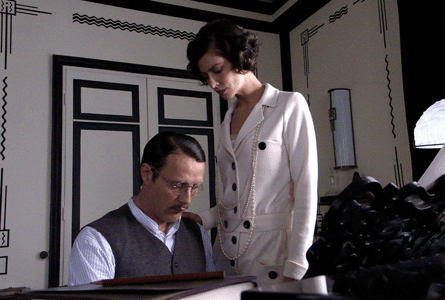
Sometimes, good things come in threes; on other occasions, the third time is the charm. The latter is certainly true in the case of Coco Chanel & Igor Stravinsky, a strikingly good film by Jan Kounen. It follows the lifeless made-for-TV Coco Chanel, and the stuffy Coco Before Chanel with Audrey Tautou. Unlike those two films, this one takes an artistic plunge, unafraid to engage in intuitive, free-flowing artistic interpretation, in what is ultimately a cinematic fictionalization of a hazy period in the lives of these two towering cultural icons.
Working from a novel (and screenplay) by British writer Chris Greenhalgh, Kounen opens his film with an extraordinarily bold sequence: a recreation of the disastrous 1913 Paris premiere of Stravinsky's ballet, The Rite of Spring. Chronicling this event in incredible, dramatic detail, Kounen's roving camera captures Stravinsky's (Mads Mikkelsen) backstage agony, the stoicism of his doting wife Katarina (Elena Morozova), and the pleasantly perplexed response of a noteworthy spectator, Coco Chanel (Anna Mouglalis). Beyond a swift introduction of the three main characters with near-silent efficiency, this remarkable sequence treats us to a good chunk of Stravinsky's music, as well as Nijinsky's original choreography.
Unfortunately, the Parisian audience does not take kindly to Stravinsky's supremely radical work. The crowd erupts into a near-riot, and the performance is halted as police rush in to contain the melee. Chanel, however, could not be more impressed, and when she meets Stravinsky at a party several years later, she invites the composer, and his wife and four children, for an extended stay at her country home so that he is able to concentrate on his work.
The sickly Katarina spends enormous amounts of time in bed, diligently copying Stravinsky's scores. Her husband and Chanel have an almost immediate, unspoken attraction in which they are slow to indulge. But when they do, they don't hold back. Although the pair attempts to honor some semblance of discretion, Katarina is no fool. Yet despite the difficulties caused by their ill-timed affair, Chanel and Stravinsky serve as mutual muses over a period that is crucial and productive for them both.
The special force of this film is its unhurried pace and intense focus on the actors. Wisely keeping dialogue to a minimum (which reduces the soap opera factor), Kounen elicits three stellar performances. Mikkelsen's Stravinsky is a pressure cooker of erotic yearning capped only by a tenuous sense of self-respect. As Chanel, Mouglalis is beautiful, austere, self-confident, and wary of her own emotions. She embodies a rare poise rooted in masked vulnerability. Elena Morozova is a dignified Katarina, refusing to play a victim or to feign ignorance, or to give in to Chanel's "mannish" sense of superiority; Katarina is, ultimately, despite her husband's failings, his savior.
This is the third Chanel film in two years, and it wisely abandons the usual transparent bio-drama fussiness over historical "accuracy," and instead finds richer emotional truth in what is a factually speculative story.
The DVD
Image
Having seen the film during its original theatrical release, I can confirm that the drab palette and "high cloud cover" light evident in the transfer does justice to the film's intended look. The production design favors earth tones and a color scheme that mimics Chanel's own tastes. The outstanding photography is served well be a transfer that shows good contrast and detail, with shadow delineation only occasionally falling into muddiness. Overall, a solid job.
Sound
The (mostly) French-language soundtrack is mixed to 5.1 specs, and it's a very involving track. From the stirring opening that prominently features The Rite of Spring, to the later scenes at Chanel's home, the soundtrack utilizes Stravinsky's music with extreme care. The bombast of The Rite of Spring is right up front and in our faces, just as it must have appeared at its premiere; and later in the film, we can hear Stravinsky at the piano, often in a well-separated background context, even when we are elsewhere in Chanel's house with other characters. This excellent sense of ambiance is the overarching characteristic of the soundtrack.
Bonus Content
The only extra here is the twenty-minute The Making of Coco Chanel and Igor Stravinsky. Unfortunately, it is little more than an EPK piece. A commentary with the principal creative team would have been most welcome, and so would a piece that discussed the writing process in terms of the historical versus fictional elements of the story.
Final Thoughts
Kounen blends a grounded approach to his characters with a classy technical sensibility and marvelous editorial craftsmanship. Coco Chanel & Igor Stravinsky doesn't just do the other Chanel films one better; it stands alone as an exceptional achievement. Highly Recommended.
|



| Popular Reviews |
| Sponsored Links |
|
|
| Sponsored Links |
|
|
| Release List | Reviews | Shop | Newsletter | Forum | DVD Giveaways | Blu-Ray | Advertise |
|
Copyright 2024 DVDTalk.com All Rights Reserved. Legal Info, Privacy Policy, Terms of Use,
Manage Preferences,
Your Privacy Choices 
| |||||||