
|
| ||||||||||||||||||||||
|
|
|
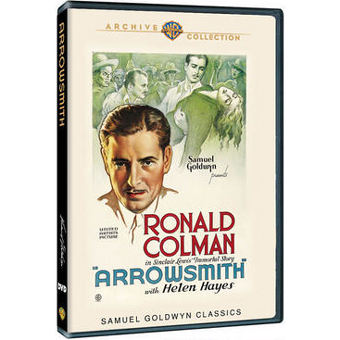
Early in the 20th century, popular literature was often a conduit for progressive social criticism. Author Sinclair Lewis won a Pulitzer Prize with his 1925 novel Arrowsmith, which gave the medical profession a good whacking inside and out. Lewis's own father was a physician. Quackery, greed and entrenched interests dog the progress of the idealistic young doctor-hero, who must oppose faith healers as well as resist employers that wish to waste his talent for profit. Unlike Sinclair's earlier stories of small town boosterism, this book was less satirical. Director John Ford kept that earnestness when he tackled Arrowsmith for Samuel Goldwyn in 1931. Not particularly well written, the early talkie is beautifully acted by Ronald Colman and Helen Hayes. It waves the banner of science, but oversimplifies medical and research details. The film's message pits science against humanitarianism, making our 'hero' begin to resemble a proto- Ayn Rand type. 1 With its great performances and literary pedigree, Goldwyn and Ford's film was nominated for four Oscars including best picture. But the Production Code showed little respect for such things. Eleven minutes may have been removed from the film after the Code was enforced. Even with certain sections restored the show has continuity issues, which may or may not be due to censorship. 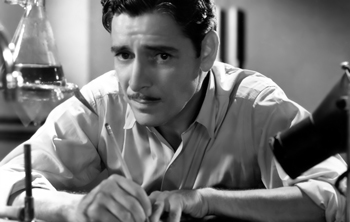
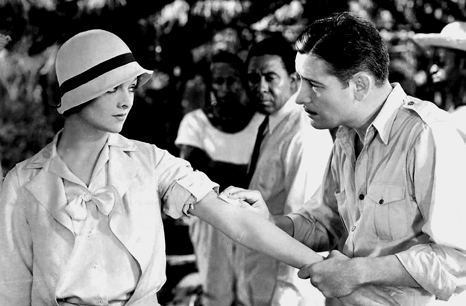
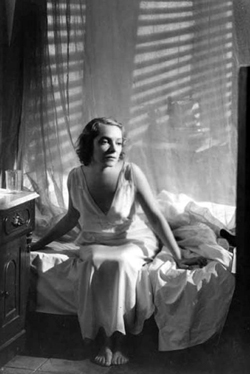
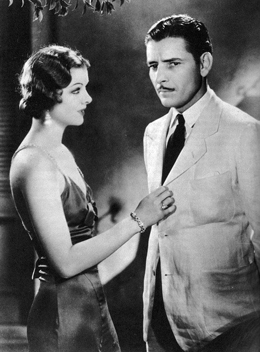
Promising medical student Martin Arrowsmith (Ronald Colman) is an ideal candidate for medical research. But he must turn down a chance to work at New York's prestigious McGurk Institute with his mentor Professor Max Gottlieb (A.E. Anson) because he wants to marry his sweetheart Leora Tozer (Helen Hayes). The newlyweds have a tough time on the rural doctoring circuit in South Dakota, but he's encourged by the advice of touring lecturer Gustav Sondelius (Richard Bennett). When Martin's tinkering creates a serum to cure a livestock disease, he earns a ticket back to a good research job back with his mentor in New York. After a couple years, he makes a big breakthrough only to be "scooped" by Louis Pasteur. Humiliated by the McGurk Institute's premature publicity, Martin then takes a dangerous trip to St. Hubert in the Caribbean, where a runaway plague offers an opportunity to perform experimental serum trials. Leora refuses to stay behind, and once the island he keeps her away from the main area of contagion... a bad decision. To prove that his anti-plague serum is effective, Martin must do an experiment in which he gives the medicine to only half of the people at risk. When the local authorities block Martin's way, a local Doctor Marchand (Clarence Brooks) offers his village to serve as the first test subjects: half serum, half placebo. The great actress Helen Hayes didn't make very many movies, and she and Ronald Colman make a compelling screen couple. She's scrubbing a floor when they meet and their wedding ceremony is a depressing visit to a city clerk's office. Hayes's Leora gives up nursing to be a full-time wife, and no mention is ever made of it again. Perhaps it's for the best, as Leora's later behavior around vials of deadly plague suggest that she paid no attention in her nursing classes. The glamorous Myrna Loy makes an interesting appearance, but her scenes in the movie may have been minimized by the Production Code censors. More on this a bit later. The story's social criticism has been redirected as a sentimental drama. Screenwriter Sidney Howard also adapted Sinclair Lewis's celebrated book Dodsworth for the stage, and then for Goldwyn and director William Wyler. As originally conceived, the idealistic Martin Arrowsmith character is a flawed man who makes big mistakes at every step of his life. The elegant actor Ronald Colman easily conveys Martin's idealism, but always seems incapable of taking a misstep. His voice alone evokes high moral values. John Ford's personal preferences weigh heavily on the film. A superfluous pioneer prologue has been retained from the novel seemingly because Ford liked such material. The director displays his talent for expressive compositions but he doesn't seem engaged with Sinclair Lewis's ideas about the state of modern medicine. The movie reverts to the cliché that doctors are sacred individuals holding the power of life and death, and that the vocation elevates them above common men. The sentimentalist Ford commonly depicts doctors as priest-like characters and/or happy drunks for comic effect. Martin Arrowsmith is instead put on a pedestal. When inspired he's like a mad doctor, working alone without sleep or food. The message is that scientists must deny their humanity if they wish to achieve great breakthroughs. Martin Arrowsmith must choose a rural private practice because entry-level research work won't let him support his new wife in the city. Both the book and film of Arrowsmith preach that the noble calling of medical researcher is incompatible with a normal home life, ideas that now seem silly. The obvious solution is for Leora continue to work after marriage, but most movies treated that option as unthinkable. Today, of course, audiences might also ask why Martin doesn't take a living-wage job to allow Leora to pursue the vocation of her dreams. Arrowsmith's sojourn as a country doctor is treated as a waste of his talent. His bumpkin patients are not worthy of him, even though John Ford is at his best when directing the farmers. One is played by John Qualen, who does the "Yumpin' yiminy' Swedish immigrant act favored in Ford's later The Grapes of Wrath and The Searchers. Ford also seems to like the colorful Gustav Sondelius (Richard Bennett), a hard-drinking, fraud-debunking Swedish scientist. Arrowsmith's other role model Professor Gottlieb (A.E. Anson) is a drier academic with no bad habits; Ford shows little interest in him. The book had more to say about doctors and research institutes that put profit ahead of progress, but in the film we're not exactly sure why the McGurk institute stifles Martin's work. A brilliant breakthrough is ruined when Martin's boss releases a silly news blurb about a panacea that will "end all disease forever." None of this is very convincing; John Ford just rushes through it. Even more troubling is the movie's wrongheaded view of clinical trials. I should think that concept of dividing test subjects into two groups, those that receive the drug and the "controls" that don't, would have been around a lot earlier than 1925. Martin and Professor Sondelius go to the West Indies to fight the terrible plague, but also to get conclusive proof that Martin's new serum works, that it can be mass-produced for use against the plague in the future. Why is the wholesale distribution of an unproven serum considered a good idea in the first place? To heighten the drama, the screenplay has Martin propose his research idea to the local authorities in ridiculously harsh terms. When Martin insists that half the population will be "sternly denied" the serum, it sounds like he wants to commit medical murder. In reality, only a limited number of test subjects (100? 200?) would be needed for the test. |
|||||||||||||||||||
Review Staff | About DVD Talk | Newsletter Subscribe | Join DVD Talk Forum
Copyright © MH Sub I, LLC dba Internet Brands. | Privacy Policy
Subscribe to DVDTalk's Newsletters
|
| Release List | Reviews | Forum | Blu-Ray | Advertise |







 (more spoilers)

 1.
1.
